
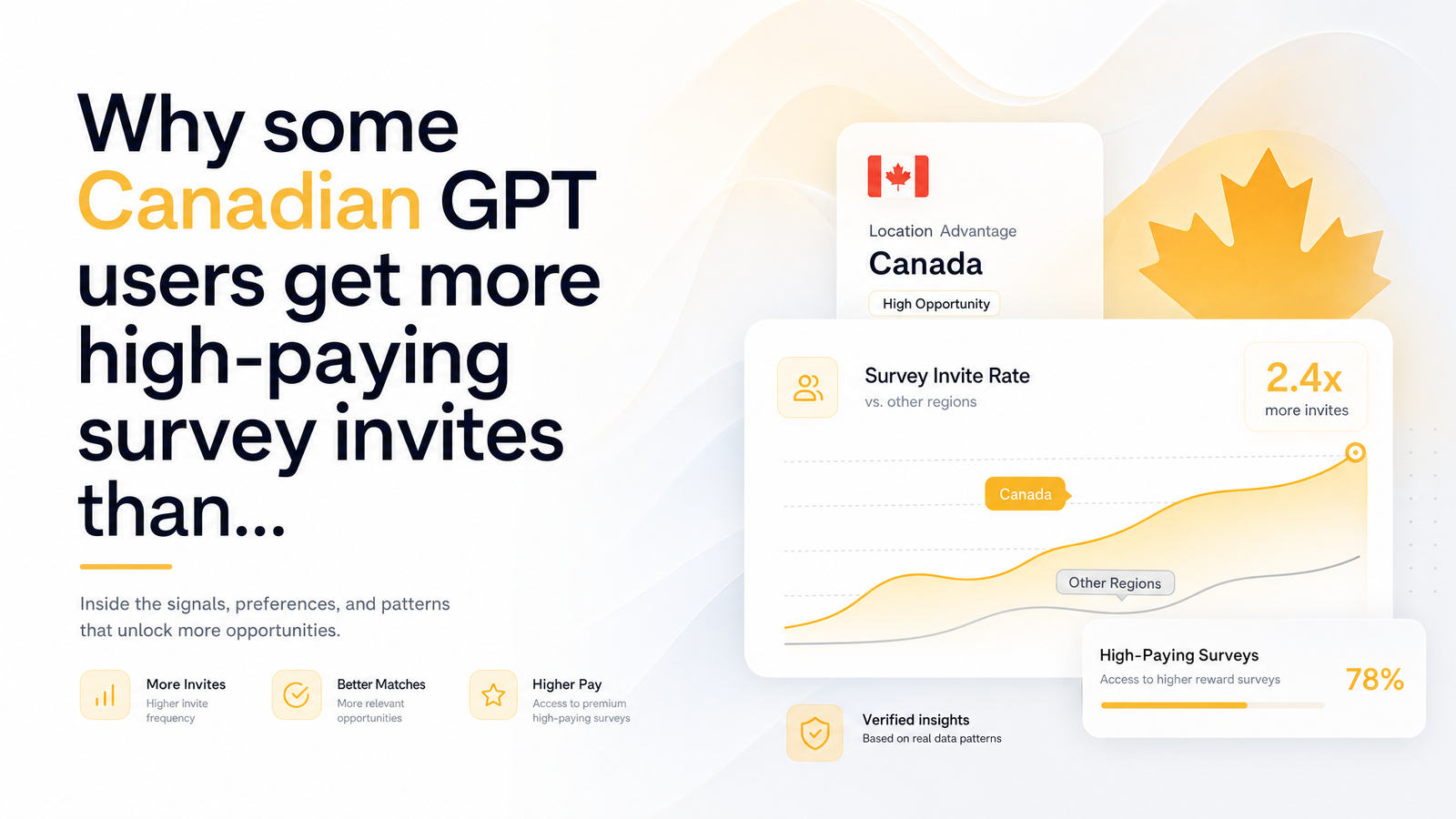
Signed up for a GPT site, got flooded with invites in week one, and now the offers have slowed to a trickle? That's not bad luck — it's your survey reputation score at work. Every panel and router quietly tracks how you behave, and that track record decides whether you see premium, high-paying studies or get stuck scraping the bottom of the offer wall.
This guide pulls back the curtain on how that scoring actually works and gives you a practical plan to build (or rebuild) a strong survey trust score in Canada.
What Is a 'Survey Reputation Score' — And Does It Really Exist?
There's no single glowing number on your dashboard labeled "trust score," but the concept is real and it runs across the entire industry, not just one platform. A survey reputation score Canada users accumulate is really a composite of behavioral signals — completion rate, disqualification patterns, answer consistency, and device or location stability — that panels and survey routers use to decide who deserves access to better-paying opportunities.
Think of it less like a credit score and more like a reliability rating. Panel operators, and the router marketplaces that connect them to advertisers (the same category of infrastructure behind Lucid/Cint-style panel exchanges), need to prove to their clients that respondents are real, attentive people who qualify honestly. Every survey you start feeds data into that judgment. Panel quality scoring exists because advertisers pay a premium for clean data, and they won't keep paying it if a chunk of respondents are guessing through screeners or contradicting themselves survey after survey.
The upshot: this isn't a CashSprint-specific gimmick or a punishment system. It's the underlying mechanic that makes the entire GPT economy function, and understanding it is the fastest way to stop feeling like invites are random.
The Signals That Actually Move Your Score
A few concrete factors do most of the work behind the scenes.
Completion rate is the simplest and most heavily weighted signal. It's calculated as completed surveys divided by surveys started (not just invited). If you start ten surveys and finish three, your GPT completion rate is 30%, and that number gets shared — directly or indirectly — with the routers deciding your next invite. A low completion rate signals either poor targeting or respondent unreliability, and routers respond by sending fewer, lower-value invites until the ratio improves.
Disqualification patterns matter almost as much. Getting screened out occasionally is normal and expected; every respondent hits screeners that don't fit their profile. But a pattern of survey screener disqualification in Canada — especially disqualifying immediately after several minutes of questions — can look like inconsistent or fabricated answers rather than genuine mismatch, and that gets flagged.
Response consistency across time is the quiet one most users never think about. Panels run consistency checks by asking the same demographic or lifestyle questions in different surveys, months apart, worded differently. If you reported no children in March and three kids in July, that's a coherence failure, not a paperwork issue — and it erodes trust fast.
Speeding and straight-lining (racing through a survey or picking the same answer down a grid without reading it) are classic survey fraud detection flags. Timing data is recorded automatically, and answering a five-minute survey in ninety seconds reads as low-effort regardless of your actual intent.
Finally, device and location stability feeds into digital fingerprinting systems that panels use to detect fraud rings and multi-accounting. Frequent IP changes, shared devices, or mismatched geolocation don't automatically ban you, but they add noise that lowers confidence in your profile.
Why High-Paying Invites Go to Some Users and Not Others
Premium studies — the ones paying several dollars for fifteen minutes — usually have tight quotas and a specific incidence rate, meaning the client only needs a narrow slice of respondents (say, small-business owners in Ontario who bought a vehicle in the last year). Because those slots are expensive to fill and easy to waste on unreliable data, survey router matching preferentially sends them to users with a proven track record of honest qualifying and clean completions.
This is why two people who joined the same week can have wildly different experiences. It isn't personal, and it isn't random — a user with a strong completion history and no consistency red flags looks like a safe bet for a client who's paying premium rates, so the router routes premium survey access their way first. A newer or flagged account gets tested with lower-stakes studies until it proves the same reliability.
That also explains why "being too honest" rarely disqualifies people from earning altogether. Answering accurately about income, household size, or health conditions might screen you out of a specific study's quota, but it's precisely that accuracy that earns trust for the next one. Guessing or adjusting answers to try to "qualify" is the behavior that actually damages long-term standing.
How to Build (or Rebuild) a Trustworthy Profile on CashSprint
None of this requires gaming the system — it rewards doing the ordinary things consistently.
- Keep your CashSprint profile settings current. Update employment status, household details, and interests as they change in real life. Stale profile data causes mismatches that look like inconsistency even when you're being honest.
- Answer demographic and screener questions the same way every time. If a question phrasing changes, answer based on your actual current situation rather than what you think will help you qualify.
- Slow down on screeners. Read each question fully before answering. Rushing to "beat" a screener is one of the fastest ways to trigger a disqualification flag.
- Use a stable device and connection. Avoid switching between multiple devices, browsers, or VPNs mid-session. A consistent digital fingerprint builds confidence over time.
- Finish what you start. If you begin a survey, complete it rather than abandoning it partway, even if it's running longer than expected. Chronic abandonment drags down your completion rate faster than almost anything else.
- Be patient. Trust accrues over weeks of consistent behavior, not a single good session. Panels want a pattern, not a one-off.
For a deeper breakdown of specific tactics once your foundation is solid, How to Maximize Your Earnings on Cashsprint: A Step-by-Step Guide for Canadian Survey Takers walks through applying these habits to actually increase what you cash out via Interac e-Transfer, PayPal, or gift cards.
Common Mistakes That Quietly Tank Your Score
A few habits do outsized damage without users realizing it:
- Rapid-fire clicking through screeners — reads as inattention or dishonest qualifying, even if your intent was harmless.
- Contradicting past answers — consistency checks catch this quickly, and repeated mismatches are one of the strongest fraud signals panels track.
- Sharing accounts or devices with family members — muddies your digital fingerprint and can trigger duplicate-account fraud reviews.
- Using a VPN or proxy — location mismatches are a leading cause of a VPN survey site ban, since panels need to verify you're a genuine Canadian resident answering from where you say you are.
- Abandoning surveys partway through — every abandoned session drags your completion rate down and signals unreliability to routers.
Each of these is worth understanding in more depth — the Online Survey Mistakes Costing Canadians Real Cash breakdown covers the behavioral specifics and real dollar impact behind them.
Frequently Asked Questions
What exactly is a reputation or trust score on a survey/GPT platform?
It's not a single visible number but a composite of behavioral signals — completion rate, disqualification patterns, answer consistency over time, and device/location stability — that panels and routers use to judge how reliable a respondent is. This score determines whether you get routed toward premium, high-paying studies or lower-tier offers. It exists industry-wide, not just on one platform.
How is completion rate calculated and why does it matter?
Completion rate is completed surveys divided by surveys started, not surveys invited. It matters because it's one of the most heavily weighted signals routers use — a low ratio suggests either poor targeting or unreliable respondent behavior, and it directly reduces future invite volume and value.
Why do some users get invited to premium/high-paying surveys while others don't?
Premium studies have strict quotas and specific incidence rates, so clients want respondents with a proven track record of honest qualifying and clean completions. Routers preferentially send these higher-value studies to users with strong histories, while newer or flagged accounts get tested with lower-stakes surveys first.
What behaviors lower a user's reputation score?
Speeding through questions, straight-lining answer grids, contradicting previous responses, using VPNs or shared devices, and abandoning surveys mid-way are the main culprits. Each one creates a signal — inattention, fraud risk, or unreliability — that routers and panels weigh against you on future invites.
How can a Canadian user rebuild or improve a damaged reputation score?
Keep profile details current, answer consistently and honestly across surveys, slow down on screener questions, use a stable device and connection, and finish every survey you start. Improvement happens gradually over weeks of consistent behavior rather than overnight, so patience matters as much as the habits themselves.
Take five minutes today to audit your Cashsprint profile for outdated fields, and look back at your last dozen surveys for a pattern of early disqualifications or abandoned sessions. Small, honest, consistent behavior compounds — check your progress against the Online Survey Mistakes Costing Canadians Real Cash list, keep your answers accurate rather than "optimized," and the better-paying invites follow naturally. If you're still weighing whether the effort pays off, How Much Can You Earn Taking Surveys in Canada? lays out the realistic upside.