
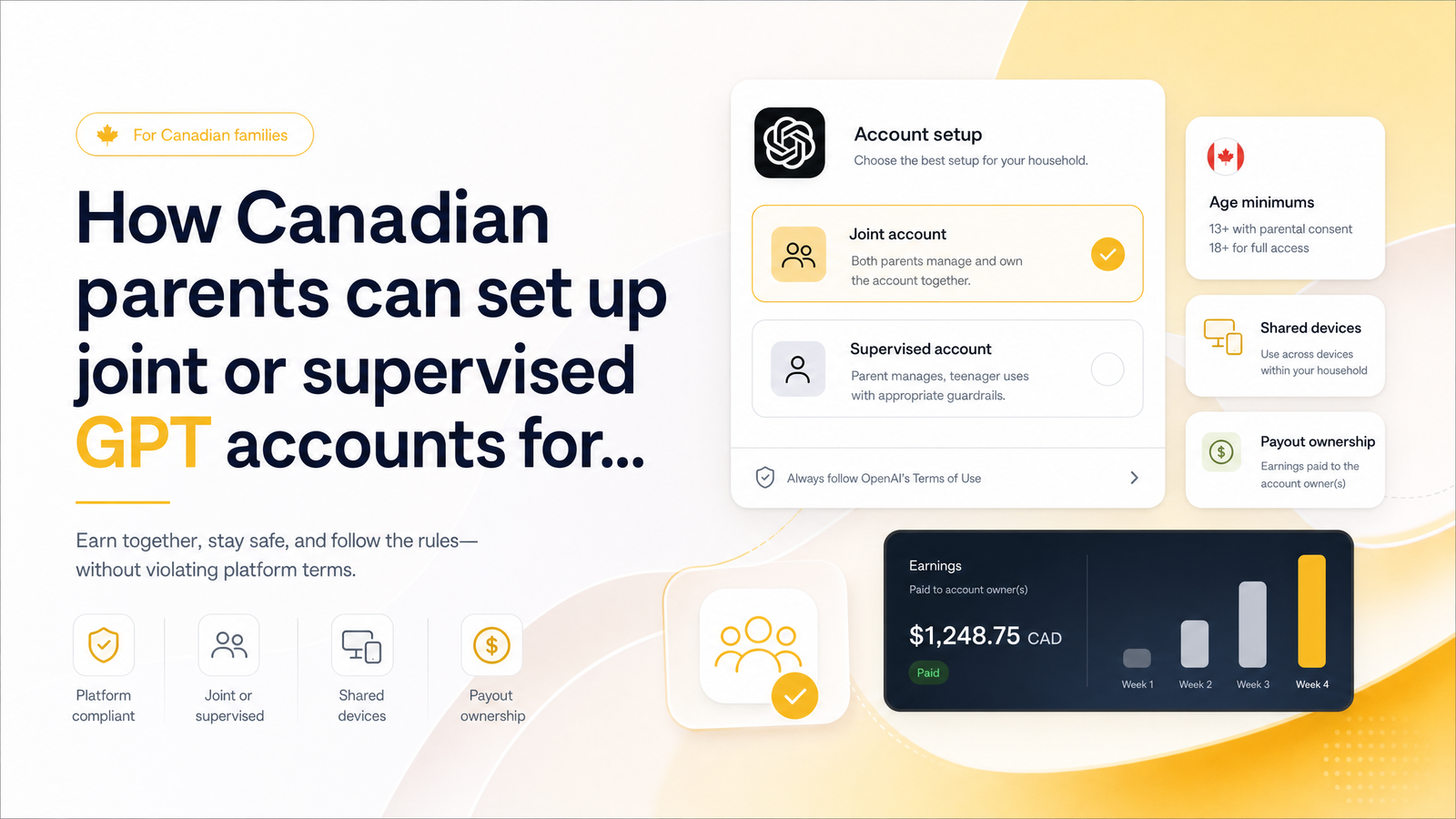
Canadian parents chasing extra household income through surveys, offers, and cashback quickly hit the same wall: every platform, payout rail, and bank rule assumes one person owns the account. If you've been searching for how GPT accounts for families Canada actually work, the honest answer is that there's no "family plan." There's one legal owner and a household that participates around them — and understanding that distinction keeps your earnings safe.
Why 'Joint' GPT Accounts Don't Really Exist in Canada
A joint GPT account Canada doesn't exist in any formal sense. Get-paid-to platforms like CashSprint, along with the payout rails behind them — PayPal and Interac e-Transfer — are all built around a single, verified, legally responsible adult. There's no "household mode" or multi-user login the way a streaming service might offer.
That's not a design flaw; it's a compliance requirement. Payout providers need to know exactly who they're paying, for tax, fraud-prevention, and anti-money-laundering reasons. So when parents ask about GPT accounts for families Canada, the realistic goal isn't a shared account — it's one compliant account owner, with the rest of the household contributing time, opinions, and effort under that person's supervision. Once you accept that framing, device sharing, payout splits, and teen involvement become much easier to plan around without accidentally breaking a platform's terms of service.
If you're still deciding whether CashSprint is worth building this system around, this evidence-based review of CashSprint's legitimacy is a useful starting point before you register.
The Age Minimums That Actually Matter
The GPT age minimum Canada question has two layers: the platform's own sign-up age, and the payout method's legal age. Most GPT sites set their own minimum around 16 or 18, but that number is almost beside the point, because the payout rails enforce a stricter rule regardless.
The Interac age requirement is tied to the age of majority in each province: 18 in Ontario, Quebec, Alberta, Saskatchewan, Manitoba, and Prince Edward Island — but 19 in British Columbia, Nova Scotia, New Brunswick, Newfoundland and Labrador, the Northwest Territories, Nunavut, and Yukon. Confirm specifics in the Interac e-Transfer Terms of Use.
PayPal minimum age Canada requirements work the same way: PayPal requires users to have reached the age of majority in their province of residence, per the PayPal Canada User Agreement. In practice, a 15-, 16-, or 17-year-old can genuinely enjoy surveys and cashback offers, but cannot legally be the named holder of the account that receives the money — whether payout lands via Interac, PayPal, or certain gift card redemptions tied to identity verification. That single fact anchors everything else in this guide.
The Compliant Setup: One Adult Owner, Household Contributors
The practical model that works — and the one CashSprint recommends — is straightforward: one parent registers, verifies, and owns the account. Everyone else contributes under that person's supervision rather than opening accounts of their own.
This is what a supervised survey account for teens should look like: the teenager answers surveys or plays qualifying offers, and results flow into the parent's already-verified profile. No separate login, no separate email tied to a new registration, no second identity being created. The teen contributes effort; the parent's account absorbs and reports the earnings, exactly as the platform's terms expect.
This structure also solves the trust problem parents worry about — you're not asking a 15-year-old to manage KYC verification, banking details, or a payout method they're not legally eligible to hold. Household GPT earnings Canada stay centralized, auditable, and compliant, while every family member who wants to pitch in still gets to.
The rule that trips people up is the assumption that "more accounts equals more income." Nearly every GPT platform's terms of service explicitly prohibit multiple accounts per household, per address, or per device — even if each is technically opened by a different real person under the same roof. That's a fast way to get every linked account frozen at once, so resist the temptation.
Shared Devices Without Triggering a Multi-Account Flag
Shared device GPT Canada situations are extremely common — one laptop, one Wi-Fi connection, multiple family members wanting to log in at different times of day. Platforms detect this through IP addresses and device fingerprinting, and the fix is simpler than most parents expect: don't create separate profiles per person on the same device or network.
Multiple GPT accounts same household is one of the most common triggers for automated fraud detection, because the system sees one IP address and one device ID cycling through several different logins and reasonably assumes account farming. To avoid that:
- Stay logged into the single household account rather than logging out and back in under a different name.
- Never register a second account "just to try it" from the same browser, even out of curiosity.
- If a spouse or teen wants to contribute time, they do it inside the existing account's session, not their own.
- Avoid browser profiles, incognito windows, or VPNs to disguise multiple sign-ups from the same address — this looks more suspicious, not less.
None of this limits how much time your household can spend earning. It only limits how many separate identities appear to be earning at once, which is the actual thing platforms are policing.
Payout Ownership: Who the Money Legally Belongs To
Whoever's legal name sits on the PayPal account, the Interac e-Transfer, or the identity-verified gift card redemption is the person the money legally belongs to — full stop. GPT payout ownership follows the name on the account, not who did the clicking or typing.
This is where a family cashback account Canada setup needs a bit of internal bookkeeping, separate entirely from the platform itself. A few methods work well in practice:
- An allowance system — the parent cashes out normally, then hands over an agreed share to the teen in cash or e-transfer to their own (non-GPT) bank account, if they're old enough to hold one.
- A simple tracked ledger — log which surveys or offers were completed by which household member, so payouts can be divided fairly at the end of the month without disputes.
- Prepaid or store gift cards — since many GPT platforms, including CashSprint, offer gift card payout options, a parent can redeem a card and pass it directly to the teen as their share, sidestepping the need for the teen to hold a payment account at all.
None of these methods involve the teen appearing on the platform's payout records — they're purely internal arrangements between family members, which is exactly how it needs to stay compliant.
What Happens If a Platform Flags Your Household
If a platform's fraud system decides your household setup looks like a banned multi-account situation, the usual consequence is a suspended account or a frozen balance while the platform investigates. This isn't personal — it's an automated response to a pattern (same IP, same device, multiple registrations) regardless of the actual explanation behind it.
The good news is that a CashSprint account suspended for this reason isn't necessarily unrecoverable. If you're already dealing with a GPT account flagged household situation, don't panic and don't open a new account to "fix" it — that only reinforces the exact pattern that triggered the flag. Review the dedicated articles on the multiple-account policy and on appealing a suspension for the specific steps to take, since the recovery process differs depending on which trigger caused the flag.
Prevention is far simpler than appeal: keep it to one account, one owner, supervised contributors, and no duplicate registrations from the same home.
Get Set Up the Right Way
If your household is ready to start earning through surveys, offers, and cashback, the move is simple: have the one eligible adult in your home create or consolidate everything under a single Cashsprint account, rather than letting multiple family members register separately. Before cashing out, double-check your payout settings — Interac, PayPal, or gift card — to confirm the name on file matches the legal account owner. And if you're troubleshooting an existing issue, the multiple-accounts policy article and the suspension appeal guide walk through exactly what to do next.
Frequently Asked Questions
Can my teenager have their own GPT account in Canada?
Generally no, not one that can legally receive payouts, because PayPal and Interac both require users to have reached the age of majority in their province — 18 or 19 depending on where you live. A teen can absolutely take part in surveys and offers, but their results should flow into a parent's verified account rather than a separate registration in their own name.
What is the actual age of majority for Interac e-Transfer in Canada?
It's 18 in Ontario, Quebec, Alberta, Saskatchewan, Manitoba, and Prince Edward Island, and 19 in British Columbia, Nova Scotia, New Brunswick, Newfoundland and Labrador, the Northwest Territories, Nunavut, and Yukon. This threshold, confirmed in Interac's own terms of use, determines who can be named on a payout, regardless of a GPT platform's own sign-up age.
Is it against the rules for multiple family members to use the same laptop for GPT surveys?
Using the same laptop is fine as long as everyone contributes through a single account rather than each registering separately. The problem isn't shared hardware — it's multiple accounts being created or logged into from the same device or IP address, which fraud-detection systems flag as likely account farming.
How can I fairly split GPT earnings with my kids if only I can hold the payout account?
Track contributions with a simple ledger, then divide the payout afterward through an allowance, a direct transfer to the teen's own bank account, or by handing over a specific gift card redeemed through the platform. All of these happen outside the GPT platform itself, so the account's payout ownership stays clean and compliant.
What happens if CashSprint suspects my household is running multiple accounts?
Your account can be suspended or your balance frozen while the platform reviews the activity, since automated systems flag shared IPs or devices tied to multiple registrations. Consolidating everything under one account before this happens is the best prevention; if it's already occurred, follow the appeal process rather than creating a new account to work around it.