
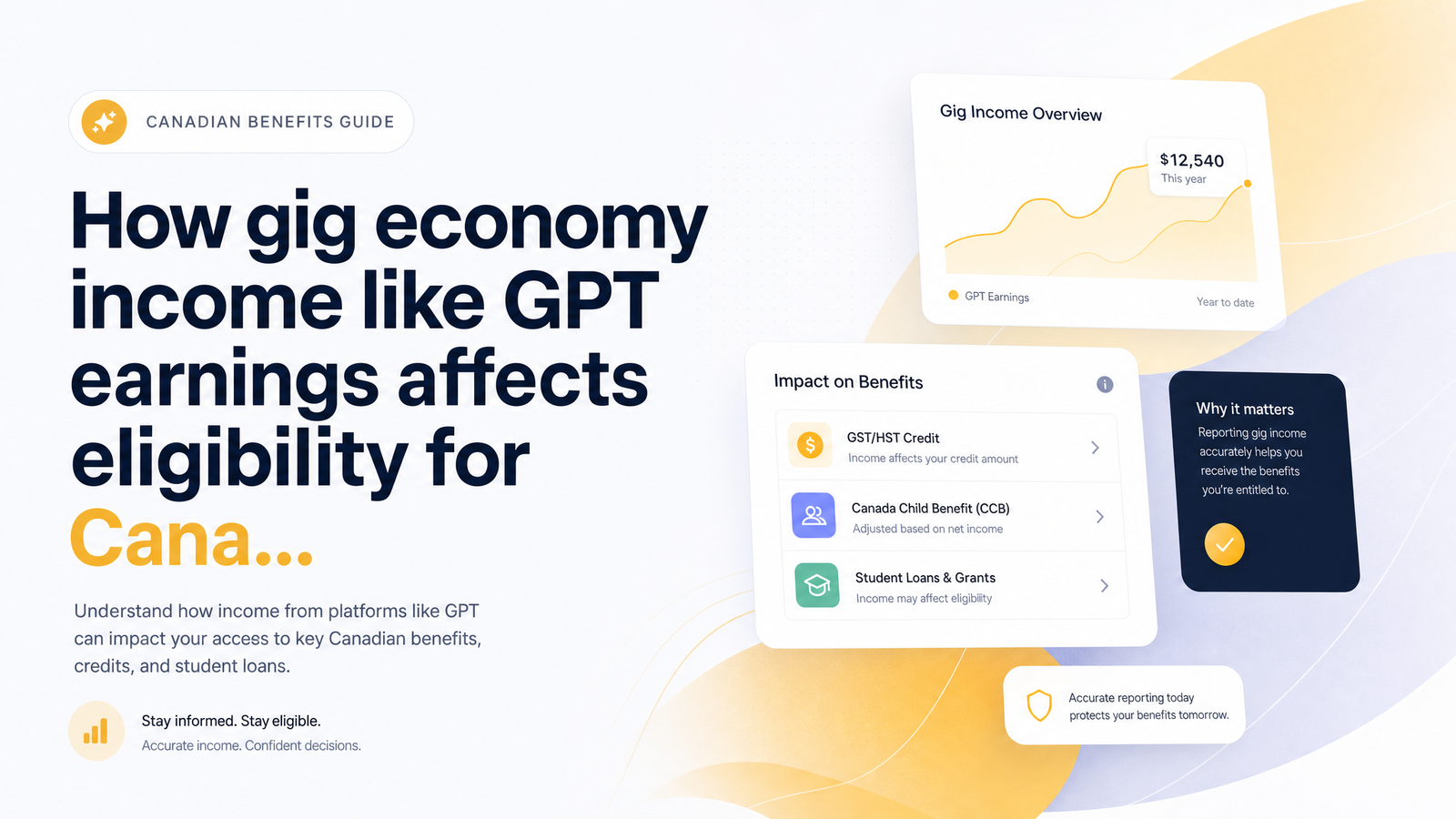
Earning $30 from a survey site or $200 in cashback over a year feels harmless — until you wonder whether it'll trigger a smaller GST/HST credit cheque or a Canada Child Benefit clawback. The honest answer: for almost every casual earner, GPT income affects benefits in Canada far less than people fear, but the mechanics are worth understanding so you're not guessing at tax time.
This article walks through exactly how survey, game, and cashback earnings flow into the formulas the CRA and student loan agencies actually use — not just whether you owe tax, but whether reporting that income can move your family across a benefit threshold.
Does GPT Income Actually Count as Income in the CRA's Eyes?
Yes. Money earned through surveys, GPT games, offer walls, and cashback platforms is income, and the CRA expects it reported.
The relevant distinction is hobby vs. business under CRA rules. A hobby is something you do without a genuine expectation of profit — no structure, no repeated effort to earn. Most GPT activity fails that test the moment it becomes consistent: signing up for multiple platforms, completing offers regularly, or referring others for bonuses all point to a "reasonable expectation of profit," which is the CRA's bar for treating an activity as a business rather than a pastime.
In practice, you report survey income, game rewards, and cashback earnings as self-employment or "other income," depending on how it was earned. Cashback that simply reduces the price you paid for something isn't income — but points, gift cards, or cash you receive for completing tasks, watching content, or referring friends generally is. Recent commentary on CRA audit triggers confirms the agency is actively scrutinizing gig and platform-based income, which makes the hobby argument a weak shield if you're earning regularly.
Once you accept that GPT income belongs on your return, the next question is what happens after it lands there — and that's where adjusted family net income comes in.
The Real Mechanism: Adjusted Family Net Income (AFNI)
Nobody gets cut off from GST/HST credit or CCB payments because they crossed a single "benefits limit." Instead, both programs use adjusted family net income — AFNI — a figure built from your line 23600 net income (plus your spouse's, minus certain adjustments) that determines how much your benefit shrinks as your household earns more.
This is the core of how GPT income affects benefits in Canada: it doesn't disqualify you outright. It adds a few dollars, or a few hundred dollars, to the AFNI figure that benefit formulas already use. Whether that addition matters depends entirely on where your family already sits relative to the phase-out thresholds — quantified in the next two sections.
Because GPT earnings typically get reported as self-employment or other income, they flow into line 23600 exactly like wages, freelance income, or rental income would. There's no special carve-out and no separate "gig income" bucket that CRA benefit calculations ignore.
GST/HST Credit (Now the Canada Groceries and Essentials Benefit): Where GPT Income Fits
The GST/HST credit — increasingly referenced alongside the Canada Groceries and Essentials Benefit — phases out gradually once your AFNI passes a set threshold, rather than disappearing at a hard cutoff. The credit is reduced by 5% of the amount your AFNI exceeds that threshold, split proportionally if you have a spouse or common-law partner.
To put that in perspective: if the applicable GST credit income threshold for your family size sits well above what a typical part-time GPT earner brings in from surveys and offers, an extra few hundred dollars simply doesn't move the needle. The current AFNI phase-out thresholds and the 5% reduction formula show that a family would need to already be earning close to the upper edge of the phase-out range before a modest side income makes any visible difference to the quarterly payment.
The practical takeaway: casual GPT earners — the person doing surveys during commercials, cashing out gift cards a few times a year — are nowhere near the range where reported earnings dent this credit. It's the household already near the income ceiling for their family size where an extra few hundred dollars could trim the payment by a modest, calculable amount, not eliminate it.
Canada Child Benefit: How Reporting GPT Earnings Affects CCB
The same principle governs CCB, with one added wrinkle: because CCB is recalculated annually based on the previous year's tax return, the effect of your GPT income shows up the following July, not immediately.
Self-employment income — which is how most GPT earnings should be classified — counts fully toward AFNI for CCB purposes, the same as any other declared self-employment income. There's no exemption for platform-based or app-based earnings just because they arrive in small increments through gift cards or e-transfers.
What reassures most families is scale. The CCB recalculation each July adjusts your payment based on your new AFNI, and CCB program details confirm that self-employment income is factored in exactly like employment income. But the reduction formula is proportional — a few hundred dollars of added AFNI produces a correspondingly small reduction, typically a fraction of what you'd owe in tax on that same income. GPT income and CCB rarely intersect in a way that outweighs simply reporting honestly and keeping your tax return clean.
Parents running a household GPT account, or splitting earnings between partners, should also think about how that income is attributed for tax purposes — the compliant setup guide for family GPT accounts covers how to structure accounts so reporting stays clean without overcomplicating things.
Student Loans: What OSAP and NSLSC Actually Check
This is the area where undeclared GPT income carries the sharpest downside — not because the dollar amounts are large, but because the verification is direct. OSAP and other provincial aid programs, along with the National Student Loans Service Centre (NSLSC), cross-reference the income you report on your student aid application against what the CRA has on file for that tax year.
OSAP's own guidance confirms that reported income is checked against CRA records, and discrepancies can trigger reassessment of your aid eligibility or restrict access to future funding. An NSLSC CRA income check works the same way in principle: your loan repayment assistance calculations depend on accurately reported income, and a mismatch between what you told the program and what you told the CRA is the kind of thing that gets flagged automatically, not manually overlooked.
For a student earning modest GPT income, the risk isn't that $150 in survey earnings alone will disqualify aid — it's that failing to declare it, and having it surface through a CRA match, creates a documented inconsistency that can affect how future applications are assessed. Student loan income verification systems are built precisely to catch this kind of gap, so treating GPT earnings as "too small to matter" is riskier than simply including them.
So Should You Worry? A Quick Reality Check
Put the pieces together and the pattern is consistent: does GPT income affect benefits in Canada? Technically yes, because it adds to AFNI and to your reported income for student aid — but for the vast majority of casual earners, the actual dollar impact is too small to meaningfully cross a phase-out threshold or trigger a real clawback.
Should I report survey income even if it's only a few hundred dollars? Yes, for two reasons that matter more than the marginal benefit reduction. First, the tax owed on modest self-employment income is usually smaller than people assume once basic expenses are factored in. Second, the protection against audits, benefit reassessments, and student loan flags is worth far more than the tiny reduction in GST credit or CCB you might see from reporting correctly.
If you're earning enough through GPT platforms that the amounts start to feel meaningful — tracking hundreds or low thousands of dollars a year — it's worth understanding the real cash value of points and rewards before you report, since the figure that matters for benefits and tax is the cash equivalent, not the face value of points or gift cards.
For most CashSprint users doing surveys, games, or cashback offers casually, the numbers here should be reassuring rather than alarming: report it, keep records, and let the phase-out formulas do what they're designed to do — reduce benefits gradually and proportionally, not punish small side income.
Frequently Asked Questions
Do I have to report GPT or survey earnings on my tax return?
Yes, if the activity shows a reasonable expectation of profit, which most repeated GPT participation does. This typically means reporting it as self-employment or other income on your return, similar to freelance or gig income, rather than treating it as a tax-free hobby.
How much GPT income can I earn before it affects my GST/HST credit?
The GST/HST credit phases out at 5% of AFNI above your family's threshold, not through a hard cutoff. Typical GPT earners — those making a few hundred dollars a year from surveys and offers — sit well below the range where this reduction becomes noticeable, since the thresholds are calibrated for much higher income levels.
Will taking surveys or playing GPT games lower my Canada Child Benefit?
It can, slightly, because self-employment income from GPT activity counts toward AFNI, and CCB recalculates every July based on your prior year's return. For modest GPT earnings, the resulting reduction is typically small and proportional, not a meaningful cut to your overall benefit.
Does OSAP or NSLSC actually check side income like GPT earnings?
Yes, both cross-reference the income you report on your aid application against CRA tax data. A mismatch between declared income and CRA records can trigger reassessment or restrict future aid eligibility, which makes accurate reporting the safer approach even for small amounts.
Is GPT income considered self-employment income or just extra cash?
Most GPT earnings are treated as self-employment or other income by the CRA once the activity is repeated and profit-driven, rather than a one-off hobby transaction. Simple cashback that reduces a purchase price is different, but points, cash, and gift cards earned for tasks generally count as reportable income.
What happens if I don't report small amounts of GPT income at all?
Unreported income risks reassessment, penalties, and interest if the CRA later identifies it through platform data or bank deposits, and it can create inconsistencies for student aid verification. The financial exposure from being caught typically outweighs the small benefit reduction that honest reporting would have caused.
For nearly everyone using GPT platforms casually, this is a manageable, well-documented corner of the tax system rather than a minefield. Get your reporting habits sorted now — the guide to organizing GPT earnings through a TFSA is a solid next step for keeping records clean before tax season — and keep earning with confidence on Cashsprint.