
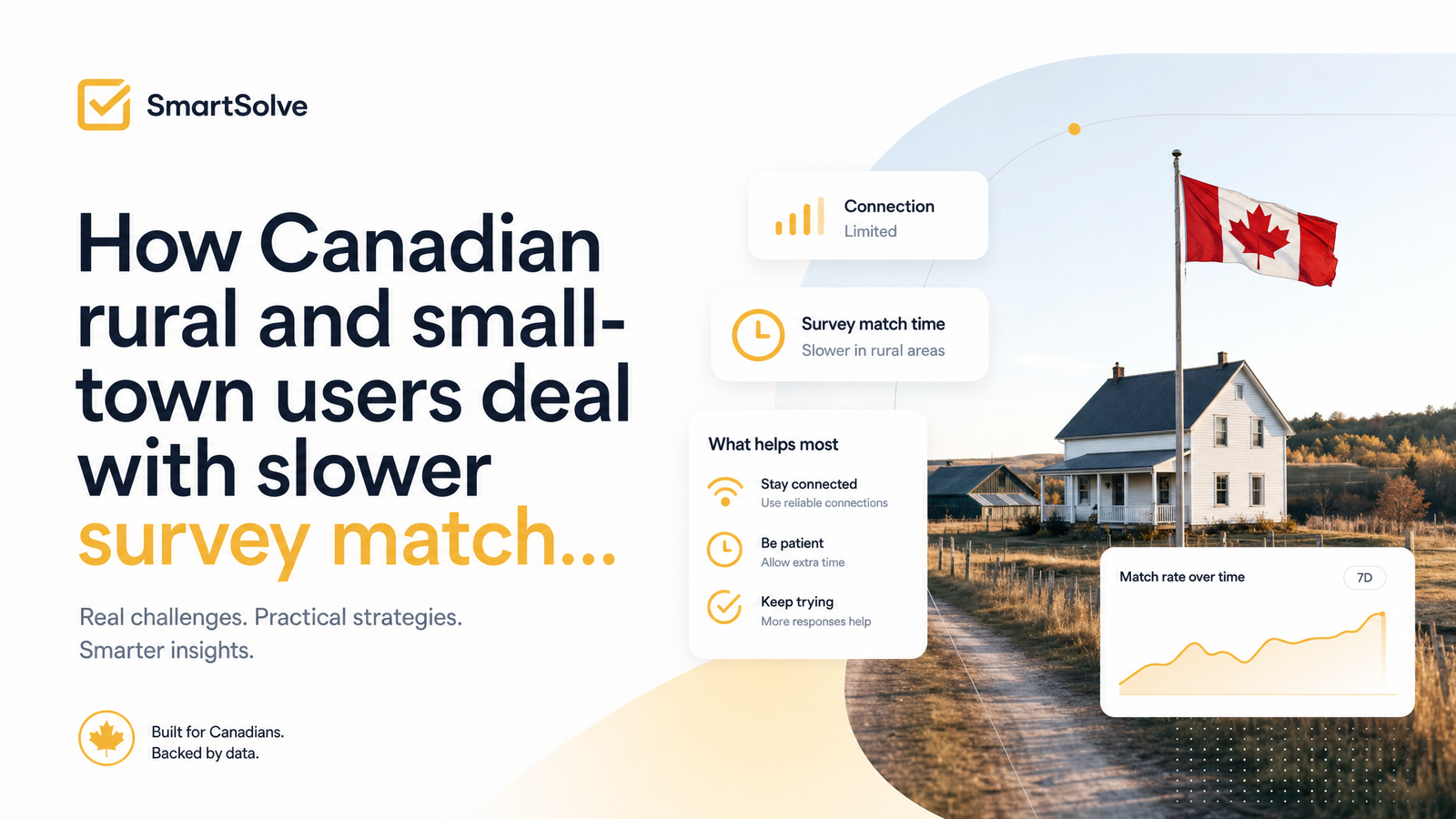
If you live outside a major Canadian city and feel like your survey dashboard is emptier than everyone else's, you're noticing something real. GPT surveys in rural Canada get matched at a slower pace than in Toronto, Vancouver, or Calgary — and the reason has almost nothing to do with your profile, your honesty, or bad luck. It comes down to how research companies build their samples and how advertising infrastructure treats geography.
Why Rural and Small-Town Canadians See Fewer Survey Matches
Most surveys on GPT platforms are distributed through quota sampling, where a research client tells the survey router: "I need 500 completes, split by region, age, and household type, matching national or provincial census proportions." Once the urban quota cells fill — and they fill fast, since that's where the bulk of the panel lives — the router stops sending that survey to anyone else, rural respondents included. It isn't that platforms deprioritize small towns on purpose; it's that quota sampling treats location as one more box to check, and the boxes for major metro areas are simply bigger and fill first.
Advertisers also design studies around population-dense markets because that's where their retail footprint, ad spend, or product distribution is concentrated. A national grocery chain testing a new snack, for instance, may only need responses from Ontario and Quebec's urban corridors to hit its numbers. Survey matching in rural Canada then becomes a function of timing and cell availability rather than eligibility — you may be a perfect demographic fit and still get closed out because the "rural Atlantic Canada, age 35-44" cell filled twenty minutes before you logged in. This is the core reason behind fewer survey offers in small towns, and it's structural, not personal.
Is Your Connection Part of the Problem?
Quota mechanics explain most of the gap, but connectivity plays a supporting role worth ruling out. Canada's broadband rollout has consistently lagged in rural and remote regions — a parliamentary review of rural broadband deployment confirms that access speeds and reliability in these areas trail national targets, even as urban centres approach near-universal high-speed coverage. That gap matters for GPT app performance because offer walls, video-based surveys, and image-heavy screeners are bandwidth-sensitive. A slow or unstable connection can cause a screener to time out mid-load, which sometimes registers as a disqualification rather than a fair shot at the survey.
Latency is the quieter culprit. Even where speeds look adequate on paper, higher latency common in satellite or fixed-wireless rural internet can delay the handshake between the survey router and the platform, occasionally causing a match to expire before your device finishes loading it. This won't fix the underlying quota problem, but it's worth testing on a strong Wi-Fi connection rather than mobile data when you can, particularly for longer or video-based studies, so you're not losing legitimate matches to a technical hiccup on top of the quota bottleneck you can't control.
Practical Workarounds That Actually Increase Offer Volume
You can't force a rural quota cell to stay open longer, but you can meaningfully increase how often you're invited to try:
- Keep your profile fully current. Panels re-route surveys based on updated household, employment, and lifestyle data. Stale profiles get skipped over even when a matching quota cell is open.
- Check in daily across categories, not just surveys. Offer walls, games, and cashback listings refresh independently of survey quotas, so a daily habit surfaces opportunities a survey-only routine misses.
- Complete every profiler and screener, even short ones. Each one feeds the routing algorithm more signal about who you are, improving future matching — skipping them narrows your funnel further.
- Qualify across multiple categories, not just one niche. If you only ever answer as a single household type or occupation, you're eligible for fewer studies. Genuinely diverse, honest answers about your household widen your eligible pool.
- Be patient with timing. Many panels release new studies in batches at specific times of day; logging in once in the morning and once in the evening catches more open quota cells than a single check-in.
None of this requires bending the truth or exploiting the system — it's about maximizing the number of accurate chances you get. For a realistic sense of what steady GPT effort translates to in your province, the GPT Side Income by Province guide breaks down what "meaningful" earnings actually look like regionally, so you can set expectations that match your market rather than an urban forum post.
Diversify Beyond Surveys: Offers, Games, and Cashback
Surveys are the most quota-sensitive earning category on any GPT platform, making them the least reliable for rural users chasing consistent volume. Offer walls, games, and cashback work differently — they're generally driven by advertiser campaigns and retail partnerships rather than demographic quotas tied to physical location. That means a cashback offer for a grocery app or a mobile game payout is available on largely the same terms whether you're in downtown Montreal or a farm outside Brandon.
This is the practical answer for anyone whose dashboard looks thin on survey invites: fill the gap with categories that aren't gated the same way. A detailed look at how games actually pay out, and where the honest limits are, is covered in Games to Earn Money: The Honest Canadian Breakdown. If you're weighing which category deserves more of your time, Survey Sites vs Cashback Apps: Which Pays More in Canada? compares the two directly so you can allocate your effort where it's currently paying off, rather than waiting on a survey category that's structurally slower where you live.
It's also worth double-checking that offers you did complete are actually crediting properly — tracking issues are a separate, common frustration from matching volume, and this explainer on why credits go missing covers what to do when a completed offer doesn't show up in your balance.
What to Avoid: VPNs, Fake Location Tricks, and Scam Promises
It's tempting, once you understand that urban quotas fill faster, to think a VPN set to a Toronto or Vancouver IP address might trick the router into treating you as urban. Don't do this. Every major GPT platform's terms of service prohibit location spoofing, and panel software is specifically built to detect mismatches between your declared location, IP address, device signals, and payment details — Interac e-Transfer and PayPal accounts are tied to real addresses, so a spoofed location usually creates a flag rather than a benefit. Accounts caught doing this risk suspension, forfeited balances, and in some cases a ban across the panel network the platform draws from, which costs you far more than the extra surveys you were chasing.
The same instinct also makes rural users a target for scam sites that promise "guaranteed rural surveys" or "no-disqualification panels." These claims exploit exactly the frustration this article addresses, and they typically lead to data harvesting or payout accounts that never actually pay. If you're evaluating a new platform because your current one feels slow, review Fake GPT Sites in Canada: How to Spot and Report Them before signing up anywhere unfamiliar. The honest path — accurate profile data, daily check-ins, and diversified categories — is slower to describe but it's the one that actually protects your account and your payout history.
Frequently Asked Questions
Why do I get disqualified from surveys more often living in a small town?
Disqualifications in rural areas are often tied to quota cells filling or closing based on region-specific targets set by the research client, not your individual answers. Once a location-based quota cell is full, the survey router screens out further respondents from that area regardless of eligibility. Keeping your profile data current and answering screeners honestly is still your best lever, even though the quota mechanics themselves are outside your control.
Does living in a rural area actually reduce how many GPT offers I see?
Yes, specifically for surveys, because advertisers frequently prioritize dense urban panels to hit sample quotas faster. Offer walls, games, and cashback deals aren't gated by the same location-based quota system, so those categories tend to be far more consistent regardless of where you live in Canada.
Can a VPN or changing my location help me get more surveys?
No — this typically triggers fraud detection rather than unlocking more surveys, since platforms cross-check your declared location against IP address, device data, and payout details like Interac e-Transfer information. Accounts flagged for location spoofing risk suspension or forfeited earnings, which outweighs any short-term benefit.
Is it worth filling out every profile survey if I live outside a big city?
Yes, because each completed profiler or screener gives the routing algorithm more accurate signal about your household and lifestyle, which improves future matching. Skipping short profilers narrows the pool of studies you're eligible for, compounding the quota disadvantage rural users already face.
Do games and cashback offers work the same in rural Canada as surveys do?
Largely yes, since games and cashback are typically driven by advertiser campaigns and retail partnerships rather than demographic sample quotas tied to physical location. This makes them a reliable way to fill earning gaps between slower survey matches in small towns.
Will my internet connection affect whether I qualify for survey invites?
It can, indirectly — a slow or high-latency rural connection may cause a screener or offer wall to time out before it loads fully, which can look like a disqualification. Using a stable Wi-Fi connection rather than mobile data for longer or video-based surveys reduces this risk, though it won't change the underlying quota limitations.
Building a complete, honest CashSprint profile and checking in across surveys, offers, and games every day is the most reliable way to work around rural quota timing — offer walls refresh on their own schedule regardless of your postal code. For a realistic picture of what that adds up to in your province, revisit the GPT Side Income by Province guide, and if a completed offer doesn't credit as expected, the tracking and crediting guide walks through next steps. Start or refine your profile at Cashsprint and check back daily — consistency, not location tricks, is what moves the needle.