
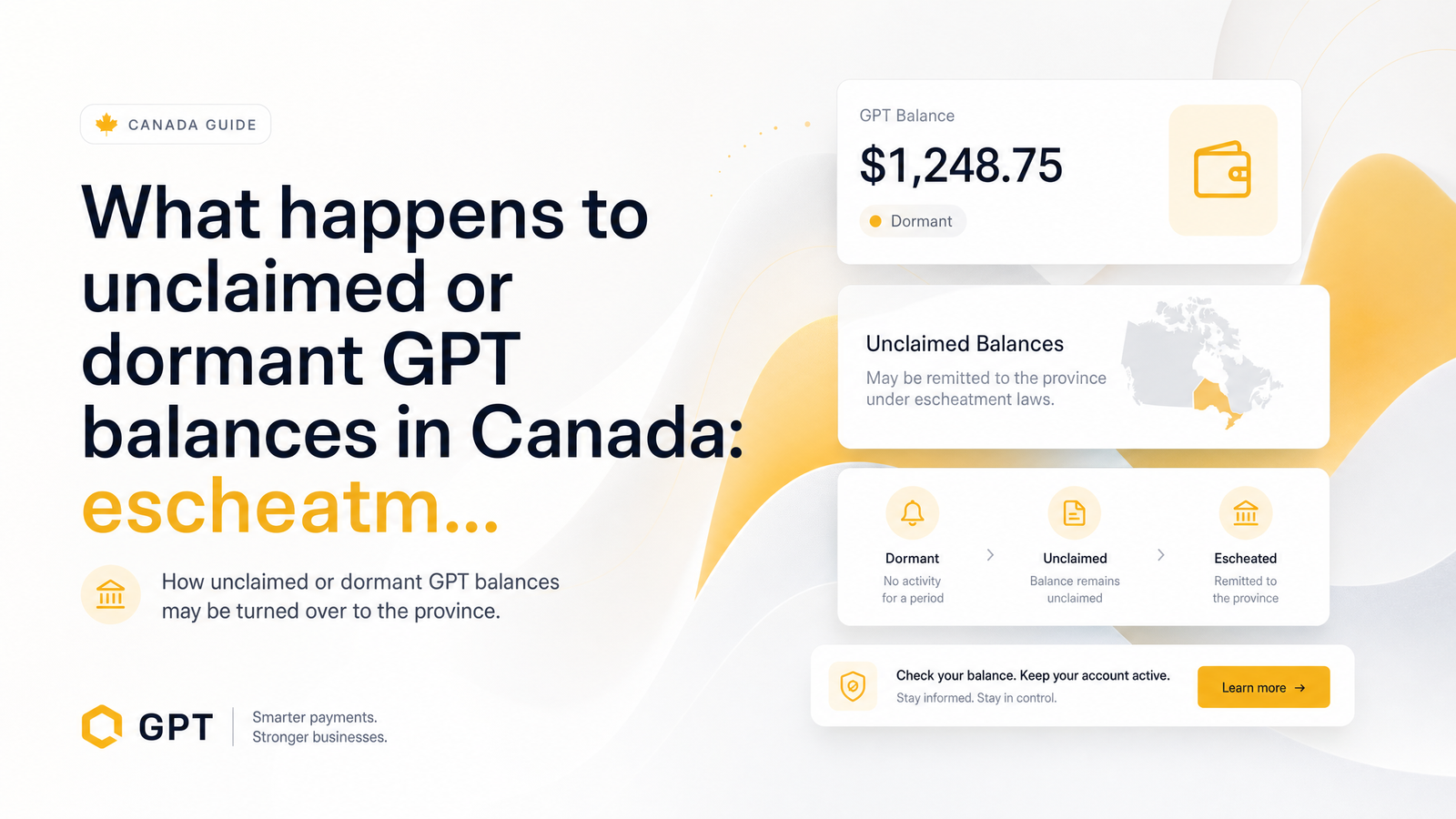
If you've stepped away from CashSprint for a few months and wondered whether your points are still there, you're asking the right question. A dormant GPT account balance in Canada isn't seized by any government — but it can be reduced, frozen, or wiped out by the platform's own Terms of Service, and that distinction matters more than most users realize.
Search "unclaimed property Canada" and you'll get pages written for bank accounts, insurance payouts, and forgotten pension funds. None of it addresses what happens when you stop logging into a survey or cashback site for a year. This guide fills that gap: it explains the actual legal backdrop, then draws a hard line between what government rules cover and what your GPT platform's fine print controls.
Does the Government Ever Claim Your GPT Balance?
No provincial or federal authority in Canada is coming for your reward points. Every province has some form of escheatment or unclaimed property regime — Ontario's Escheats Act deals with property that reverts to the Crown when a corporation dissolves without distributing its assets, and Manitoba runs an unclaimed property program with a 12-year dormancy threshold before balances get reported to the province. These regimes exist to catch forgotten bank accounts, insurance proceeds, and shareholder dividends — not loyalty points or GPT site balances.
The legal architecture behind escheatment rules in Canada was built for regulated financial institutions and dissolved corporations, entities with formal reporting obligations to provincial or federal regulators. A GPT marketplace isn't a bank, an insurer, or a trust company, so it doesn't fall under those unclaimed-property statutes. For a clear plain-language summary from a legal source, see the Blakes primer on Canadian unclaimed property legislation.
Practically: nobody is going to "escheat" your CashSprint balance to a provincial fund the way they might an old chequing account. But that's also the bad news — if a government process isn't protecting your balance, something else has to. That something is a private contract.
What Actually Controls Your GPT Balance: The Terms of Service
Inactivity forfeiture on a GPT platform is a contractual matter, not a regulatory one. When you sign up for any rewards site, you agree to Terms of Service that spell out what happens if you go quiet — and those terms can be far less forgiving than what banks are required to offer.
Canadian banks operate on a fairly standard clock: an account is typically flagged as dormant after two years of no customer-initiated activity, after which some institutions apply fees, and after ten years of inactivity, unclaimed balances get transferred to the Bank of Canada, which holds them indefinitely for the owner to claim. The Savvy New Canadians breakdown of inactivity fees walks through those bank and even PayPal timelines in detail.
A GPT account inactivity policy usually moves on a much shorter fuse — sometimes six months, sometimes a year — and there's no equivalent to the Bank of Canada standing by to hold your forfeited points indefinitely. Once a platform's terms declare a balance expired or an account closed for inactivity, recovery depends entirely on that platform's discretion and customer support, not a statutory safety net. GPT balances are contractual credits, not government-protected deposits, and the timeline for losing access is set by whoever runs the platform.
Common Inactivity Triggers on GPT and Cashback Platforms
Every rewards platform structures its inactivity rules a little differently, but a few patterns show up across the industry. Checking your own habits against these can tell you whether you're at risk of an unclaimed GPT balance in Canada without realizing it.
- No login for an extended stretch — many platforms count activity strictly as logging in, not just having a balance sit untouched. Six to twelve months of silence is a common trigger point.
- Unredeemed points expiring — some platforms attach expiry dates to specific point batches earned through promotions or bonus offers, separate from the main balance.
- Pending cashback reversing — cashback that hasn't cleared from a retailer partner can be reversed if you don't confirm the purchase or if the retailer's return window closes without action from you.
- Minimum threshold never reached — if a platform requires a minimum balance before payout and you never cross it, that balance can sit exposed to inactivity rules far longer than a cashed-out balance would.
- Email verification lapses — an unverified or bounced email address can flag an account as abandoned even if you're still technically using the platform elsewhere.
What happens after one of these triggers fires varies by platform — some issue a warning email, others quietly zero out the balance at the next audit. The common thread is that none of it involves a government agency; it's the platform enforcing its own contract terms.
Gift Cards and Cash-Out Balances: A Different Set of Rules
Once you convert GPT points into a gift card, the legal picture changes substantially in your favour. Gift cards sold in Canada are subject to provincial consumer protection law, and most provinces prohibit expiry dates and dormancy fees on gift cards outright — a level of protection your raw platform balance never had. The Financial Consumer Agency of Canada's page on gift cards confirms this provincial oversight, while noting a few exceptions for certain promotional or single-use cards, and for the territories, where rules differ.
This is why gift card dormancy fees in Canada are largely a non-issue for consumers holding standard retail gift cards, even though the underlying points balance that funded the purchase was never covered by anything similar. The Cadeau guide to Canadian gift card laws goes deeper into the province-by-province specifics if you want the full picture. The practical takeaway: unclaimed property protections around rewards essentially don't exist at the points stage, but they materialize the moment you convert those points into a regulated instrument like a gift card. If you're deciding whether to let a balance sit or cash it out, that legal gap is a real reason to favour converting sooner rather than later.
How to Check and Protect Your CashSprint Balance
None of this is meant to alarm you — it's meant to make the fine print actionable. A short, periodic routine avoids losing GPT earnings entirely.
- Log in on a regular cadence. Even a quick login every couple of months keeps your account clearly active under most inactivity definitions.
- Confirm your payout method is verified. Whether you're set up for Interac e-Transfer, PayPal, or gift cards, an unverified or outdated method is often the real reason a payout stalls, which can make an account look abandoned even when you're trying to cash out.
- Cash out at or above the minimum threshold rather than stockpiling. Letting points accumulate indefinitely just extends the window during which inactivity rules can apply. If you're weighing which method gets your money fastest, the CashSprint payout options ranked by speed breaks down the tradeoffs between e-Transfer, PayPal, and gift card redemptions.
- Watch for inactivity emails and act on them promptly. A warning notice is usually your last chance to reactivate an inactive CashSprint account before a balance is adjusted.
- Keep your email and contact information current. A bounced verification email is one of the most avoidable reasons an active user gets flagged as dormant.
Building this into a habit — rather than treating your GPT balance as a "set it and forget it" savings account — is the whole game. Points sitting idle earn nothing and carry contractual risk; points converted to cash or a verified payout method carry the legal protections described above.
Frequently Asked Questions
Can the government seize my GPT or rewards balance in Canada?
No. Provincial escheatment and unclaimed property regimes apply to banks, insurers, and dissolved corporations with formal reporting duties, not to consumer GPT or rewards platforms. Your CashSprint balance is governed entirely by CashSprint's own Terms of Service, not by any government unclaimed-property process.
How long can a GPT account go inactive before losing points?
It depends entirely on the platform's Terms of Service, but many GPT sites use windows as short as six to twelve months, compared to a bank's typical two-year dormancy fee threshold and ten-year transfer to the Bank of Canada. Always check the specific inactivity clause in the platform's terms rather than assuming a standard timeline applies.
Do gift cards purchased with GPT points expire?
Generally no. Once points are converted into a gift card, most Canadian provinces prohibit expiry dates and dormancy fees under consumer protection law, though a few exceptions exist for certain promotional cards and in the territories. This makes cashing out to a gift card meaningfully safer than letting the underlying points balance sit unredeemed.
What's the fastest way to reactivate a dormant CashSprint account?
Log back in, verify your email address if prompted, and confirm your payout method is still valid. Acting as soon as you receive any inactivity warning email gives you the best chance of reactivating an inactive CashSprint account before an adjustment is applied.
Is my GPT balance protected the same way as a bank account?
No. Bank accounts eventually transfer unclaimed balances to the Bank of Canada after ten years of inactivity, where they're held indefinitely for the owner to claim. GPT balances have no equivalent backstop — once a platform's inactivity terms apply, recovery depends on that platform's own policies and customer support, not a government safety net.
Check your CashSprint account today: confirm your last login, verify your payout method, and cash out anything sitting above the threshold rather than letting it wait for an inactivity clause to kick in. See the payout options ranked by speed to move your balance out fast, and make it a habit rather than a one-off — head back to Cashsprint to log in now.