
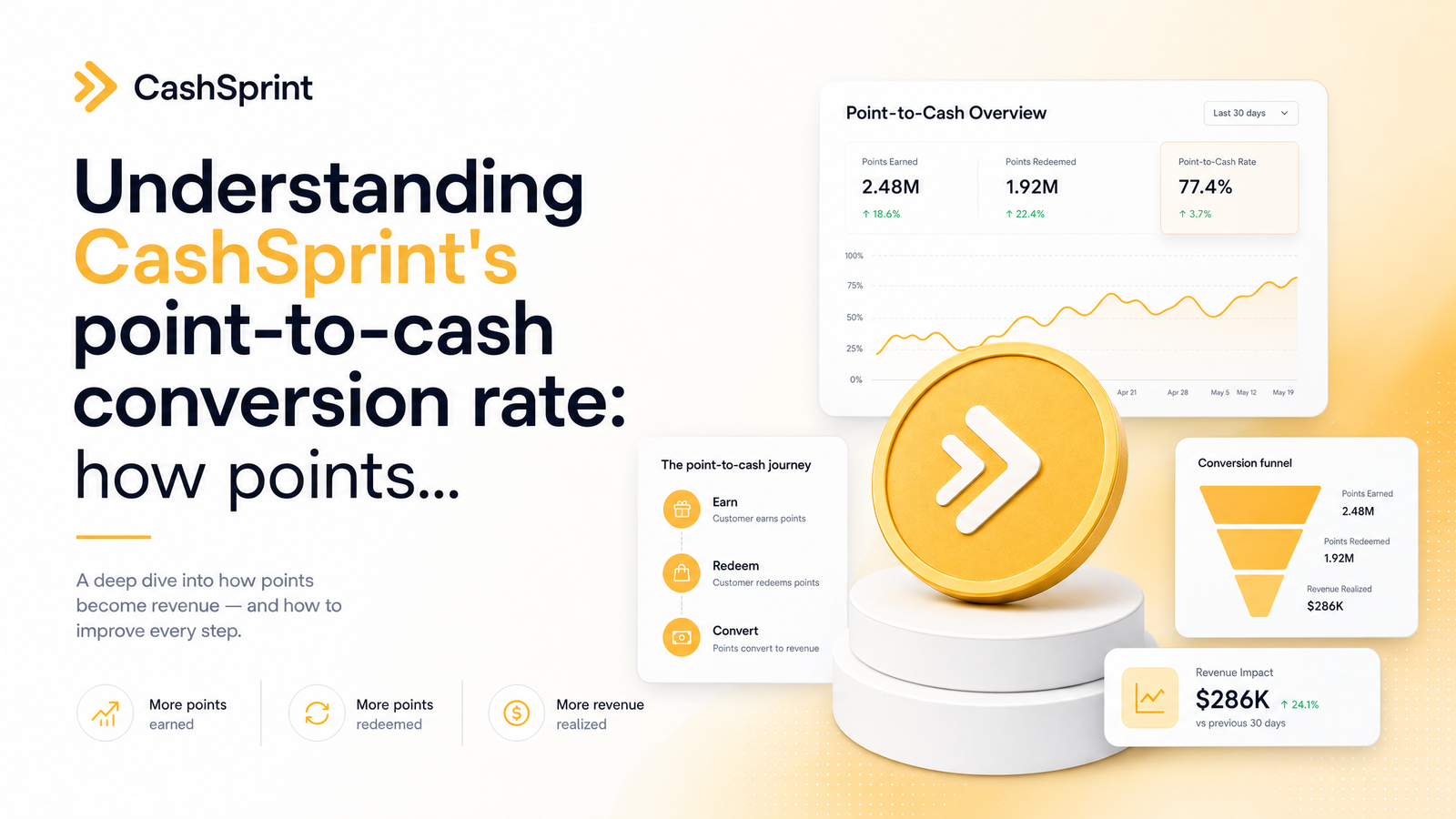
Every GPT (get-paid-to) platform speaks in points, tokens, or coins instead of dollars and cents — and that's not an accident. Once you understand GPT points to cash conversion Canada style, you stop guessing whether an offer is worth your time and start treating points like what they actually are: a currency with a fixed, calculable exchange rate.
This guide reverse-engineers that math: the formula, the reasoning behind inflated point displays, and a repeatable method for judging any survey, offer, or game before you click "start."
What a 'Point' Really Represents on CashSprint
A point on CashSprint isn't a reward in itself — it's a proxy for a fraction of a Canadian dollar. Platforms display points instead of cents because bigger numbers feel more rewarding psychologically, points let the platform run promotions and bonuses without touching real payout rates, and a shared point system makes it easier to price wildly different tasks — a two-minute poll versus a twenty-minute survey versus an in-app game milestone — on one consistent scale.
Underneath the number on your dashboard, CashSprint applies a fixed base rate: a set number of points equals $1 CAD. That rate is the anchor for every offer, survey, and cashback deal on the platform. Once you know it, every point balance becomes a dollar figure you can check in seconds, and every "earn 500 points" headline becomes something you can size up against your own time instantly, rather than trusting the marketing framing of the offer itself.
This is the core idea behind GPT points to cash conversion Canada searches: points are not a mystery currency. They're dollars wearing a costume, and the costume comes off with one division problem.
The Simple Formula for Converting Points to CAD
The formula is deliberately simple, because it needs to work instantly, in your head, while you're deciding whether an offer is worth opening:
CAD value = Points earned ÷ Points-per-dollar rate
Say CashSprint's points to CAD conversion rate is set so that 1,000 points equal $1 CAD (illustrative only — always check your live dashboard rate, since that's the figure that matters). Under that rate, 1,000 GPT points is worth exactly $1 CAD. A 5,000-point survey would be worth $5. A cashback offer paying 250 points on a purchase would return $0.25 — useful to know before you assume a "250 points!" banner means something substantial.
The formula works in reverse too. If you want to earn $10 this week, divide $10 by your dollar-to-points rate to see exactly how many points you need, then map that against the offers available. This turns a vague goal ("earn some extra cash") into a concrete target you can track against your dashboard balance in real time.
The value of this formula isn't the arithmetic — it's what it lets you do next: compare an offer priced in points against one priced directly in cents or dollars, on equal footing, without the point number distorting your judgment.
Why Some Offers Look Bigger Than They're Worth
Large point numbers are, in part, a design choice. A survey offering "2,000 points" sounds far more exciting than one offering "$2.00," even when they're identical. This is where a lot of users feel misled — not because platforms are lying about payout, but because point totals are easy to inflate visually while the real GPT points inflated value stays modest.
A few common tactics worth recognizing:
- Tiered bonus displays that show a large headline number ("up to 5,000 points!") which only applies to the rare top completion tier, while most users land on a much smaller payout.
- Multipliers on already-small base amounts — doubling 100 points to 200 points still nets you a fraction of a dollar, even though "doubled" sounds like a big win.
- Point-heavy game milestones that require significant time investment for totals that convert to only a few cents once you actually run the math.
None of this means the offers are scams — it means the point figure alone is not information. The moment you divide by your rate, the real value declares itself, and you can start filtering for best value GPT offers Canada based on actual payout rather than the size of the number displayed. If surveys are your main focus, this breakdown of realistic survey earnings in Canada applies this same lens specifically to survey payouts.
How to Spot the Best-Value Offers Before You Start
Knowing an offer's CAD value is only half the equation — the other half is time. A $2 survey that takes 20 minutes is objectively worse than a $1 offer that takes 3 minutes, even though the first number looks bigger. This is the difference between a high point-value offer and a high time-value offer, and it's the single most useful distinction for anyone trying to earn efficiently.
The fix is calculating your GPT effective hourly rate before committing to a task:
Effective hourly rate = (CAD value of offer ÷ minutes to complete) × 60
Run this on anything before you start it. A few benchmarks to use as a mental filter:
- Under CAD $0.10/minute — generally low value; only worth it if you're doing something else simultaneously.
- CAD $0.10–$0.25/minute — solid, typical of well-routed surveys and standard offers.
- Above CAD $0.25/minute — strong value; prioritize these first when they're available.
Because points per dollar vary by offer type on most GPT sites, this calculation is also how you compare across categories fairly — a cashback deal, a survey, and a game milestone all reduce to the same unit: CAD per minute. Once you're in that habit, low-value tasks stop being tempting just because the point number looks large. For a fuller strategy on stacking these decisions into a consistent earning routine, see this step-by-step guide to maximizing CashSprint earnings.
It's also worth noting that survey routing — the process that matches you to eligible surveys based on your profile — affects this math. Getting disqualified partway through a survey costs you time with zero point payout, which quietly wrecks your effective hourly rate even when the surveys you do complete pay well. Keeping your profile accurate and up to date reduces this leakage. This piece on common survey mistakes covers several ways Canadians lose value this way without realizing it.
Does Your Redemption Method Change the Conversion Rate?
This is one of the most common points of confusion, so it's worth answering directly: on CashSprint, your points value is set at the point-to-CAD conversion stage, not at redemption. Choosing Interac e-Transfer, PayPal, or a gift card doesn't retroactively change how many points you earned or what your base rate is.
That said, redemption method can still affect what you walk away with, depending on the specific reward catalog:
- Interac e-Transfer typically reflects your CashSprint points value directly in CAD, deposited to your bank account — straightforward, no denomination gymnastics.
- PayPal works similarly, converting your CAD balance to a PayPal transfer, though currency handling or minor processing considerations can occasionally apply depending on your account setup.
- Gift card redemptions sometimes include bonus value or promotional boosts on specific cards, meaning a $10 CAD balance might technically stretch further at certain retailers than a straight $10 cash-out would.
So while the underlying points-to-CAD math doesn't change, the Interac vs PayPal vs gift card GPT decision can still matter if you want to stretch redemption value further through occasional card promotions — just don't expect it to change your actual points earned. Since speed of access is often just as important as raw value, it's worth comparing options side by side using this ranked guide to CashSprint payout speeds before deciding which method fits how quickly you want your cash in hand.
Frequently Asked Questions
How many CashSprint points equal 1 CAD?
CashSprint uses a fixed points-per-dollar rate that's displayed on your dashboard and applied consistently across surveys, offers, and cashback deals. Always check your live dashboard for the exact current figure, since that number is the base you use for every conversion calculation described in this guide.
Why do some offers show huge point numbers but pay very little in real money?
Large point totals are partly a display and engagement tactic — bigger numbers feel more rewarding even when the underlying CAD value is small. Tiered bonuses, multipliers on small base amounts, and game-style milestones are the most common ways point totals get inflated without a matching increase in real payout.
Does the point-to-cash rate ever change on CashSprint?
The base conversion rate is set by the platform and applied consistently, though it's worth periodically checking your dashboard rather than assuming an old figure still holds. Individual offers can vary in how many points they award, but that's a difference in offer generosity, not in the underlying exchange rate itself.
Is it better to chase high-point offers or high-paying-per-minute offers?
High-paying-per-minute offers almost always win over high-point offers, because point totals ignore the time cost of completing a task. Calculating CAD-per-minute (or effective hourly rate) for each option is the only reliable way to compare a quick, lower-point offer against a longer, higher-point one.
Do gift card redemptions give a better points value than Interac e-Transfer or PayPal?
Your points-to-CAD conversion happens before redemption, so the core value of your points doesn't change based on cash-out method. Some gift cards occasionally include added promotional value at specific retailers, but Interac e-Transfer and PayPal both reflect your CAD balance directly without any conversion penalty.
Why did my points balance convert to less cash than I expected?
This usually happens when point totals were judged at face value instead of run through the points-per-dollar formula, especially on offers with tiered bonuses or multipliers that only partially applied. Double-checking your dashboard's current conversion rate against the raw point number before cashing out will explain most discrepancies.
Open your CashSprint dashboard now and run the CAD-per-minute formula against your current top offers — it takes seconds and immediately tells you which ones are actually worth finishing. Once you know your real earnings, compare your cash-out options in the payout speed guide and build a consistent routine with the earnings-maximization guide, so the value-spotting method becomes second nature every time you log into Cashsprint.