
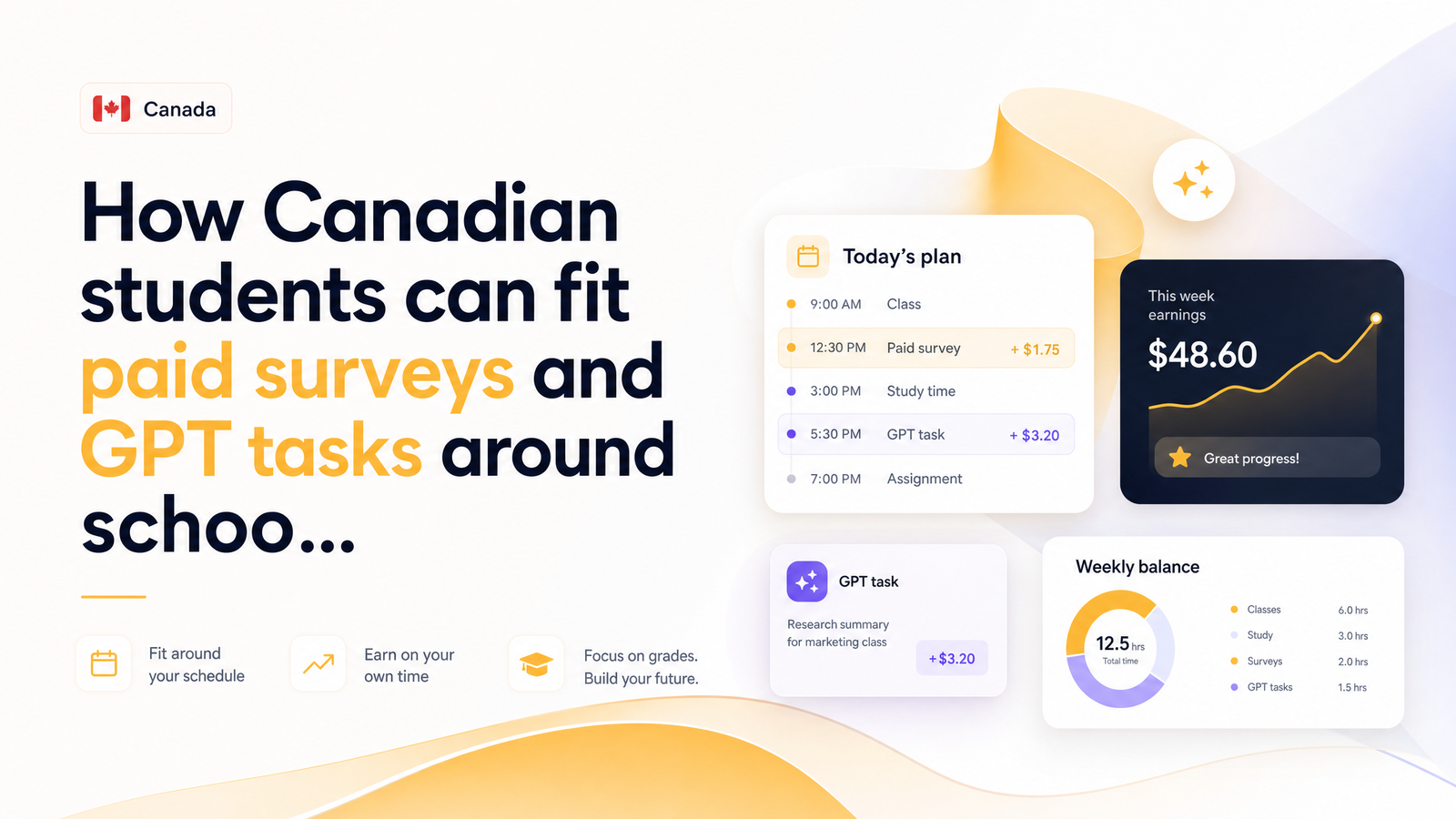
Most guides about surveys for students in Canada treat time like it's unlimited and compliance like it doesn't exist. It isn't, and it does. If you're juggling lectures, assignments, maybe a part-time job, and — for international students — a hard legal cap on off-campus hours, the real question isn't "how much can I earn?" It's "where does this actually fit, and what happens if I get it wrong?" This guide answers that.
Why Surveys and GPT Work Fit a Student Schedule Better Than a Second Job
A part-time job comes with a shift schedule, a manager expecting you, and a commitment to show up even during exam week. Get-paid-to (GPT) tasks and paid surveys don't work that way. There's no shift to miss, no boss to text when a paper runs long, and no penalty for skipping a week entirely.
That difference is what makes GPT work suit student life. You're not trading fixed hours for fixed pay — you're filling dead time that already exists in your day: the ten minutes before a lecture starts, a bus ride, a wait between labs. A retail or campus job can't be compressed into those windows. A short survey or offer on a platform like Cashsprint can.
This isn't a pitch that GPT work replaces income from a real job. It's a pitch that it's the only kind of paid activity flexible enough to sit around your timetable instead of competing with it. That flexibility is the entire value proposition for a student, more than any per-survey payout.
Is Survey/GPT Income Considered 'Work' for International Students?
Generally, survey and GPT income is treated as self-employment or contractor-style earnings rather than employment with a specific employer — you're not on anyone's payroll, there's no employer deducting source withholdings, and you're free to start or stop whenever you like. That's meaningfully different from the off-campus work-permit limit that applies to international students on a study permit.
Under current rules, eligible study permit holders can work up to a set number of off-campus hours per week during academic sessions — confirmed at 20 hours weekly after the temporary unlimited-hours policy ended. The important nuance: that cap isn't limited to jobs with a formal employer. Coverage extends to self-employment-type activity too, which is exactly the bucket most GPT and survey income falls into — confirmed by immigration reporting on how the hour limit applies.
In practice, this means international student survey income shouldn't be treated as a loophole around study permit work hours. Casual, low-time survey activity is unlikely to push most students near a 20-hour weekly ceiling — especially at the few-hours-a-week pace recommended here — but the honest move is to track your time across all paid activity, not just your formal job, and check current guidance directly through IRCC if you're unsure how your situation is classified. Rules change; this article isn't immigration advice, and IRCC's own published guidance should be your final word.
Time-Blocking: Where Surveys Actually Fit in a School Day
Treat GPT sessions like flashcard review — small, scheduled, and opportunistic rather than open-ended. A realistic weekly budget for most students is 3–5 hours total, broken into short sessions rather than one long sitting. A few slots that already exist in a typical school day:
- Between-class gaps. A 15–20 minute break between lectures is enough for two or three short surveys or a quick offer wall check.
- Commute time. Bus, train, or waiting-for-a-ride windows are dead time you're already spending on your phone anyway.
- Lunch breaks. Ten minutes before you eat, rather than during a rushed bite between obligations.
- Pre-shift waiting. If you have a part-time job, the 10–15 minutes before clock-in is often unused and predictable.
The goal isn't to fill every spare minute — it's to pick two or three recurring slots you can rely on each week and treat everything else as a bonus. Predictable slots build a habit; unpredictable "whenever I have time" attempts usually fizzle out within a week. If you want a sense of what that time is actually worth before committing to a routine, this breakdown of realistic survey earnings in Canada is a useful gut check.
Protecting Your Grades: Rules of Thumb Before You Start a Session
A few guardrails keep GPT time from eating into study time:
Cap the session before you start it. Decide "15 minutes" before you open the app, not after. Open-ended sessions are how twenty minutes becomes ninety.
Never during lecture or exam-prep windows. If a block of time is earmarked for a class or review session, it stays earmarked. Surveys go in the gaps around study blocks, not inside them.
Use it as a reward, not a warm-up. Finishing a reading or problem set and then doing a short survey session works better psychologically than doing it first — you're less likely to drag the session out when it's the reward rather than the delay tactic.
Pull back completely during high-stakes weeks. Midterms, finals, major assignment deadlines — these weeks call for zero GPT time, not reduced GPT time. The few dollars from a survey session aren't worth a lower grade, and long survey batteries in particular have a way of expanding past their advertised length.
Combining GPT Income With an Existing Part-Time Job
If you already work a part-time job, GPT and survey time should sit in the margins your job doesn't touch — not stack on top of it. Two things to watch:
First, energy, not just hours. A closing shift followed by an hour of surveys before bed sounds productive on paper but usually just means worse sleep and a worse next day. Layer GPT sessions into moments when you're mentally idle anyway — the commute home, not the hour after a long shift.
Second, for international students, hour tracking matters more once a formal job is in the mix. If your off-campus job already uses a meaningful chunk of your weekly cap, keep any self-employment-style GPT activity light and be conservative about how you account for it against that limit. This is the scenario where checking current IRCC guidance directly is worth the ten minutes it takes, rather than assuming casual survey time doesn't count at all.
Before committing real time to any platform, it's worth confirming the platform is worth your limited hours — this evidence-based look at Cashsprint's legitimacy is a reasonable starting point, and it's also worth knowing the common mistakes that waste survey-takers' time before you build a habit around bad ones.
Taxes and Reporting: What Students Need to Know
All GPT and survey income counts as income for tax purposes, regardless of how small the amount is or how it's paid out — cash, e-transfer, or gift card. The CRA doesn't set a minimum threshold below which earnings become tax-free; keep a simple running total as you go so tax season isn't a scramble.
Filing a return is worth doing even on modest student income, since it's typically what triggers eligibility for benefits like the GST/HST credit. The CRA publishes a short, student-specific rundown of what students need to know at tax time, covering filing basics and common credits — worth a read once, rather than guessing.
A Simple Weekly Routine to Try First
Don't build your whole semester around GPT income on day one. Test it during a lighter week — no major deadlines, no exams — with something small: two 10–15 minute sessions a day, one between classes and one during a commute or lunch break. That's roughly 2–3.5 hours across a week, comfortably inside the 3–5 hour budget mentioned earlier and nowhere near any off-campus hour concerns.
Track how it actually felt: did it cut into study time without you noticing, or did it genuinely just fill dead minutes? If it's the latter, scale up slightly the following week. If it's the former, dial it back or drop one of the two daily sessions. Either way, you'll know within a week or two whether GPT work has a real place in your schedule — rather than assuming it does and finding out the hard way during finals.
Ready to try it? Cashsprint is built for exactly this kind of low-commitment routine — sign up, set aside one 10-minute session between classes this week, and see how it fits before you commit any more time. When you're ready to cash out, this comparison of payout options by speed will help you pick the method — Interac, PayPal, or gift card — that suits a student budget best.
Frequently Asked Questions
Do international students need a work permit to take paid surveys in Canada?
No separate work permit is needed for survey or GPT income specifically, since it's typically self-employment-style earning rather than employer-based work. However, this activity can still count toward the off-campus work-hour limit tied to your study permit, so it's worth confirming your specific situation with current IRCC guidance rather than assuming it's exempt.
How many hours a week should a student spend on surveys and GPT tasks?
Most students do well with 3–5 hours per week spread across short sessions, rather than long single sittings. This keeps GPT work in the gaps around classes and study blocks instead of competing with them, and it's well within any off-campus hour limits for international students.
Will doing surveys affect my off-campus work hour limit as an international student?
It can, since self-employment-type income is generally covered by the same off-campus hour rules that apply to formal jobs, currently set at 20 hours per week for eligible study permit holders. Track your total time across all paid activity — job plus GPT work — and check IRCC's current published limits if you're combining the two.
Is survey and GPT income taxable for students in Canada?
Yes, all GPT and survey earnings must be reported to the CRA regardless of the amount or how it's paid out. Filing a return is worth doing even on low income, since it's often what makes students eligible for benefits like the GST/HST credit.
What's the best time of day for a student to do paid surveys?
Short, predictable gaps work best — between classes, during a commute, or over lunch — rather than open-ended evening sessions. Capping each session at 10–15 minutes and scheduling it around existing dead time keeps it from creeping into study hours.
Can I do surveys and a part-time job at the same time as a student?
Yes, as long as GPT sessions fill time your job and studies don't already use, rather than stacking on top of a tiring shift. For international students, keep an eye on combined hours against the off-campus work limit once a formal job is part of the mix.