
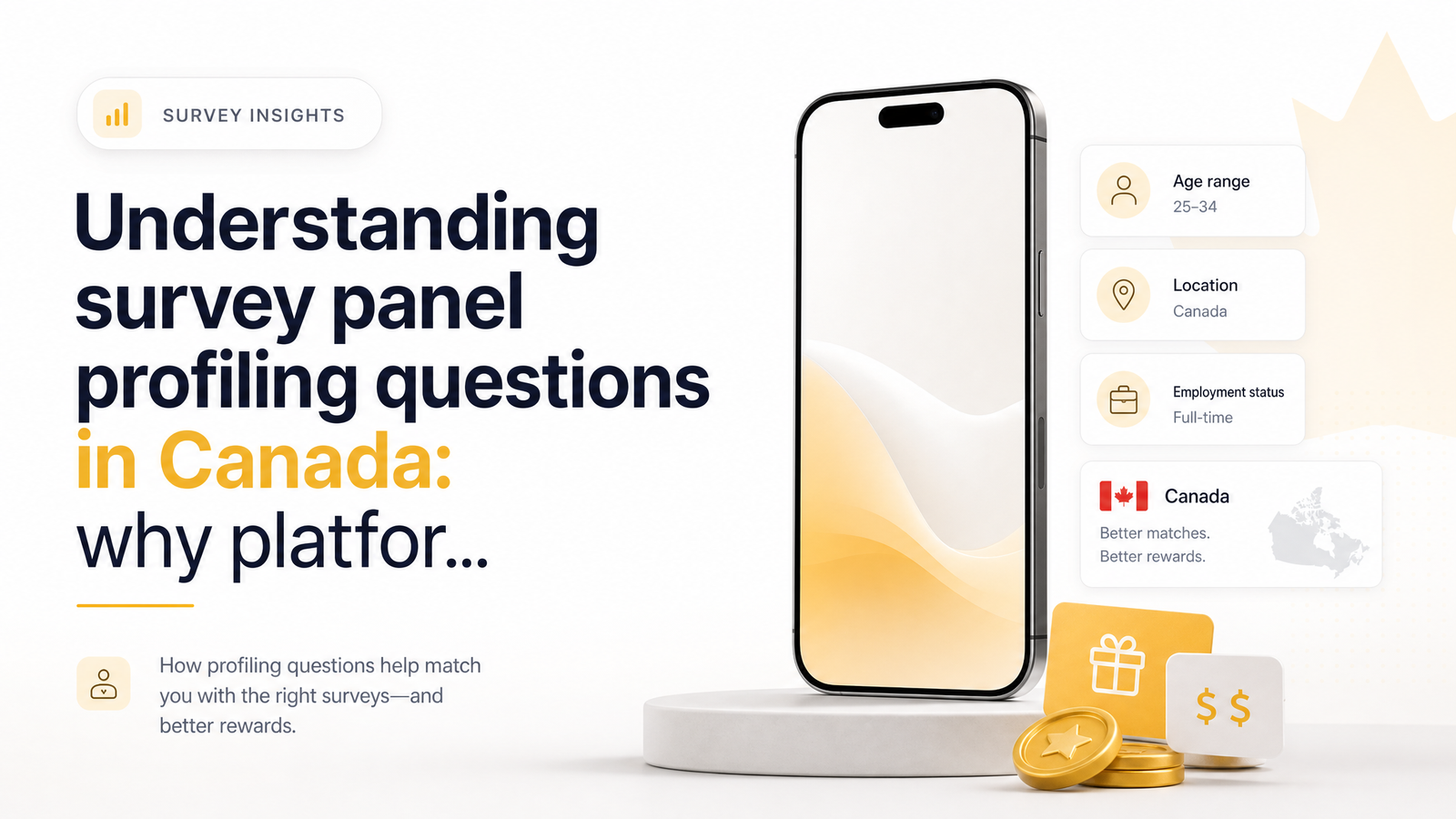
What Are Survey Profiling Questions, and Why Do They Feel So Personal?
Before a single paid survey shows up in your queue, most Canadian GPT platforms run you through profiling questions: household size, employment status, income bracket, lifestyle habits, and sometimes health conditions. These differ from the sign-up or ID verification step that confirms you're a real person eligible to get paid. Profiling questions aren't about proving who you are — they're about figuring out which paid opportunities you actually qualify for.
It's reasonable to feel uneasy the first time a platform asks how much you earn or whether you manage a chronic condition. But survey profiling questions in Canada exist for a specific, practical reason: they're the filtering mechanic that connects you to research studies designed for people exactly like you — less an interrogation, more a job application filter, where the more accurately your profile reflects reality, the better the matches that come back.
GPT profile questions in Canada typically fall into a few buckets: demographic (age, location, household), financial (income, employment), and health/lifestyle (conditions, habits, purchasing behaviour). Each category feeds a different kind of research demand, which is why income and health get separated out below.
Why Platforms Ask About Income
Market research firms and brands pay survey platforms to reach people in defined income brackets — a bank testing a new credit product wants one earning range, a luxury retailer wants a different segment, and a budgeting app wants feedback from people managing tighter finances. Income data is the routing mechanism that gets you into surveys actually built for someone like you, rather than ones you'll be screened out of partway through.
This is the core of why surveys ask about income: it's not curiosity, it's targeting. A survey matching algorithm in Canada uses your stated income, alongside other profile fields, to filter out studies you're ineligible for before you start one. Without that data point, the platform may send you into surveys where you get disqualified after five minutes of unpaid screening — the exact frustration covered in Online Survey Mistakes Costing Canadians Real Cash. Accurate income data reduces wasted screen-outs on both sides: yours and the researcher's.
Why Platforms Ask About Health
Health-related profiling questions tend to feel the most invasive, but they map to one of the highest-paying corners of market research. Medical and pharmaceutical companies, health insurers, and clinical research firms routinely commission surveys targeting people with specific conditions — diabetes, migraines, arthritis, sleep disorders — because that feedback is difficult and expensive to gather any other way. Panels that can supply verified respondents matching a niche health profile can charge premium rates, and a share of that premium flows back to you as a higher per-survey payout.
This is why surveys ask health questions: it's a legitimate, high-value research category, not idle nosiness. If you skip or falsify these fields, you're not avoiding scrutiny — you're removing yourself from consideration for some of the best-paying opportunities on the platform, including ones built around exactly your situation.
Is It Legal and Safe to Answer Honestly in Canada?
Canadian federal privacy law treats income and health information as sensitive categories requiring a higher standard of care than routine demographic data. Under the Personal Information Protection and Electronic Documents Act (PIPEDA), the Office of the Privacy Commissioner's interpretation bulletin on sensitive information explicitly names financial and health information as data that generally demands express consent, rather than the implied consent covering lower-sensitivity fields.
PIPEDA's Fair Information Principle 3 on consent spells out what that express consent should look like: clear disclosure of why data is collected, opt-in rather than pre-checked defaults, and no requirement to hand over more than necessary to receive a service you're otherwise entitled to. Applied here, a compliant platform should let you decline sensitive fields without losing account access, explain in plain language what the data is used for, and never bury consent inside unrelated terms.
When evaluating any GPT platform, that consent structure is what to look for — not just a privacy policy that exists, but one giving you a real choice at the point each sensitive question is asked.
Honest Answers vs. 'Optimized' Answers: What Actually Gets You More Matches
The instinct to "optimize" profile answers — nudging income up or down, checking a safer-seeming health box, skipping fields — usually comes from a reasonable but mistaken theory: that platforms reward a certain profile shape and punish others. In practice, the opposite tends to happen.
Picture two respondents. One reports actual household income and an actual health condition. The other guesses at a "middle" income to seem broadly eligible and leaves the health section blank. The first gets routed into fewer surveys, but a much higher share are ones they'll actually qualify to complete, including niche higher-paying studies tied to their specific income bracket or health profile. The second gets a broader stream of invitations but hits far more mid-survey screen-outs, because their stated profile doesn't match the deeper screening questions inside the survey itself — questions the platform can't see in advance.
This is the practical case for honest answers producing more matches, not fewer: accuracy reduces the mismatch between what a platform thinks you qualify for and what a study actually needs. Fudged answers don't unlock more opportunities — they just delay disqualification to a later, more time-wasting point. If screen-outs have been a recurring frustration, an inaccurate profile is one of the most common hidden causes — worth cross-checking against Online Survey Mistakes Costing Canadians Real Cash.
There's also a real cost to worrying that a low income or a disclosed health condition will get you excluded outright. Both are targeting criteria specific studies are built around — a lower-income household is exactly who a budgeting-app study wants; a specific condition is exactly who a pharmaceutical panel needs. Exclusion happens far more often from mismatched or contradictory answers than from any particular income level or health status. For how profile accuracy connects to real earnings over time, How Much Can You Earn Taking Surveys in Canada? lays out what consistent, well-matched participation looks like.
Profiling vs. Verification: Two Different Kinds of Trust
Profiling questions and account verification solve two unrelated problems, though it's easy to lump them together as "the platform checking me out." Profiling data — income, health, household, lifestyle — exists to match you with relevant surveys. It doesn't confirm your identity and isn't used to approve payouts.
GPT account verification in Canada is separate: confirming you're a real, unique individual and that the payout destination (Interac, PayPal, or a gift card) is legitimately yours, protecting both you and the platform from fraud. Verification typically involves confirming an email, sometimes an ID check, and payout account details — it has nothing to do with which surveys you're offered, which is the job of your profile.
Keeping these two categories separate clears up a common source of suspicion: a platform asking for income data isn't performing the same "trust check" as asking for ID at payout time. One decides what you see; the other decides that you get paid securely for what you complete.
How to Keep Your Profile Accurate Over Time
A profile filled out honestly once still goes stale. Income changes with a new job or a raise, employment status shifts, household composition changes when someone moves in or out, and health circumstances evolve. None of that updates itself.
- Revisit income and employment fields whenever either changes materially — even a bracket shift can move you into or out of relevant studies.
- Update household details (dependents, marital status, homeownership) as they change; these feed a surprising number of consumer research categories.
- Check health and lifestyle sections periodically rather than assuming a one-time answer still applies months or years later.
- Treat an outdated profile as a direct cause of lower-quality matches, not a neutral, "set it and forget it" formality.
Making a habit of updating your survey profile in Canada, rather than treating it as a one-time signup task, keeps the matching engine working with current information — the only information it can actually act on.
Frequently Asked Questions
Why does CashSprint ask for my income if I'm just trying to take surveys?
Income is the primary filter market research studies use to target respondents, since brands pay specifically to reach defined income brackets. Sharing yours routes you toward surveys you're actually eligible for and away from ones that would screen you out partway through.
Are health questions on survey platforms actually used by real medical researchers?
Yes — pharmaceutical companies, health insurers, and clinical research firms commission niche studies targeting specific conditions, often at premium rates. Health profiling questions connect qualified respondents to that legitimate, higher-value research category.
Can I skip a profiling question if I don't want to answer it?
Generally yes, and a privacy-compliant platform should let you. Under PIPEDA, sensitive categories like income and health require express, opt-in consent, meaning you shouldn't be forced to disclose them just to keep using the platform, though skipping may reduce which surveys you qualify for.
Will answering honestly about a low income mean I get fewer survey offers?
Not typically — a lower income bracket is exactly the target demographic for many studies, from budgeting tools to value-focused retail research. Fewer, better-matched offers based on accurate data usually outperform a broader stream of offers you'll end up screened out of.
Is my income or health data sold to third parties in Canada?
Under PIPEDA, sensitive information like income and health data requires express consent for its stated purpose, and a compliant platform should disclose exactly how that data is used, not silently resell it. Always check a platform's privacy policy for how sensitive data is handled before assuming otherwise.
What's the difference between profiling questions and the ID verification CashSprint requires?
Profiling questions determine which surveys and offers you're matched to; ID and payout verification confirms you're a real, unique person and that your Interac, PayPal, or gift card destination is legitimately yours. One shapes your opportunities, the other protects your payout.
Your profile is the fastest lever you actually control over how much you earn on Cashsprint — more than any single survey or offer. Fill it in honestly, update it as your circumstances change, and pair that with the strategies in How Much Can You Earn Taking Surveys in Canada? and Online Survey Mistakes Costing Canadians Real Cash to turn better matches into real, consistent payouts.