
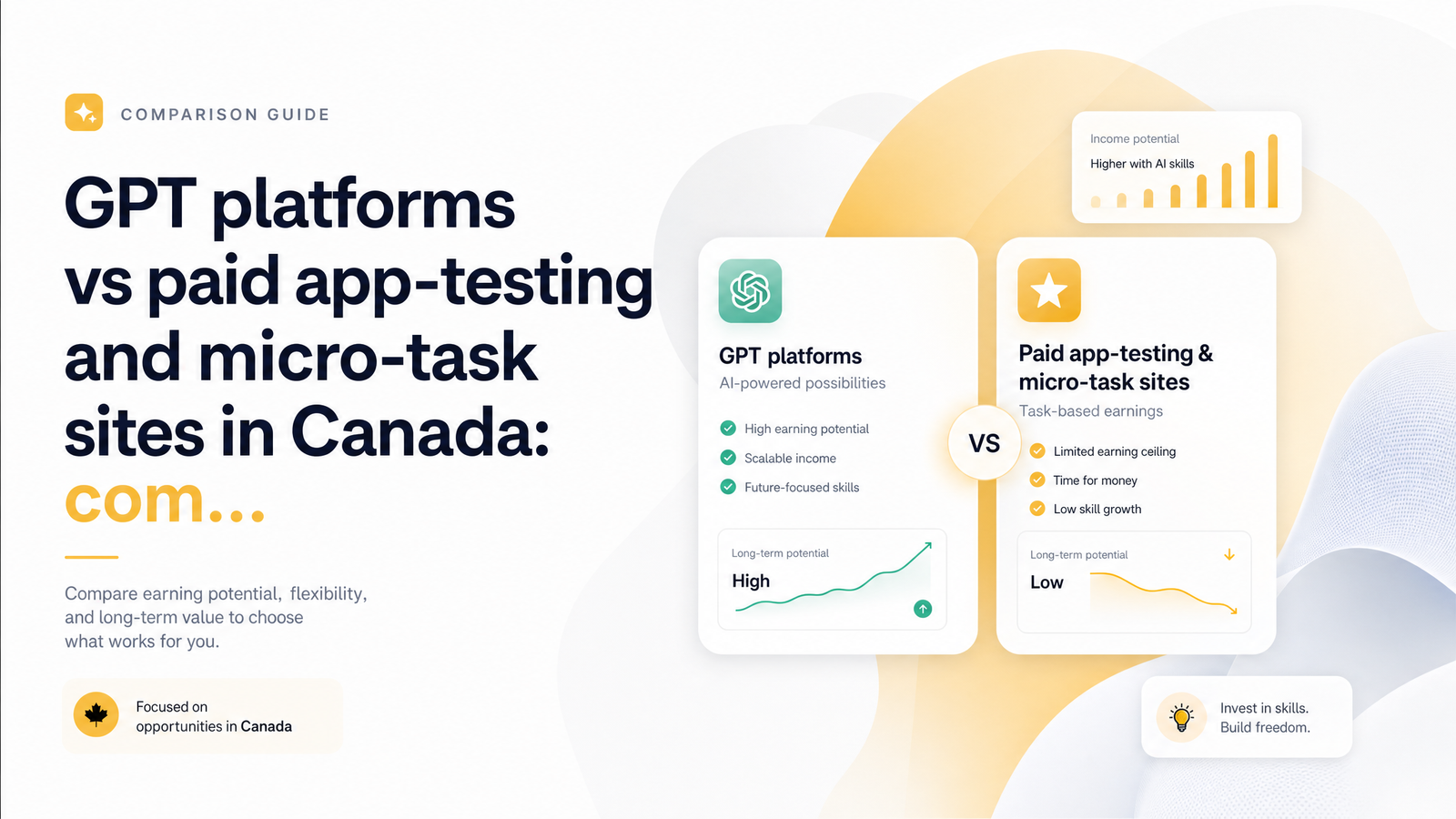
GPT Sites vs Paid App Testing: Two Different Games
The paid app testing vs GPT sites Canada question comes up constantly, but it's rarely framed correctly. Most comparisons pit one GPT platform against another, or stack surveys against cashback apps. That misses the more useful comparison: a GPT platform like CashSprint runs on a completely different business model than an app testing marketplace like UserTesting, uTest, Userfeel, or Testbirds.
A GPT (get-paid-to) marketplace is always-on. You log in and there's a stream of surveys, offers, games, and cashback opportunities waiting — no application, no audition. An app testing marketplace works more like freelance gig work: you apply, sit through a qualification screener, and only get paid tasks when a client's project needs someone matching your profile. Both can put real money in your Interac or PayPal account, but they demand different amounts of patience, skill, and tolerance for rejection. The rest of this guide breaks down how they compare, so you can decide how to split your time — or whether to run both at once.
How Paid App-Testing Sites Actually Work
UserTesting Canada access works the same way it does everywhere else: create a profile, answer demographic and device questions, then wait to be matched to studies. Before any paid task, though, you typically face a screener — a short set of qualifying questions (sometimes with a practice recording) designed to filter for the age group, device type, shopping habit, or profession a client is targeting. Fail the screener and you don't get the paid task. This is the single biggest structural difference from GPT platforms, where nearly every visitor qualifies for something.
Once through, most UserTesting-style work involves recording your screen and voice while narrating your experience navigating a website or app — an unmoderated test. Some platforms, including uTest (owned by Applause), lean more toward bug bounty testing, paying per verified bug rather than a flat fee per session. Userfeel and Testbirds follow similar patterns: apply, get screened, wait for an invite, then complete a recorded or written task. Trymata and Userlytics round out the category with comparable screener-then-task structures. The upshot is that an app testing marketplace rewards people who can pass screeners repeatedly and communicate clearly on camera — a narrower skill set than simply answering surveys or clicking offers on a GPT platform.
Pay Rates Head-to-Head: Per-Task Earnings Compared
Numbers make the business-model difference concrete. According to UserTesting's own compensation disclosures, a standard unmoderated test pays around $10 for about 20 minutes, a figure also confirmed as the widely cited benchmark by Software Testing Help's review. Longer or live moderated sessions can pay more — $30 to $120 for extended studies isn't unusual, but those invites are rare and go to a small slice of the tester pool. Userfeel's pay runs roughly $3 to $30 depending on task length and complexity, per Swift Salary's testing-platform roundup, while Testbirds' bug bounty payouts vary widely because you're paid per accepted bug rather than per session — a session with no bugs found can pay nothing.
UserTesting pay per test looks attractive on paper — $10 for 20 minutes works out to roughly $30/hour if invites keep coming. But they don't. Once you factor in time spent applying, waiting, and getting rejected by screeners, the app testing hourly rate Canada testers actually realize is often far lower than the headline per-task number suggests.
GPT survey pay Canada rates look modest by comparison on a per-task basis — a typical survey might pay a dollar or two for ten to fifteen minutes, with offers and cashback adding variable bonus income. But because a GPT platform has no screener bottleneck, you can work through survey after survey, offer after offer, all day. Our breakdown of survey earning potential shows how that steady, lower-per-task volume adds up with consistent daily use — often producing a more predictable hourly return than app testing's occasional high-value session.
Payout Speed and Methods: Interac vs PayPal vs Gift Cards
Getting matched to a task is only half the equation — getting paid is the other. UserTesting payment via PayPal typically takes about seven to fourteen days after a test is approved. Userfeel pays weekly, faster but still on a fixed schedule. Testbirds and uTest follow broadly similar PayPal-based cycles tied to approval and invoicing.
GPT payout Interac Canada options work differently because the marketplace controls the entire loop — no third-party client approval is needed before your reward is confirmed. CashSprint offers Interac e-Transfer, PayPal, and gift card cashouts, with speed depending on method and threshold. Our payout options ranked by speed walks through the timelines for each rather than repeating them here — but the short version is that GPT payouts tend to be faster and more flexible, since Canadians can choose Interac for near-instant transfers instead of waiting on a fixed weekly or biweekly PayPal cycle.
Availability and Consistency: Which One Actually Has Work for You Today
This is where the app testing availability Canada question really bites. Because app-testing platforms only release tasks when a client commissions a study, and each study targets a narrow demographic or device profile, Canadian testers commonly report screener disqualification rates of 50-70% — more than half of the screeners you attempt will reject you before you ever see a paid task. Combine that with unpredictable invite timing, and it's common to go several days without a single qualifying opportunity.
GPT sites daily tasks work the opposite way. A rewards marketplace aggregates dozens of survey providers, offer walls, game partners, and cashback merchants simultaneously, so there's essentially always something available, even if the per-task payout is smaller. If you want income you can rely on daily, a GPT platform structurally has the edge. If you're comfortable with feast-or-famine timing for a shot at bigger per-task payouts, app testing has a place — just not as your primary income stream.
Which Should You Choose — Or Should You Do Both?
Neither category makes the other obsolete — they solve different problems. App testing suits someone with reliable recording equipment, decent verbal communication, and patience for rejection, who wants occasional shots at $10-$120 per session. GPT platforms suit someone who wants a steady, low-friction way to earn in the background every day, with no audition required.
The smartest approach for most Canadians is to stack GPT and app testing income rather than choosing one exclusively. Use a GPT platform as your reliable base — logging in daily for surveys, offers, and games that don't require qualifying — and treat app testing as opportunistic bonus income you check into when you have a spare 20 minutes and feel like gambling a little time on a screener. There's no rule preventing you from running a CashSprint account and a UserTesting or uTest profile side by side; they're unrelated services with no exclusivity requirements. In a CashSprint vs UserTesting framing, think of it less as either/or and more as "steady floor" versus "occasional ceiling."
For a broader view of how these categories fit alongside other earning methods — cashback apps, gig work, and flexible side jobs — our effort-based side hustle guide for 2026 maps out where each option sits on the time-versus-payout spectrum. And if you're weighing GPT platforms against each other rather than against app testing, our honest comparison of CashSprint and other survey sites and our surveys-vs-cashback-apps breakdown fill in the rest.
Frequently Asked Questions
Is UserTesting actually available to people in Canada?
Yes, UserTesting accepts Canadian applicants, and Canada-specific roundups like Finder's user-testing guide confirm the platform along with alternatives such as Trymata as viable options. Availability of actual paid tasks still depends on passing screeners for studies matching your demographic and device profile, so signing up doesn't guarantee steady work.
Which pays more per hour: app testing or GPT survey/offer sites?
App testing has a higher per-task ceiling — around $10 for a 20-minute UserTesting session versus a dollar or two for a typical GPT survey. But GPT sites have no screener bottleneck, so their consistent volume often produces a more reliable realized hourly rate once you account for time spent applying and getting rejected by screeners.
Do I need special skills or equipment to start app testing?
Yes — most app-testing platforms require a working microphone, screen-recording capability, and comfort narrating your thoughts clearly on camera or audio. GPT platforms require none of that; you just need a browser or phone to answer surveys and complete offers.
Can I use CashSprint and UserTesting at the same time without violating either platform's rules?
Yes, there's no exclusivity clause on either type of platform, and Canadians commonly run a GPT account alongside one or more app-testing profiles. Using CashSprint as a daily base and app-testing sites as occasional bonus income is a practical way to stack both without conflict.
Why do app-testing sites reject so many applicants for each test?
Because each study is commissioned by a specific client targeting a narrow demographic, device type, or behavior profile, screener disqualification rates commonly run 50-70% among Canadian applicants. The screener exists to filter out anyone who doesn't match that client's exact research criteria, not to judge your ability.
Which is faster to get paid: a GPT site like CashSprint or an app-testing platform like UserTesting?
GPT sites are generally faster, since CashSprint controls its own payout loop and offers Interac e-Transfer alongside PayPal and gift cards. UserTesting's own compensation policy states payments process in roughly 14 days via PayPal, tied to approval timing rather than on-demand cashout.
Ready to start earning without waiting on a screener? Cashsprint gives you daily access to surveys, offers, games, and cashback with no qualification test standing between you and your first payout — read the evidence-based legitimacy review if you want the receipts first, then layer app-testing platforms on top once you're ready to chase higher per-task ceilings.