
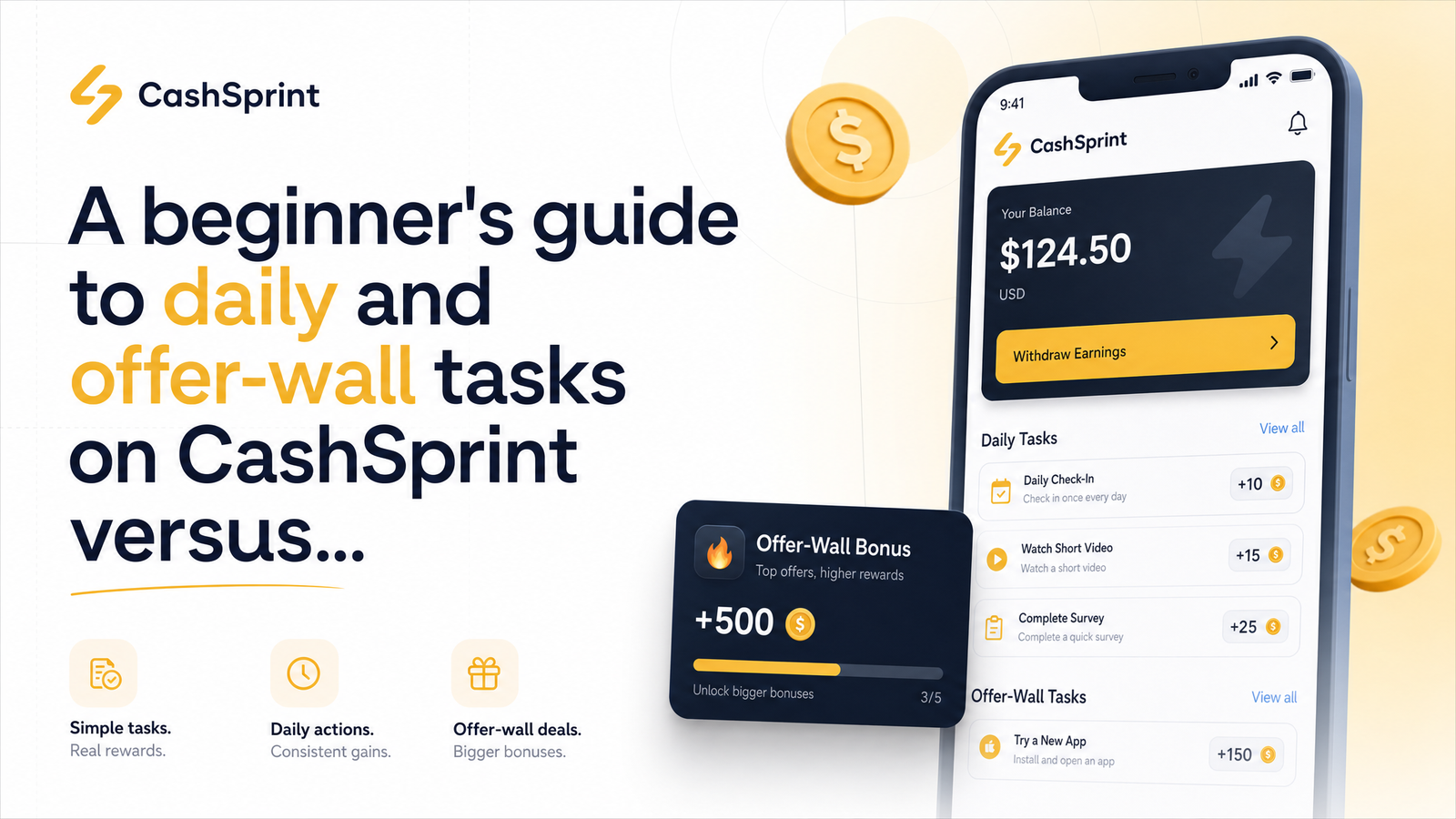
Every session on a GPT site starts with the same fork: tackle the offer wall or knock out a survey. The honest answer to offer wall vs surveys Canada isn't "one is better" — each wins under different conditions, and knowing which applies to your next 20 minutes matters more than any generic earnings estimate.
This guide skips vague "earn up to $X" language and gives you a formula, worked examples, and a weekly mix so you can decide, session by session, where your time actually pays best.
Offer Walls vs Surveys: The Core Difference
An offer wall on CashSprint is a curated list of third-party actions — install an app and reach level 5, sign up for a free trial, create a retailer account, sometimes make a small qualifying purchase. You complete the action, the advertiser confirms it, and CashSprint credits your account. These are the GPT daily tasks Canada users see most often, since new offers rotate constantly and many pay flat, guaranteed amounts once the requirement is met.
A survey is different: you answer a screening question, then — if you qualify — move through a full questionnaire, usually 10 to 20 minutes, on topics like shopping habits, health, or opinions on products. Surveys typically arrive through a survey router, which tries to match you to whichever study fits your demographic profile at that moment.
The practical distinction beginners need: offer wall tasks explained simply are "do a specific thing once, get a fixed payout," while surveys are "answer questions for a variable payout, with a real chance of earning nothing if you're screened out partway through." That risk profile is why the hourly comparison matters more than the sticker price on either task.
How to Actually Calculate Your Hourly Rate
Advertised payouts are close to meaningless alone because they ignore time spent on tasks that produce zero payout. The fix is a simple formula:
Real hourly rate = total payout ÷ total time spent (including screen-outs, setup, and app downloads)
Worked example, surveys: You attempt four surveys in a session. Two screen you out after 3 minutes each (6 minutes, $0). One pays $1.20 for 15 minutes. One pays $2.00 for 18 minutes. Total time: 39 minutes. Total payout: $3.20. Real hourly rate: about $4.92/hour — well below the sticker rate either completed survey implied alone. This gap is explored further in How Much Can You Earn Taking Surveys in Canada?
Worked example, offer wall: You install an app and complete a tutorial level for a $3.50 payout, taking 12 minutes including download and setup. You then sign up for a free trial offer worth $6.00, taking 8 minutes of form-filling (the trial runs in the background, needing no further active time). Active time: 20 minutes. Total payout: $9.50. Real hourly rate: roughly $28.50/hour on active time.
That gap looks dramatic, but it only holds under specific conditions — unpacked in the next two sections. This paid surveys hourly rate Canada math and the offer-wall math above are both real, both common, and both misleading if you assume they apply every session.
Offer Walls: When They Win on Pay
Offer walls tend to beat surveys on real hourly pay when there's no screen-out risk — once you meet the stated requirement, payout is close to guaranteed, unlike a survey where you can be screened out after most of the time is already spent. Short, well-defined app trials are usually the best GPT tasks for beginners since active work is minimal: download, open, reach a specified level or day, done.
The trade-offs are real, and they're why offer wall Canada earners need to read the fine print first:
- Spending requirements. Some higher-paying offers require an in-app purchase or paid subscription trial. Forget to cancel before it converts, and the "profit" evaporates.
- App storage and clutter. Install-based offers eat phone storage, and juggling five active trials at once gets confusing fast.
- Longer commitment offers. Some pay well but require reaching a level over several days, stretching time-to-payout even if the hourly math looks good on paper.
The offers that win cleanly are short, no-spend, no-subscription tasks — reach a specific screen, verify an email, complete a short setup — where the total time investment is under 15 minutes and payout doesn't depend on ongoing behaviour.
Surveys: When They Win on Pay
Surveys pull ahead in different situations. First, with short, unpredictable free time — five minutes in a waiting room, a break between classes — a quick pre-screener costs almost nothing if you're screened out, and if you qualify for a short study, you're paid without installing anything or spending a cent.
Second, surveys are the safer bet if you don't want financial exposure: no trial to forget to cancel, no subscription that silently renews, no purchase requirement. Which pays more, surveys or offer walls, often comes down to risk tolerance as much as raw math: surveys cap your downside at wasted time, while some offer-wall tasks cap it at wasted time plus wasted money if you're not careful.
Third, survey volume tends to be more predictable day-to-day than offer wall inventory, which can dry up in certain categories. For steady, incremental progress toward a payout goal, paid surveys Canada tasks provide a more consistent drip, even if the average per-survey payout is modest.
The core drawback remains screen-out rate — the single biggest variable separating a good survey session from a frustrating one. Online Survey Mistakes Costing Canadians Real Cash covers the specific habits that make screen-outs more frequent than they need to be.
A Beginner's Weekly Mix That Works
Rather than picking a side permanently, treat offer walls and surveys as two tools for two different time windows.
Short windows (5-10 minutes), several times a day: Attempt one survey pre-screener. If you screen out, the loss is small; if you qualify, you bank a payout without leaving the survey tab. This is the lowest-friction way to chip away at a payout threshold between other tasks.
Longer windows (20-30 minutes), a few times a week: Work the offer wall. Scan for short, no-spend, no-subscription tasks first — app installs with a simple level requirement, free account sign-ups, email verifications. Save higher-payout trial offers for times you can actually track and cancel them if needed.
Weekly rhythm: Aim for roughly 4-5 short survey attempts spread across the week alongside 2-3 offer wall sessions. This blend tends to reach an Interac e-Transfer, PayPal, or gift card payout threshold faster than relying on either task type alone — quick guaranteed wins from the offer wall, with surveys filling the gaps during time you'd otherwise waste.
Whichever mix you settle on, check CashSprint's payout thresholds before starting a session so you know how close a task gets you to your next cash-out, and pick your redemption method — Interac e-Transfer for speed, PayPal for flexibility, or a gift card if you're shopping somewhere specific — ahead of time. For a broader view of how this task-mix approach compares to using CashSprint as a whole platform, see Cashsprint vs Survey Sites: The Honest Canadian Comparison, and if cashback is also on your radar, Survey Sites vs Cashback Apps: Which Pays More in Canada? rounds out the comparison with a third earning method worth layering in.
This blended approach is the practical core of any CashSprint offer wall guide worth following: match task type to time window, track actual hourly rate rather than advertised payout, and let both tools work toward the same cash-out goal instead of treating them as competitors.
Frequently Asked Questions
Is it faster to earn money on CashSprint through the offer wall or through surveys?
Offer walls usually deliver a faster path to a fixed payout when there's no screen-out risk, since you know the exact reward before starting. Surveys can be faster in short, unpredictable time windows because a quick pre-screener costs almost nothing if you don't qualify. The fastest overall progress comes from combining both rather than relying on just one.
Do offer wall tasks pay real cash or just points on CashSprint?
Offer wall tasks pay real cash-equivalent value, redeemable through Interac e-Transfer, PayPal, or gift cards once you hit the applicable payout threshold. The payout is typically fixed and disclosed upfront, so you know the reward before starting. Confirm the requirement (level reached, trial signed up, account created) before beginning so it counts.
Why do some surveys pay $0 even after 10 minutes of questions?
Surveys pay $0 when you're screened out partway through — a common outcome when your demographic profile or answers no longer match what the study needs. Survey routers try to match you to studies in real time, and initial screening questions don't always catch every disqualifying factor immediately. It's a structural risk of survey-based earning, not a sign you did anything wrong.
Can I do both offer walls and surveys in the same session on CashSprint?
Yes, and alternating between them is a practical strategy rather than a limitation. Many beginners start with a quick survey attempt, then move to an offer wall task if screened out, keeping the session productive either way. This mix also helps balance guaranteed offer-wall payouts against the variable but frequent flow of survey opportunities.
Which offer wall tasks are the best hourly rate for beginners?
Short, no-spend, no-subscription tasks — simple app installs with a low level requirement, free account sign-ups, and email verifications — tend to give beginners the best hourly rate. These avoid the time drag of longer trial commitments and the financial risk of forgotten subscription renewals. Scan the offer wall for the shortest clearly defined requirements first before considering higher-payout but longer offers.
How much can a Canadian realistically earn per hour combining both task types?
Realistic hourly earnings vary widely depending on screen-out luck and which offers are available that day, which is why tracking your own real hourly rate matters more than any advertised figure. Blending a few short surveys with occasional no-spend offer wall tasks tends to produce steadier results than relying on either task type alone. Tracking your own sessions over a couple of weeks gives a far more reliable personal number than any platform-wide average.
Ready to see your own numbers instead of estimates? Log into Cashsprint and run the beginner's first session — one offer-wall task plus one short survey — then divide your total payout by total time spent to get your real hourly rate. Track a few sessions in a simple spreadsheet and you'll know within a week which task type deserves more of your time.