
What Trial and Subscription Offers Are (and Why They Pay So Much)
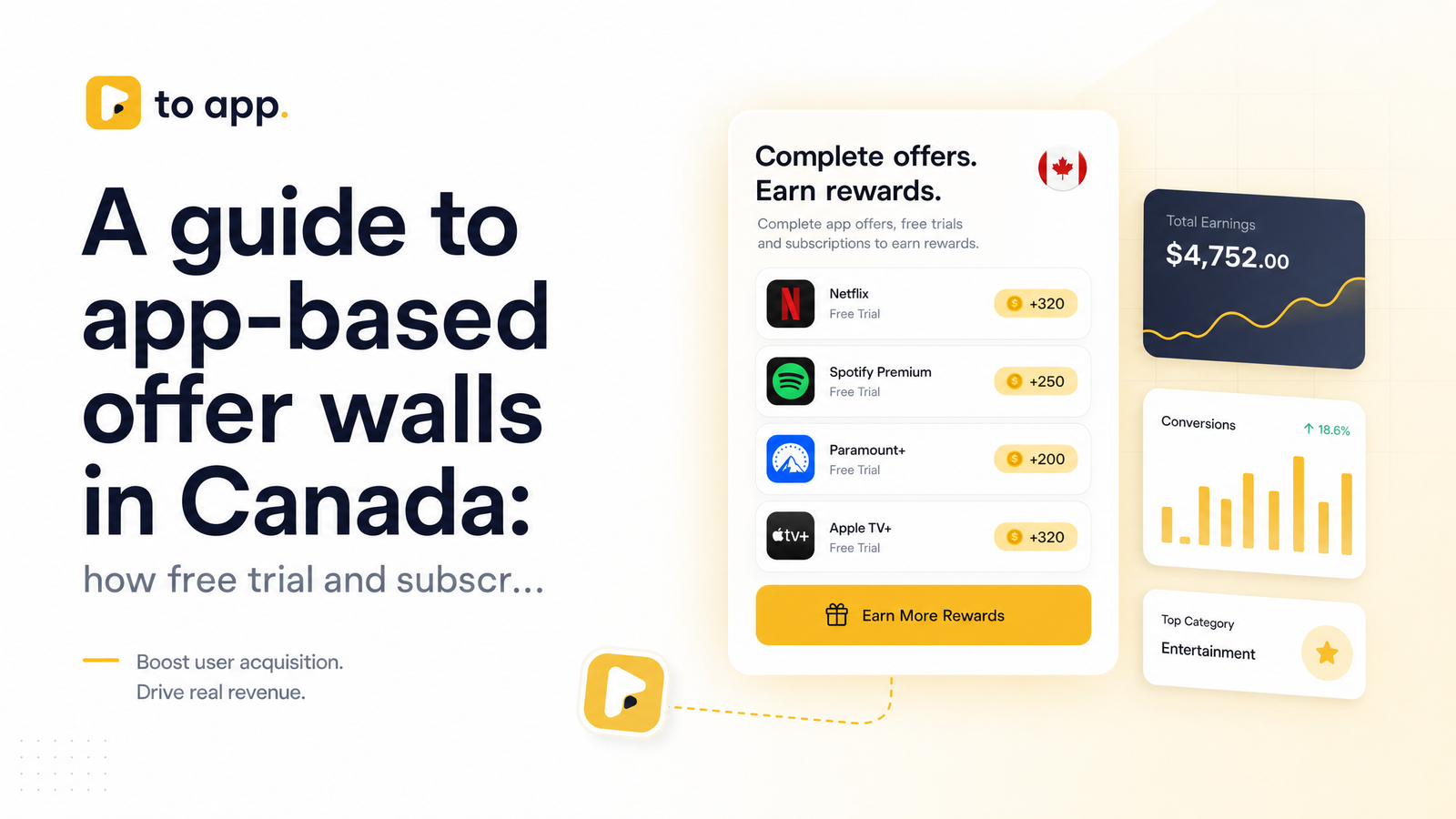
Scroll through any offer wall trial offers Canada users encounter, and one thing jumps out: the payouts dwarf what you get for a ten-minute survey. A streaming trial or subscription box signup might pay several dollars, while a survey pays cents. That's not a glitch — it reflects a real cost the advertiser is paying.
Install and survey offers pay for a simple action: opening an app, answering questions, reaching a game level. Subscription offers on a subscription offer wall are different. The advertiser — a streaming service, meal-kit company, software vendor — is paying for a customer who hands over billing details and (they hope) forgets to cancel, converting into a paying subscriber. That's far more valuable than an app install, so the cost-per-action (CPA) they're willing to pay the network — and by extension the offer wall — is much higher.
This is why GPT app free trial offers sit at the top of most earnings pages. They're a genuine slice of an advertiser's customer-acquisition budget, routed through a network and a wallet instead of a TV ad. Understanding that economic logic matters, because it explains why these offers take longer to confirm, why they're pickier about qualifying you, and why the terms deserve more attention than a five-question poll.
How Crediting Actually Works Behind the Scenes
Picture a four-link chain: advertiser, network, offer wall, your wallet. You complete a trial signup on the advertiser's site. The advertiser's tracking system logs the conversion and reports it to the offer network (infrastructure companies like Tapjoy, Fyber, or AdGem-style networks run). The network then sends a postback — a small server-to-server notification — to the offer wall app, confirming the action happened and should be paid.
A postback is simply an automated message saying "this user, this offer, this outcome, confirmed." Its timing explains delayed crediting. An app install can postback in minutes because the action is binary and instantly verifiable. A trial subscription can't confirm that fast, because the advertiser often waits to see if you complete additional funnel steps — verifying an email, entering payment details, sometimes staying subscribed past a short window — before firing the postback. Some advertisers also run a "scrub" pass, auditing conversions for fraud before finalizing payment. If your click gets caught in that scrub, cash sprint trial offer tracking can show a completed action on the advertiser's end that still won't clear onto the offer wall.
This is the crux of why "completing" an offer in the advertiser's app and it "crediting" on the wall are two separate events. You've done your part once you finish the signup flow, but your reward only lands after the postback travels the entire chain — a pipeline entirely outside CashSprint's control, since it lives with the advertiser and network. For a deeper technical breakdown of the SDK and postback mechanics, the Coinis guide to offer walls is a useful reference on how rewarded offer walls are architected in 2026.
Why a Completed Trial Sometimes Doesn't Credit
Most "I did the offer and got nothing" tickets trace back to a handful of repeat causes, not a broken system:
- Ad blockers or privacy extensions strip out the tracking pixel or script that fires the click, so the advertiser never sees you arrive from the offer wall.
- VPNs and proxies change your apparent location or IP mid-session, which can break session tracking or trigger fraud filters that quietly scrub the conversion.
- Wrong click path — closing the offer wall's browser tab and reopening the advertiser's site manually, or switching from mobile browser to app halfway through, breaks the referral chain the network relies on.
- Incomplete funnel steps — many trial offers require more than starting a subscription: confirming an email, completing an onboarding survey, or reaching a specific in-trial milestone. Skipping any required step means the postback for full completion never fires.
- Delayed postbacks — as covered above, subscription offers often have built-in holding periods before the network confirms the action, which is normal and not a sign of an offer wall not crediting properly.
Before assuming you were shorted, retrace your steps: did you click through the offer wall itself rather than search for the advertiser separately, did you disable ad blockers, and did you complete every requirement listed in the offer's terms? Most legitimate trial offer scrub cash sprint cases resolve once the postback catches up — which can take days, not minutes, for subscription products specifically.
The Pre-Signup Checklist: What to Check Before You Start a Trial Offer
Free trial offers on GPT sites are worth taking seriously in both directions — as income and as a billing risk. A short checklist before you click "start trial" saves far more hassle than any dispute afterward:
- Screenshot the terms page before entering any payment details, including the trial length and the price you'll be charged if you don't cancel.
- Note the exact trial-end date, not just "in two weeks" — write down the calendar date and set a reminder two to three days earlier, not on the deadline itself.
- Find the cancellation method before you sign up. Search "[company name] cancel subscription" and confirm whether it's a self-serve toggle, an email request, or a phone call — some companies deliberately make phone cancellation the only option to create friction.
- Use a card you actually monitor, ideally one with transaction alerts turned on, so an unexpected charge shows up the moment it posts rather than a month later.
This due diligence is the practical companion to any offer wall trial offers Canada readers pursue for income — the reward is real, but so is the obligation you're agreeing to if you don't act.
What to Cancel — and When — Before You Get Charged
Cancel free trial before charged Canada searches spike for a reason: missing the window is common, and it's rarely because people are careless — it's because the cancellation flow is designed to be hard to find. Follow this sequence:
- Set two reminders, not one — three days before the trial ends and again on the actual deadline.
- Cancel through the account dashboard first. Most legitimate services have a self-serve cancel button under billing or subscription settings.
- Get written confirmation. Screenshot the cancellation confirmation screen or save the confirmation email. This is your evidence if a charge appears anyway.
- Check your bank or credit card statement within a few days of the trial-end date to confirm no charge posted.
If a company makes cancellation deliberately obstructive — hiding the option, requiring a call during limited hours, or ignoring cancellation requests — that crosses into what Canadian regulators call negative option billing: charging a consumer who didn't affirmatively agree to continue paying. The Competition Bureau of Canada has published clear guidance on how these subscription traps work and where to report them. If you've been charged despite a documented cancellation attempt, you also have the option of a credit card chargeback — banks generally require proof you tried to cancel, which is exactly why the screenshots and confirmation emails from step three matter.
Spotting a Legitimate Trial Offer vs. a Scam
A genuine high-payout trial offer and a fake one dressed up to look like it can seem identical at a glance, but a few checks separate them reliably:
- Recognizable advertiser. Legitimate offers link to a real, named company's actual billing page — not a generic third-party checkout with no brand identity.
- Terms are visible before payment. If you can't find the trial length or post-trial price anywhere before entering card details, that's a red flag, not an oversight.
- The offer wall discloses payout timing. A platform that's upfront about scrub windows and postback delays is being straightforward about how the pipeline works, rather than promising instant credit it can't guarantee.
- No request for unrelated sensitive information. A trial signup needs standard billing details, not your SIN or banking login credentials.
CashSprint vets the advertisers and networks feeding its offer wall specifically to filter out the second category, but no offer wall can eliminate every risk in an advertiser's own funnel — vigilance on your end is still the best filter. If you're still weighing whether the platform itself is trustworthy, Is Cashsprint Legit? A Skeptic's Evidence-Based Review walks through the evidence in detail.
Frequently Asked Questions
Why hasn't my free trial offer credited on the offer wall yet?
Subscription offers typically take longer than app installs or surveys because the advertiser waits for you to complete every funnel step, then runs a fraud/scrub check before sending the postback that confirms your reward. Delays of several days are normal for trial offers specifically, unlike instant-tracking install offers. If it's been longer than the offer's stated crediting window, that's the point to contact support with proof of completion.
Is it safe to give my credit card for a free trial offer on a GPT site in Canada?
It can be safe if you treat it like any other subscription signup: confirm the trial length and post-trial price before entering payment details, and use a card with transaction alerts. The risk isn't the offer wall — it's the advertiser's billing terms, so the same due diligence you'd apply to any free trial elsewhere applies here too.
What happens if I forget to cancel a trial offer before the deadline?
You'll be charged the full subscription price the advertiser disclosed in the trial terms, and you'll typically need to cancel afterward to stop future charges. If you catch it quickly, contacting the company for a refund or disputing the charge with your bank is often still possible, especially within the first billing cycle.
Do offer wall trial offers show up faster than survey rewards?
No, generally the opposite — survey rewards tend to confirm faster because the completion is verified instantly, while trial offers involve advertiser-side verification and postback delays that can take days. This is a structural difference in how each offer type is tracked, not a sign that trial offers are less reliable.
Can I dispute a charge if a company makes it hard to cancel a free trial in Canada?
Yes — if a company obstructs cancellation, that can qualify as negative option billing, which the Competition Bureau of Canada actively addresses. You can pursue a credit card chargeback with documentation of your cancellation attempt, and you can report the company to the Competition Bureau directly.
Why do some trial offers pay more than others on the same offer wall?
Payout size reflects what the advertiser is willing to pay to acquire a subscriber, which varies by industry, subscription price, and how competitive that advertiser's acquisition costs are. A higher-priced subscription service can afford a bigger CPA payout than a low-cost one, and that difference flows straight through to what you see on the offer wall.
Ready to put this into practice? Browse Cashsprint's offer wall for trial offers with clearly disclosed terms, log each completion against your own tracking spreadsheet, and if a legitimate trial completion still hasn't credited after its stated window, reach out through CashSprint's support flow with your proof of completion. Once those trial earnings land in your balance, check Cashsprint's Payout Options Ranked by Speed to decide whether Interac e-Transfer, PayPal, or a gift card gets your cash to you fastest.