
Ask most "best GPT sites" articles about payout minimums and you'll get a footnote buried under a list of survey categories. That's backwards. For anyone earning through get-paid-to platforms in Canada, the minimum payout threshold GPT Canada sites impose is often the single biggest factor determining whether you see real cash this month or three months from now.
A $5 minimum and a $30 minimum aren't a small difference — they represent completely different waiting games. This article puts the threshold front and centre, compares it across major platforms operating in Canada, explains why these numbers exist at all, and shows how CashSprint's lower bar changes the math for everyday earners.
Why the Minimum Payout Threshold Matters More Than the Rewards Rate
Every GPT platform advertises its earning potential — cents per survey, cashback percentages, bonus offers. Almost none lead with the number that actually controls your access to that money: the balance you need to hit before you're allowed to withdraw anything.
Two users earning identical amounts per week can have wildly different experiences. One cashes out every Friday. The other watches a growing balance sit untouched for weeks because it hasn't crossed the platform's line. The rewards rate determines how fast your balance grows; the payout threshold determines how long you wait before that growth becomes spendable money. For casual users — students topping up a chequing account, parents earning grocery money, anyone doing a survey or two between other tasks — the threshold is often the more consequential number.
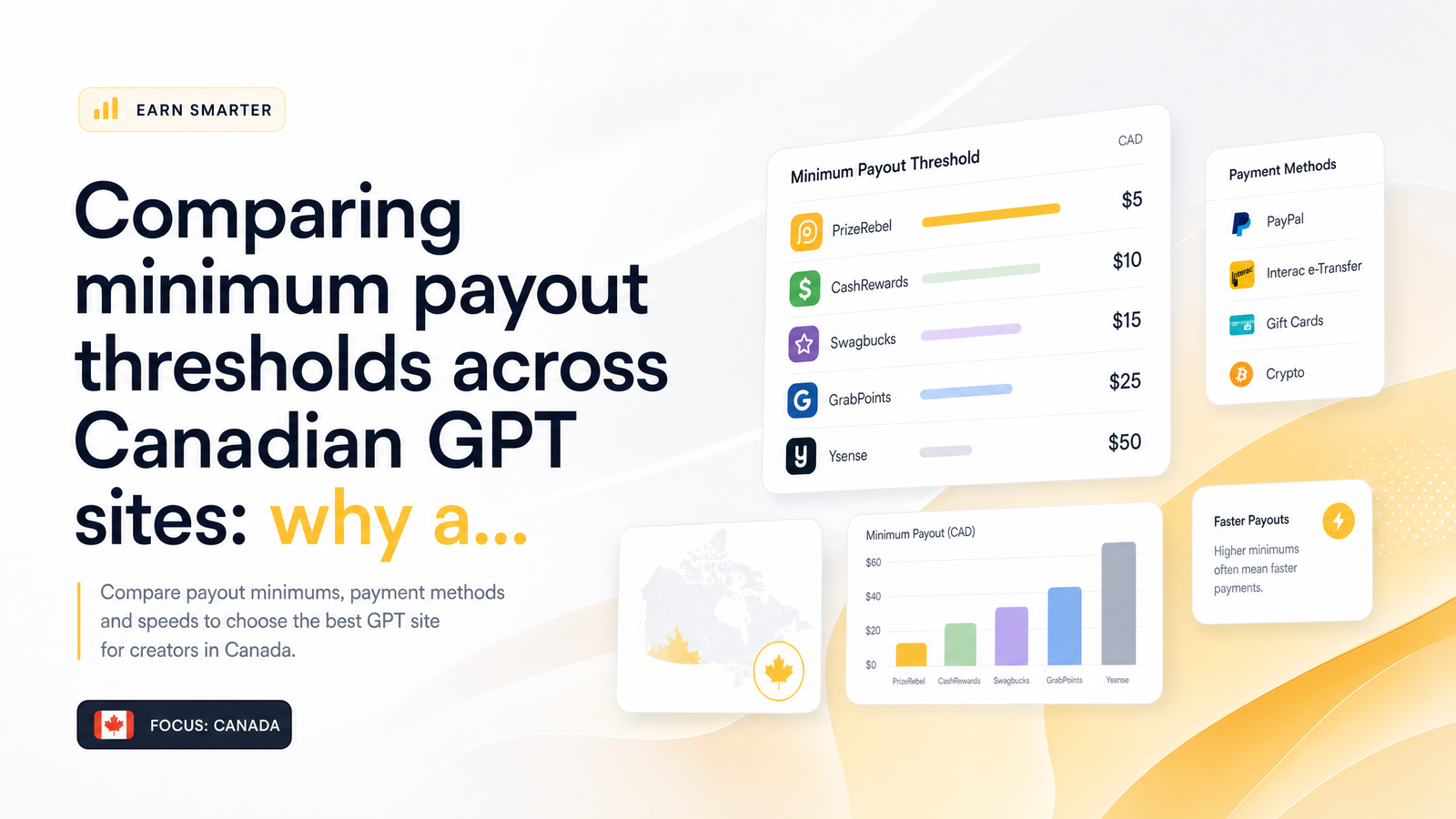
How Minimum Payout Thresholds Compare Across GPT Platforms
Published thresholds change occasionally, and some platforms vary the minimum by cashout method, but the general landscape for Canadian users looks like this:
InboxDollars sets one of the higher bars in the category, with a minimum payout threshold of $30 before a withdrawal request can be processed. If you're earning small amounts from short surveys or occasional offers, reaching $30 can take a meaningful stretch of time compared to platforms with lower floors.
Swagbucks and similar points-based platforms typically require balances equivalent to $25 or more before gift card or cash redemption unlocks, though specific gift card denominations can create their own effective minimums.
PrizeRebel and comparable panel sites often sit in the $5–$10 range for gift cards, with cash options like PayPal sometimes carrying a higher floor.
CashSprint is built around a materially lower threshold — $5 or less depending on cashout method — which means a handful of completed offers or a short cashback purchase history can be enough to trigger a withdrawal, rather than needing to stockpile earnings over multiple weeks.
The pattern across the industry is consistent: cash payouts via Interac e-Transfer or PayPal tend to carry higher minimums than gift card redemptions, because gift cards are cheaper for platforms to fulfill at scale. Canadians who want actual cash in their bank account, rather than a retailer credit, are usually the ones most affected by high thresholds.
The Real-World Impact: $30 vs. $5 in Practice
Numbers illustrate this better than generalities. Imagine a Canadian user earning an average of $8 per week through a mix of surveys, offers, and cashback — a realistic pace for someone using a GPT platform casually alongside other commitments.
On a platform with a $30 minimum payout threshold, that user needs roughly four weeks of consistent activity before a single dollar becomes withdrawable. Miss a week because life gets busy, and the wait stretches further. If the user's interest fades or their circumstances change before they cross the threshold, that balance can sit stranded indefinitely — money earned but never collected.
On a platform with a $5 threshold, the same user could cash out after their very first week, sometimes after a single higher-value offer. That's not a marginal convenience; it's the difference between a get-paid-to platform feeling like a real income source and feeling like a waiting room. Faster access also means faster feedback — users can see tangible results from their effort almost immediately, which is part of why lower-threshold platforms tend to see stronger repeat engagement.
The gap compounds for infrequent users too. Someone who only logs in occasionally, doing a survey here and a cashback purchase there, may never accumulate $30 in a single stretch if a platform resets or expires balances after inactivity. A low minimum payout threshold protects exactly this kind of casual earner, who represents a large share of the Canadian GPT audience.
Why Payout Thresholds Exist in the First Place
Thresholds aren't arbitrary gatekeeping — they exist because processing a withdrawal costs the platform money and administrative effort, regardless of the amount being paid out. Interac e-Transfers, PayPal transfers, and even gift card issuance all carry transaction fees or reconciliation overhead. If a platform allowed withdrawals of $0.50 with no floor, the processing cost could exceed the payout itself, especially at scale across thousands of users.
Higher-threshold platforms are typically absorbing larger advertiser payouts per action — think long, complex market research surveys — and structuring their economics around fewer, larger transactions. Lower-threshold platforms like CashSprint generally rely on a higher volume of smaller-value actions — quick offers, everyday cashback, shorter tasks — and build their payout infrastructure to handle frequent, smaller withdrawals efficiently rather than batching users into infrequent, larger ones.
There's also a retention incentive baked into higher minimums: the longer a balance takes to reach the threshold, the more time a platform has to keep a user engaged with additional offers before that money leaves the ecosystem. That's a legitimate business strategy, but it works against the user's interest in fast access to their own earnings. A lower threshold shifts that balance back toward the earner.
What Canadian GPT Users Should Actually Compare
When evaluating any get-paid-to platform, the payout minimum deserves the same scrutiny as the earning rate. A few questions worth asking before signing up:
- What is the minimum payout threshold GPT Canada users actually see at checkout, not just in marketing copy — does it differ by cashout method?
- Does the threshold change for Interac e-Transfer versus PayPal versus gift cards?
- Are there processing fees once you hit the minimum, and how long does the transfer itself take?
- Does the platform expire unredeemed balances after a period of inactivity?
- Can you realistically hit the threshold given your expected activity level, or will your balance sit stuck for months?
A platform advertising generous per-survey rates loses much of its appeal if the practical minimum payout threshold keeps that money out of reach. Comparing thresholds side by side, rather than treating them as fine print, is the more accurate way to judge which GPT site actually suits a casual or moderate Canadian user.
Where CashSprint Fits
CashSprint was structured around the idea that a lower minimum payout threshold isn't a minor feature — it's the mechanism that makes a get-paid-to platform genuinely useful for people earning modest, irregular amounts. With a threshold of $5 or less depending on your chosen cashout method, Canadians using CashSprint for surveys, games, offers, or cashback can typically convert their balance into Interac, PayPal, or gift card funds far sooner than on platforms holding balances to $25 or $30.
That structure doesn't sacrifice earning potential; it changes the timing of when you can access what you've already earned. For anyone who has felt the frustration of watching a balance grow on another platform without being able to touch it, a lower threshold removes that friction entirely.
Frequently Asked Questions
What is a minimum payout threshold on a GPT site?
A minimum payout threshold is the balance a user must accumulate before a get-paid-to platform allows a cashout request. It varies by platform and often by cashout method — cash transfers like Interac or PayPal frequently require a higher balance than gift card redemptions.
Why do some GPT platforms have a $30 minimum while others allow $5?
The difference usually comes down to transaction costs and business strategy. Platforms processing fewer, larger payouts (like InboxDollars' $30 minimum) build their economics around batching earnings, while platforms designed for frequent small withdrawals, like CashSprint, structure their systems to handle lower minimums efficiently.
Does a lower payout threshold mean lower earnings per survey or offer?
Not necessarily. The payout threshold controls when you can access your balance, not how much you earn per activity. A platform can offer competitive per-offer rates while still allowing withdrawals at $5 or less.
Can unredeemed GPT balances expire before reaching the minimum?
Yes, some platforms expire balances after a period of inactivity, which is a real risk for casual users on high-threshold sites. Checking a platform's expiry policy alongside its minimum payout threshold is a smart step before relying on it for regular earnings.
Is Interac e-Transfer usually subject to a higher minimum than gift cards?
Generally yes. Gift card redemptions tend to carry lower minimums because they're less costly for platforms to fulfill, while cash methods like Interac e-Transfer or PayPal often require a higher balance due to processing fees and transfer overhead.
How do I know which GPT platform's threshold fits my earning habits?
Compare the stated minimum against your realistic weekly or monthly earnings on that platform before committing. If you earn small, irregular amounts, a lower threshold like CashSprint's $5-or-less minimum will get you actual cash far sooner than a platform requiring $25–$30 before any withdrawal is possible.
Stop leaving money stuck behind a high minimum. Check your current balance against CashSprint's own cashout threshold, sign up, and see how quickly a $5-or-less minimum turns your surveys, offers, and cashback into real money at Cashsprint. For the fuller picture on how quickly that money actually lands once you request it, read our companion breakdown on payout speed.