
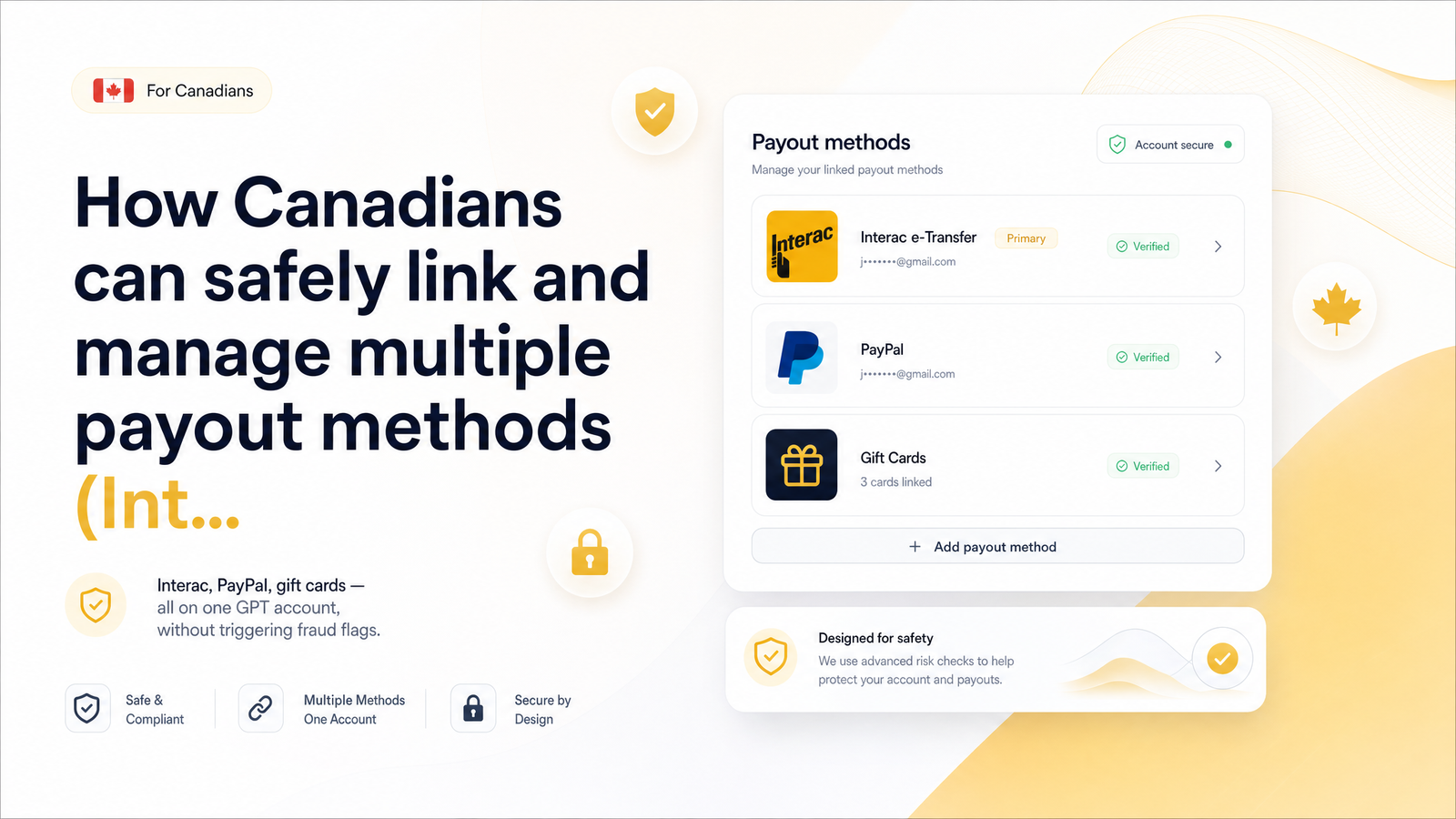
Adding a second or third payout method to a GPT (get-paid-to) account feels harmless — more options should mean faster cash-outs. But how you link payout methods to a GPT account in Canada matters more than most people realize, because fraud-detection systems at PayPal, Interac-participating banks, and the GPT platforms themselves are all watching the same signals: identity consistency, device behavior, and pace of change. Handle it carelessly and you risk a held payout or a limited account. Handle it deliberately and you can run Interac, PayPal, and gift cards on one profile without ever tripping a wire.
This guide treats payout methods as a risk-management system rather than a menu, walking through why flags happen, what needs to match, and the exact order of operations to follow.
Why Managing Multiple Payout Methods Can Trigger Fraud Flags
Every payout you request passes through at least two fraud engines: the GPT platform's own risk model and the receiving service's (PayPal's or your bank's, via Interac). These systems are built to catch account takeover, money laundering, and multi-accounting abuse — patterns that overlap heavily with normal behavior when someone adds several payout methods quickly.
Payout fraud detection generally scores three things. First, identity consistency: does the name, email, and phone tied to the payout match what's on file for the GPT account? Second, velocity: how many new methods or redemptions have happened in a short window? Third, shared signals: is this device or IP address also connected to other accounts, on this platform or on PayPal itself. A single mismatch rarely causes a problem. Several at once — a new email, a new device, and a same-day redemption — reads like the early signature of a compromised or fraudulent account, even when it's just an honest user reorganizing their finances. Fraud flags are almost never about one bad action; they're about a cluster of unusual signals appearing together.
The Golden Rule: One Identity, Consistently Verified
If there's a single rule that prevents the vast majority of payout problems, it's this: your name, email, phone number, and address should be identical — not just similar — across your GPT account, your PayPal account, and the bank account you use for Interac e-Transfer.
Identity verification for GPT payouts works by cross-referencing these fields automatically. A name mismatch between PayPal and Interac is one of the most common triggers for manual review, because it's exactly what happens when someone tries to redirect funds to an account that isn't theirs. Simple things cause this more often than people expect: a maiden name on one account, a nickname used at sign-up, a business name on PayPal versus a personal name on the GPT profile, or an old address still listed with your bank. None of these are fraud, but they all look identical to fraud from a system's point of view. Before adding any new payout method, take five minutes to confirm your legal name, current phone number, and address match across every account involved.
How to Safely Add Interac, PayPal, and Gift Cards to One Account
Once your identity details are aligned, add payout methods deliberately rather than all at once. This is the practical checklist for adding a payout method to a GPT account without raising suspicion:
- Verify your GPT account fully first — confirm your email, phone, and any ID checks before touching payout settings at all. An unverified account requesting multiple payout links is a red flag on its own.
- Add one method at a time, starting with whichever you'll use most — Interac e-Transfer or PayPal.
- Confirm it with a small test payout before requesting a larger one. This proves the linkage works and gives the fraud engine a clean, low-risk data point to build trust on.
- Wait a reasonable interval — several days to a couple of weeks — before adding the next method. Space signals patience, not urgency.
- Never link the same bank card or account number to two different services under different names or emails. If adding a gift card option alongside Interac or PayPal, use the same verified profile details throughout.
If you're setting up a CashSprint account for the first time, this order works well alongside the platform's own onboarding flow — the step-by-step guide for Canadian survey takers covers the broader setup process this checklist slots into.
Switching Between Payout Methods Without Raising Red Flags
Choosing Interac one month and a gift card the next is completely normal user behavior, and no legitimate fraud engine penalizes preference-based switching on its own. What draws attention is the pattern around the switch, not the switch itself.
Safe cadence looks like: one method used consistently for a stretch of redemptions, then a considered change, then consistency again. Risky cadence looks like: alternating methods redemption-to-redemption, adding and removing payout details repeatedly in the same week, or switching immediately after a large balance builds up. That second pattern resembles structuring — a known laundering technique where funds are split or rerouted to avoid detection thresholds — even when the actual intent is innocent. If you want to compare which method suits a given payout, review the trade-offs in advance rather than testing multiple methods live; the payout options ranked by speed breakdown and this gift card vs. cash comparison let you decide once, then execute cleanly.
Cashing out through a GPT platform without triggering a flag comes down to predictability: the system should be able to explain your behavior with a simple story ("this user prefers Interac but occasionally redeems gift cards"), not a complicated one.
Common Mistakes That Get Payouts Held or Accounts Limited
Most held payouts and account limitations trace back to a small set of avoidable errors:
- Mismatched names. A PayPal account under a spouse's name, or an Interac-linked bank account not updated after a legal name change, is the single most common cause of a held payout.
- Using someone else's email or account. Redirecting a payout to a friend's or family member's PayPal or Interac email — even for a legitimate reason — looks identical to third-party fraud from the system's perspective. PayPal's own policy permits only one personal account per person, and shared logins or devices across accounts are explicitly treated as a risk signal, as outlined in this breakdown of PayPal's rules on multiple accounts.
- Logging in from shared or public devices, especially library or workplace computers, which can tie your account to unrelated device fingerprints.
- Rapid-fire redemptions — requesting several payouts within minutes or hours of each other.
- Requesting an unusually large amount immediately after setup, before the account has any redemption history. Interac e-Transfer itself has bank-imposed daily and weekly limits precisely because sudden, large transfers draw anti-money-laundering scrutiny; the mechanics behind those caps are explained in this Interac e-Transfer limits breakdown. A GPT platform's own review threshold works on a similar principle at a smaller scale.
Avoiding these five behaviors resolves the overwhelming majority of PayPal-limited or Interac-held payout cases reported by GPT users in Canada.
How CashSprint Verifies Payouts to Keep Your Account Safe
CashSprint structures its payout verification around the same principles this article has walked through, rather than treating fraud prevention as an afterthought. New accounts go through KYC-style checks before any payout method is activated, confirming that the name and contact details on file match what's presented later at cash-out. Only one payout method is confirmed as "active" at a time during initial setup, limiting the exposure of adding several unverified links at once. Redemptions above certain thresholds trigger a manual review rather than an automatic hold-and-flag, reducing false positives that frustrate legitimate users. This layered approach is part of why CashSprint has built a track record worth scrutinizing — for readers who want the receipts, the evidence-based review of CashSprint's legitimacy lays out exactly how the platform has held up under independent examination.
The result is a system where adding Interac, PayPal, and gift cards to one account is expected behavior, not a red flag — provided you follow the same identity-consistency and pacing principles CashSprint's own verification is built around.
Frequently Asked Questions
Can I use Interac e-Transfer and PayPal on the same GPT account without a problem?
Yes, as long as the name, email, and phone number tied to each method match your GPT account exactly. Problems arise from mismatched identity details or rapid switching, not from having multiple methods linked. Add each method separately and confirm it with a small test payout before relying on it.
Why did my payout get delayed or flagged after I changed my cash-out method?
A delay usually means the new method's identity details didn't fully match your account profile, or the change happened too soon after a previous redemption. Fraud engines treat a sudden method change paired with a payout request as a velocity signal worth reviewing. Waiting a few days after adding a method before requesting a large payout usually avoids this.
Does switching payout methods often make a GPT account look suspicious?
Switching occasionally — for example, monthly — is normal and rarely causes issues on its own. What looks suspicious is switching with every redemption, or switching immediately after a large balance accumulates, since that pattern resembles structuring behavior used to evade detection thresholds.
Is it safer to stick with one payout method instead of using several?
Sticking with one method is simpler but not necessarily safer, since well-verified accounts can use multiple methods without issue. What matters more than the number of methods is consistent identity data and a sensible pace between changes.
Will linking a gift card option alongside Interac or PayPal cause issues?
No, adding a gift card option alongside Interac or PayPal is low-risk since gift cards don't involve bank transfer verification the way Interac does. The same identity-consistency rule still applies: use the same name and email across all methods on the account.
What personal details need to match across my GPT account and payout methods?
Your legal name, email address, phone number, and mailing address should match exactly across your GPT account, PayPal, and the bank account linked to Interac e-Transfer. Even small discrepancies, like a maiden name or outdated address, can trigger a manual review or a held payout.
Ready to put this into practice? Open or verify your account with Cashsprint and add your payout methods one at a time, following the checklist above — verify first, test small, then space out each addition. For a deeper look at how each method compares, read the payout options ranked by speed guide and the CashSprint legitimacy review before you link your first bank account.