
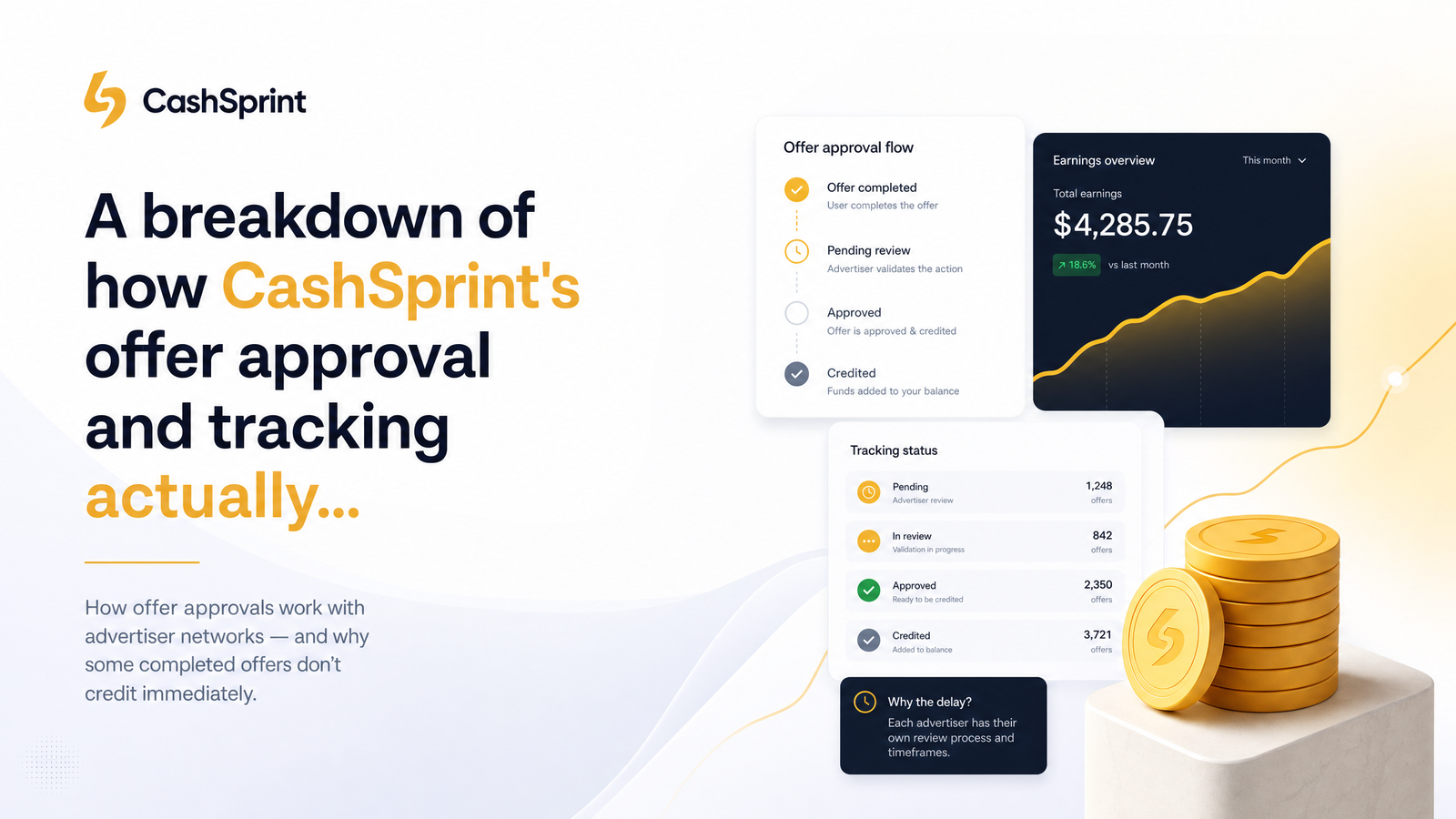
You finished the survey, downloaded the app, or signed up for the trial. The confirmation screen appeared. And then... nothing. Your CashSprint balance didn't move. If you've hit this wall, understanding GPT offer tracking not credited situations in Canada starts with one fact: crediting a completed offer usually isn't a one-step process, and CashSprint isn't the only party involved.
This article breaks down the actual technical chain between a click and a credited balance, so you can tell the difference between "still processing" and "actually broken," and know what to do about each.
The Three Parties Behind Every 'Completed' Offer
Every offer involves three separate parties. There's the advertiser — the company running the trial, app, or survey campaign. There's the advertiser network — the intermediary platform that hosts thousands of these campaigns and tracks user activity across them. And there's CashSprint, the GPT platform that shows you the offer and eventually pays out points or cash based on what the network reports back.
CashSprint doesn't generate offers itself and doesn't unilaterally decide whether your survey or trial "counts." It relies on the advertiser network to confirm that a completion happened and that the advertiser accepted it. This is standard GPT offer tracking architecture across the industry — it's how offerwalls, cashback sites, and survey routers all function, not something unique to CashSprint. When people ask whether CashSprint is legit, the multi-party structure is part of the answer: CashSprint can't speed past the network or the advertiser's own approval process, because it isn't the one holding the data.
A delayed credit almost always means the confirmation hasn't finished traveling through this chain yet — not that CashSprint received your completion and decided to sit on it.
How Tracking Actually Works: Click IDs and Postbacks
When you click an offer on the CashSprint offerwall, the platform generates a unique click ID — a string identifying you, the specific offer, and the timestamp of that click. This click ID is passed along as you're redirected to the advertiser's page, tucked invisibly into the URL or a tracking cookie.
You complete the action — the survey, the app install, the trial signup. The advertiser's system (or the network's tracking layer in front of it) registers a completion event tied to that same click ID. The critical next step is a postback, also known as server-to-server tracking: instead of relying on your browser to report back to CashSprint (unreliable, since browsers close, connections drop, cookies get cleared), the advertiser network's server sends a direct, silent message to CashSprint's server saying "click ID X completed offer Y." Your browser isn't involved in this step, which is why it's more reliable than older cookie-only tracking, but it does mean there's a data hop between two servers that takes some time.
CashSprint receives that postback and matches it against the original click ID. If everything lines up, the offer moves to "pending" or gets credited immediately, depending on the offer's approval rules. This click-to-postback chain is the backbone of affiliate and offer tracking industry-wide, and understanding it is the fastest way to demystify "offer approval" as a whole.
Why Some Offers Credit Instantly and Others Don't
Not all completions are treated equally, and this is where most confusion happens. Offers generally fall into two buckets:
Auto-approved, instant offers — simple actions like completing a short survey, watching a video, or finishing a game milestone. The advertiser has pre-set rules that automatically approve these the moment the postback fires, so your balance often updates within minutes.
Delayed, manually reviewed offers — trials, subscriptions, lead-gen forms, and purchases. These require the advertiser to verify the action wasn't fraudulent, that a trial wasn't immediately cancelled, or that a lead is genuinely qualified. Advertiser approval time on these can stretch from a few hours to several weeks. A free-trial offer, for example, often can't be confirmed until the trial period ends, since the advertiser needs to see whether you cancelled within the window.
This is normal, not a red flag. An offer sitting in offer pending status for a week doesn't mean it's lost — it means the advertiser hasn't finished its own review cycle. The realistic expectation: instant offers should update same-day; delayed offer credit on anything trial- or purchase-based can reasonably take one to four weeks, occasionally longer, depending on the advertiser's own policies, which neither CashSprint nor the network control.
Common Reasons Tracking Breaks on Your End
Some tracking failures aren't about waiting at all — they're caused by something on the user's side interrupting the click ID and postback chain before it ever completes. The most frequent culprits:
- Ad blockers and privacy extensions. These are the single biggest cause of "ad blocker offer not credited" tickets. Many ad blockers strip tracking parameters from URLs or block the pixel/script that fires the postback, meaning the advertiser never sees your click ID at all.
- VPNs. A VPN survey tracking failure happens because switching your apparent location mid-session can break geo-targeted offers or make the network's fraud checks flag the session as inconsistent, since your IP no longer matches the country you started in.
- Clearing cookies or cache mid-offer. If the tracking cookie holding your click ID gets wiped before the postback fires, the advertiser can't attribute the completion back to you.
- Closing the tab too early. Some offers still rely on a final redirect back to CashSprint to confirm completion. Closing the browser before that redirect finishes can cut the chain short.
- Switching devices or browsers mid-offer. Starting a survey on your phone and finishing it on a laptop breaks the session continuity the tracker relies on.
- Using incognito/private mode. This often blocks or auto-deletes the very cookies tracking depends on, sometimes before the offer even confirms.
None of these guarantee failure — plenty of offers still track fine with an ad blocker active — but each one increases the odds. The simplest fix is prevention: disable extensions and VPNs, stick to one browser tab, and let the confirmation page fully load before navigating away. This guide on maximizing earnings on CashSprint and this breakdown of survey mistakes costing Canadians money both cover these habits in more depth.
What To Do When an Offer Doesn't Credit
Once you understand the three separate steps — advertiser approval, network tracking, and CashSprint crediting — you can diagnose where things likely stalled and act accordingly, rather than guessing.
- Check the offer's status first. CashSprint's dashboard typically shows offers as pending, approved, or rejected. Pending simply means the postback hasn't arrived yet or the advertiser hasn't finished reviewing.
- Wait out the stated attribution window. For instant-type offers, give it 24–48 hours before worrying. For trial, purchase, or lead-gen offers, a realistic window is 7 to 30 days, since that's the advertiser approval time built into these campaign types.
- Gather proof while you wait. Screenshot the offer's confirmation page, note the exact timestamp of completion, the email or account used, the device/browser, and the offer's name and payout amount. This is exactly what support needs to trace the click ID through the network's logs.
- Submit a missing-offer ticket if it's still absent after the window. Include everything from step 3 — timestamp, email, offer name, device used, and whether you were using a VPN or ad blocker at the time. The more specific the ticket, the faster support can match it against network records rather than asking follow-up questions first.
A delayed credit is not evidence that CashSprint isn't paying out — it's evidence that one link in a three-party chain hasn't finished reporting yet. Once an offer does credit, it converts into real, cashable balance, and it's worth understanding what that balance is actually worth and how quickly you can cash it out via Interac, PayPal, or gift cards once it lands.
Frequently Asked Questions
How long should I wait before an offer is considered missing?
Wait 24–48 hours for simple, instant-type offers like surveys or video completions. For trials, purchases, or lead-gen forms, give it 7 to 30 days, since advertisers often can't confirm these until a trial period ends or a lead is verified. Only treat it as genuinely missing once you've passed that window.
Does using a VPN or ad blocker cause offers not to credit?
Yes, these are among the most common causes of broken tracking. Ad blockers can strip the tracking parameters or block the postback script entirely, while VPNs can trigger geo-mismatch or fraud checks by changing your apparent location mid-session. Disabling both before starting an offer significantly reduces failed credits.
Can I get credited twice or lose credit if I retake the same survey?
Retaking the same survey or offer typically won't earn a second credit and can flag your account for duplicate activity in the network's fraud checks. Most advertisers only accept one completion per user per campaign, so retaking it wastes time rather than fixing a missing credit.
Why do some advertisers take days or weeks to approve an offer instead of crediting instantly?
Advertisers reviewing trials, subscriptions, or lead-gen forms need time to confirm the action was genuine and not immediately cancelled or fraudulent. This manual or delayed review is built into the advertiser's own approval process and is outside CashSprint's or the network's control, so a one-to-four-week wait is normal for these offer types.
What information should I include when reporting a missing offer to support?
Include the offer name, the exact completion timestamp, the email or account used, the device and browser, and whether a VPN or ad blocker was active. A screenshot of the offer's confirmation page speeds up the process significantly, since support can match it directly against network logs.
Is a delayed credit a sign that CashSprint isn't paying out?
No, a delayed credit almost always reflects where the offer sits in the three-party tracking chain — advertiser, network, and CashSprint — not a withholding of funds. Once an offer is confirmed and approved by the advertiser, it credits to your CashSprint balance and becomes cash-out-ready.
If your offer still hasn't appeared after the realistic window above, start by checking its status in your CashSprint dashboard, then submit a missing-offer ticket with your timestamp, email, and offer details attached. Explore Cashsprint to check your pending offers and get support handling any that genuinely need a closer look.