
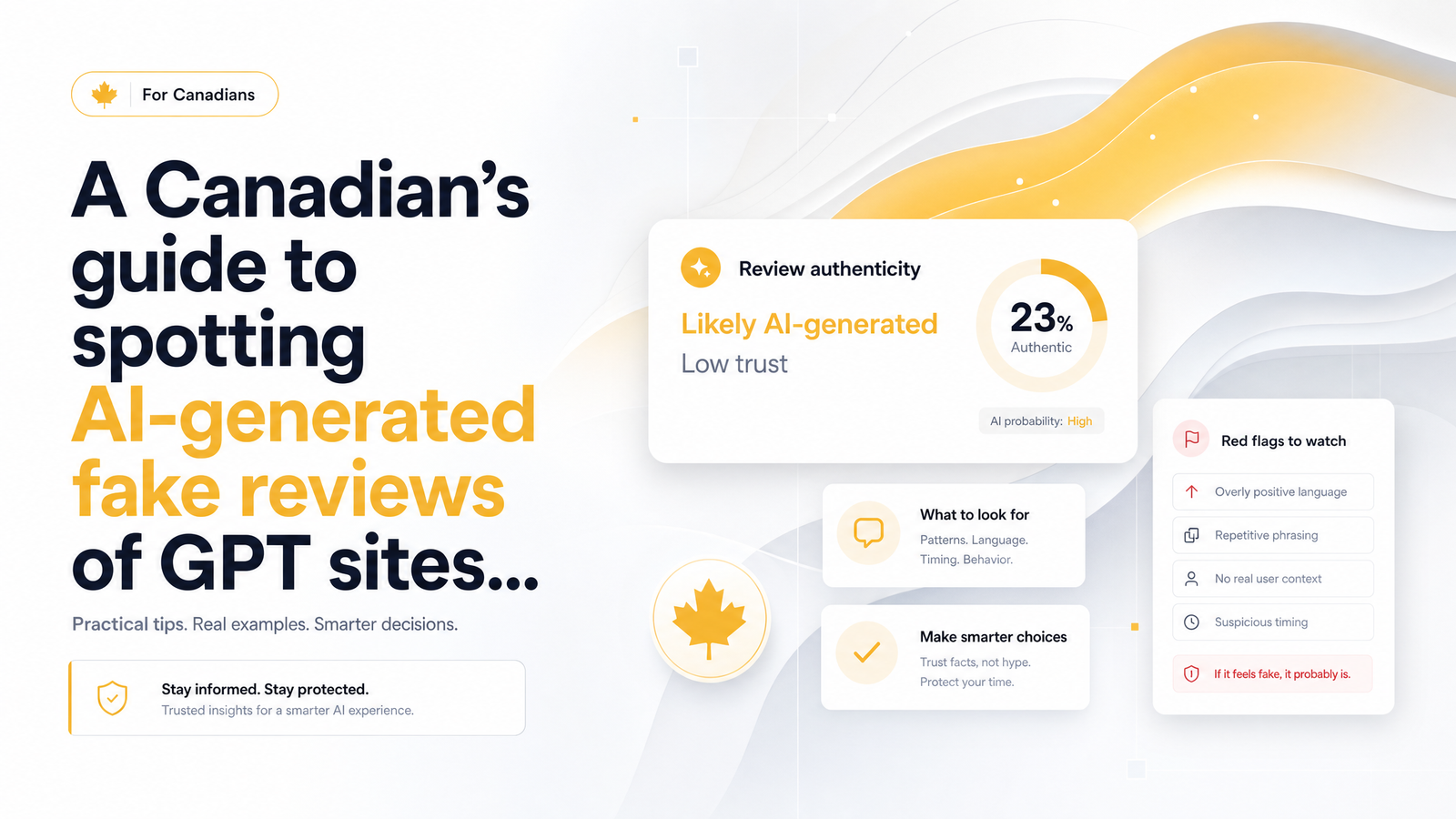
Canadians hunting for a legitimate get-paid-to site have been trained to check the reviews. That habit is now a liability. The GPT and survey niche has become one of the easiest categories to flood with AI-generated praise, and a five-star average no longer tells you much about whether a platform will actually pay out. Before you trust a glowing review of a survey or rewards site, it's worth asking whether that review was ever written by a real person at all.
Why GPT Site Reviews in Canada Are Especially Easy to Fake
The GPT industry runs on referral links. Affiliate marketers earn commissions every time someone signs up through their review, blog post, or YouTube video, giving thousands of people a financial incentive to publish glowing content regardless of whether the site actually pays. Layer on generative AI tools that can produce dozens of unique-sounding testimonials in minutes, and you get a review ecosystem where volume is cheap and authenticity is optional.
The stakes for Canadians are real. A platform propped up by fake GPT reviews can string users along for months collecting personal data — name, address, sometimes SIN details for tax forms — before a payout request quietly stalls or an account gets "flagged" right before cash-out. Time spent completing surveys and offers for a site that never intended to pay is time you can't get back, and the data you handed over doesn't disappear when you close the tab. Treating reviews as a screening tool works only if you screen the reviews first.
The Tell-Tale Signs of an AI-Generated Review
AI-generated reviews have a texture once you know what to look for. The most consistent giveaway is polish: real users write with typos, tangents, and uneven punctuation, while AI text tends toward grammatically flawless, evenly paced sentences that read like marketing copy rather than a personal account. According to Boast's breakdown of AI review detection, this "overcompensation" — reviews that praise a product in unusually complete, structured detail — is one of the strongest linguistic tells.
A second pattern is genericness dressed up as enthusiasm. A real GPT user typically mentions something specific: the exact survey that disqualified them, how many days an e-Transfer took, or a screenshot of a $47.82 payout. AI-written reviews for fake GPT reviews Canada campaigns tend to gush about "easy money" and "great platform" without ever landing on a concrete detail, because the model generating them has no actual payout to describe.
Watch, too, for repeated phrasing across supposedly unrelated reviewers — the same three-word compliment or sentence structure showing up under different names is a strong sign of templated or AI-batch content. An AI-detection professional interviewed by Frommer's points out that reviewer profiles posting their very first (and often only) review, timed suspiciously close to a product launch or marketing push, are another reliable red flag. On app stores and Trustpilot alike, a burst of five-star, first-time reviews clustered in a short window is worth more scrutiny than the star rating itself.
7-Point Legitimacy Checklist Before You Trust a GPT Site Review
Run any batch of reviews — on Trustpilot, the App Store, Google Play, or Reddit — through this checklist before you let them influence your decision:
- Reviewer history and profile age. Does the account have a history of varied reviews across categories, or is this a single-review profile created recently just to praise (or attack) one GPT site?
- Specificity of payout details. Real users cite dollar amounts, cash-out methods (Interac e-Transfer, PayPal, gift card), and timeframes. Vague praise with no numbers is a caution flag.
- Diversity of sentiment and star ratings. A legitimate site almost always has some 3- and 4-star reviews mentioning minor friction — slow support, a confusing offer wall. All 5-star or a suspicious wall of 1-star reviews both suggest manipulation.
- Posting-date clustering. A pile of reviews posted within the same 48–72 hours, especially right after negative press or a marketing push, points to a coordinated campaign rather than organic feedback, a pattern flagged in ReviewSense's guide to spotting fake reviews.
- Disclosure of incentives. Some reviews are legitimately incentivized (a site offers bonus points for an honest Trustpilot review) but should say so. Undisclosed incentives blur into astroturfing.
- Cross-platform consistency. Check whether the sentiment on Trustpilot matches what's said on Reddit's r/beermoneycanada, YouTube comments, and app store reviews. Wildly different reputations across platforms usually means one of them has been gamed.
- Language repetition across "different" authors. If three unrelated reviewers use near-identical phrasing to describe their experience, treat all three as one source, not three data points.
None of these checks require special tools — just a slower, more deliberate read before you trust the aggregate score.
Is Faking Reviews Actually Illegal in Canada?
Yes. The Competition Bureau of Canada has been explicit that publishing fake or misleading reviews, or failing to disclose a material connection to the business being reviewed, violates the deceptive marketing practices provisions of the Competition Act. In January 2024, the Bureau confirmed that businesses can be held liable when employees post reviews of their own employer without disclosing the relationship — a practice known as astroturfing. This establishes that both the reviewer and the company benefiting from the review can face enforcement action.
This mirrors moves in the United States, where the FTC's rule against fake reviews similarly targets undisclosed incentives and manufactured testimonials, reinforcing that this is a recognized regulatory problem, not a grey area. If you suspect a GPT site is running a fake-review operation, you can report it directly to the Competition Bureau of Canada, and flag the specific reviews to the platform hosting them (Trustpilot, Google, or the relevant app store) for removal under their own authenticity policies.
Beyond Reviews: How to Verify a GPT Site Yourself
Once you stop treating star ratings as gospel, verification becomes an active process rather than a passive scroll. A few checks matter more than any review count:
- Payout proof. Look for dated, unedited screenshots of e-Transfers or PayPal deposits — ideally ones with visible transaction references, not stock-image "proof."
- Site infrastructure basics. Confirm HTTPS, a real business registration or contact address, and terms of service that clearly outline how the platform makes money (offer walls, advertiser partnerships, cashback commissions).
- Payout transparency. Legitimate GPT sites publish their minimum cash-out threshold, processing times, and ID verification requirements up front rather than revealing them only after you've accumulated a balance.
- A small test cash-out. Before committing significant time, request the smallest possible payout and time how long it actually takes. This single test tells you more than fifty reviews combined.
If you want to see this checklist applied in practice rather than just described, CashSprint's own evidence-based legitimacy review walks through exactly this kind of skeptical, line-by-line verification — treating claims as things to check rather than facts to repeat. For readers comparing platforms rather than vetting one in isolation, the honest comparison of Cashsprint against other survey sites applies the same standard across multiple competitors instead of relying on their marketing pages.
The broader lesson holds regardless of which platform you're evaluating: reviews are a starting point for investigation, not a substitute for it. A Canadian who cross-checks payout specifics, posting patterns, and disclosure will spot a fake GPT reviews Canada campaign long before it costs them time or personal information.
Apply everything in this checklist to Cashsprint itself — read the evidence-based legitimacy review, sign up, and judge the platform by your own verified experience: your actual payout screenshots, your own e-Transfer speed, your own ID verification process. That's a standard no fake review can fake.
Frequently Asked Questions
How do I know if a GPT site's Trustpilot reviews are fake?
Look for clustering — many reviews posted within the same few days, especially right after negative press — combined with vague, superlative-heavy language that never mentions a specific payout amount or method. Reviewer profiles with only one review ever, created around the same time as the review itself, are another strong signal of a coordinated or purchased campaign.
Can AI detection tools reliably spot fake reviews?
AI detection tools can flag likely patterns — unusually uniform grammar, repeated phrasing, or template structures — but they aren't infallible and can produce false positives on legitimate reviews written concisely. They work best as one input alongside manual checks like reviewer history, posting-date clustering, and cross-platform consistency, not as a standalone verdict.
Is it illegal for a company to post fake reviews of itself in Canada?
Yes. The Competition Bureau of Canada has confirmed that fake or undisclosed reviews, including those posted by employees about their own employer, can violate the deceptive marketing provisions of the Competition Act, exposing the business to liability. Both publishing the fake review and failing to disclose a material connection are treated as enforcement issues.
Why do scam GPT sites have so many 5-star reviews?
Because affiliate marketers earn referral commissions on every sign-up, they're financially motivated to publish glowing reviews regardless of whether the site actually pays out, and AI tools make generating dozens of unique-sounding testimonials fast and cheap. A wall of uniformly positive, detail-free reviews is often evidence of an incentive to promote the site, not proof it pays reliably.
Where can I report a fake review of a survey or GPT site in Canada?
You can report suspected fake or misleading reviews to the Competition Bureau of Canada, which enforces the Competition Act's deceptive marketing provisions. You should also report the specific review directly to the hosting platform — Trustpilot, Google, or the relevant app store — since each has its own policy against fabricated or incentivized-but-undisclosed reviews.
Does CashSprint have real, verifiable reviews?
CashSprint publishes an evidence-based legitimacy review that applies the same skeptical checklist outlined above to its own platform, rather than asking readers to take star ratings at face value. Readers are encouraged to verify independently — checking payout proof, e-Transfer speed, and ID verification steps themselves — before trusting any single review source, including CashSprint's own.