
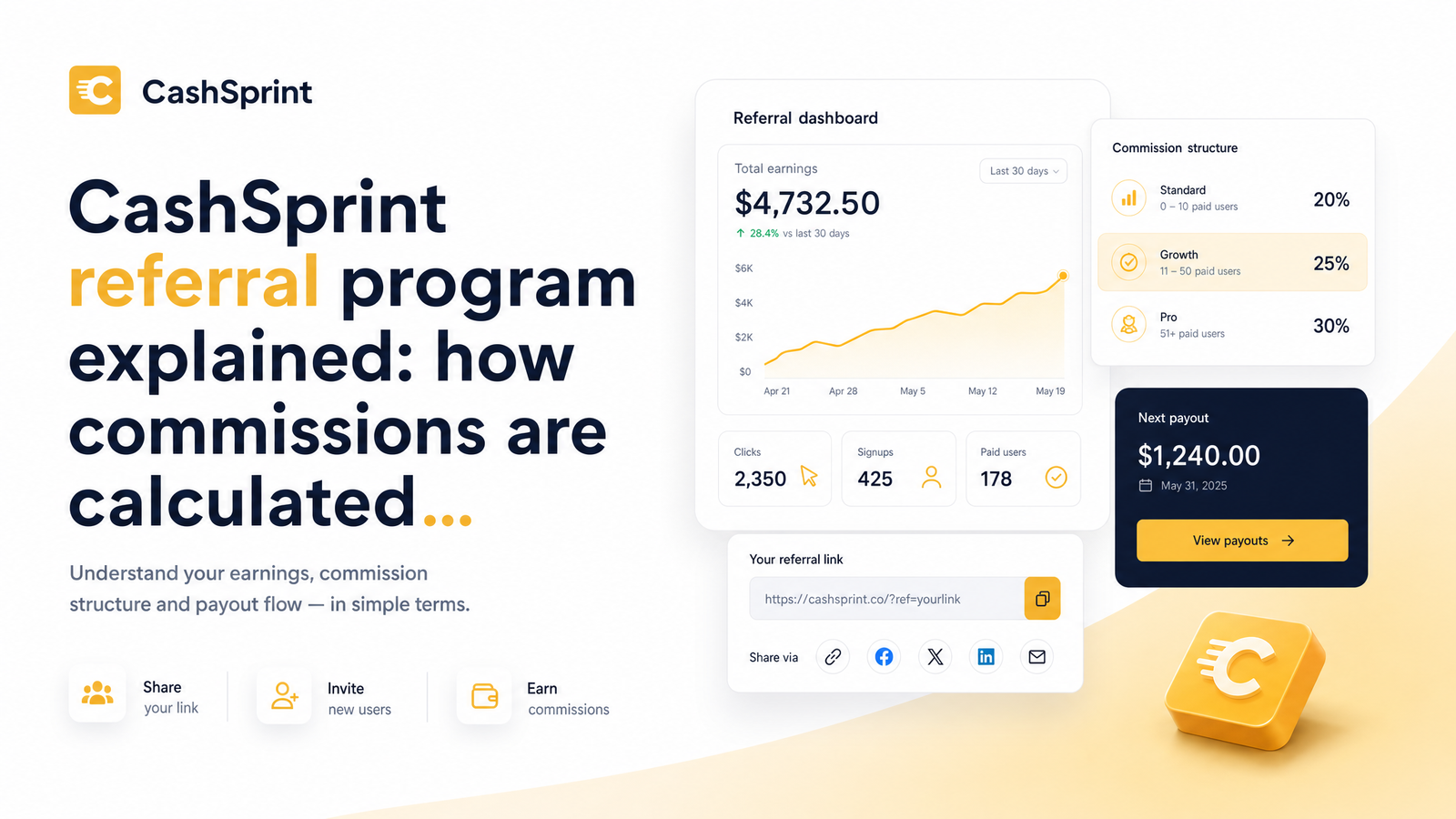
Most Canadians who join a get-paid-to platform assume referrals work like a light switch: friend signs up, cash appears. Then it doesn't, and confusion sets in — is this a bug, a scam, or a broken rule nobody explained? The CashSprint referral program isn't a one-line bonus scheme; it's a rules-based system with eligibility checks, pending states, and fraud protections built into the platform's terms. Understanding those mechanics is the difference between giving up on referrals after one bad experience and turning your link into a reliable income stream.
This guide walks through how the CashSprint referral program calculates and pays commissions, what triggers a hold or rejection, and how to share your link so invites actually convert into withdrawable money.
How the CashSprint Referral Program Works
Every CashSprint member gets a unique referral link tied to their account. When someone signs up through it, they become your referred friend — but signing up is only step one. Your friend needs to verify their email address, confirming they're a real, reachable person rather than a throwaway account created to game the system.
From there, the "refer a friend" relationship stays attached to their account permanently. As your friend uses CashSprint — completing surveys, playing games, redeeming cashback offers — a share of their qualifying earnings is calculated as your referral commission. This is the core idea behind "share and earn" on CashSprint: you're paid a cut of real, verified activity, not for recruiting bodies. That distinction is the source of most confusion referrers run into.
How Referral Commissions Are Calculated
The biggest misunderstanding new referrers have is treating signup as the trigger event. It isn't. A commission is only generated once your friend's activity is completed and credited by the underlying partner — the survey network, offer wall, or cashback provider — not the moment they click submit.
CashSprint, like most GPT platforms, doesn't control reward timing directly. Offer wall providers such as CPX, TheoremReach, and ayet each run their own verification process before confirming a survey or offer was genuinely completed. Survey rewards often take longer to confirm than a simple offer completion, since the network cross-checks response quality first. Until that partner-side confirmation happens, your friend's earnings don't exist yet, so neither does your cut.
This is also why referral commissions aren't a flat bonus. The amount you earn depends on what your friend actually completed and how that offer or survey was valued by its provider. A friend who completes a few low-value offers generates a smaller commission than one who completes a well-paying survey or cashback purchase — earnings scale with real, confirmed activity, since the underlying rewards themselves aren't fixed.
When and How Commissions Get Paid Out
Once your friend completes a qualifying activity, the resulting commission doesn't land in your withdrawable balance instantly. It moves through the same lifecycle as regular survey and offer earnings: pending, then confirmed.
A commission sits as pending while CashSprint waits on completion confirmation from the partner network, runs its own eligibility checks, and — where flagged — puts the transaction through administrative review. This is what CashSprint describes as fraud-protected reward unlocking: rewards aren't released until the platform can reasonably confirm the activity was genuine.
Pending periods vary by provider and offer type — some confirmations land within a day or two, others take longer if the partner's review cycle is slower. If a commission has been pending unusually long, the likely explanation is that the offer or survey is still working through provider-side confirmation, not that CashSprint is withholding funds. Checking your referral dashboard periodically is the most reliable way to tell whether something is genuinely stuck versus still within a normal review window.
Once a commission moves from pending to confirmed, it's added to your withdrawable balance alongside your own earnings, ready to cash out via Interac e-Transfer, PayPal, or gift cards. For a sense of how quickly confirmed funds move once you request a withdrawal, see the Cashsprint Payout Options Ranked by Speed (2024 Guide).
Why Some Invites Don't Count
This is where most frustration lives — a referrer sees a friend "join," checks their dashboard weeks later, and finds nothing. There are several distinct reasons an invite doesn't convert, and almost all trace back to CashSprint's fraud detection and eligibility rules rather than a technical glitch.
Self-referrals. Signing up a second account under your own name, email, or device to refer yourself is explicitly against the rules. The system is designed to catch matching account patterns and reject the commission — or flag both accounts for review.
Referral rings and incentivized traffic. Groups of users who agree to refer each other in a loop, or who pay/trade for signups rather than generating organic referrals, fall under referral fraud detection and disqualify the resulting commissions.
Fake or duplicate accounts. If a referred signup can't pass basic eligibility checks — duplicate personal details, disposable email patterns, inconsistent account information — the account itself may never become eligible to generate a commission, regardless of what it appears to do afterward.
Email verification never completed. A friend who signs up but never clicks the verification link is not yet a confirmed real user. No verification means no qualifying relationship exists, so nothing they do will generate a commission until that step is finished.
Reversed or charged-back partner activity. Sometimes a friend completes a survey or offer, it's credited, and a commission is generated — but the partner network later reverses that credit after finding a quality issue or chargeback. When that happens, the commission tied to it can be reversed on CashSprint's side too, even if already marked confirmed — explaining why an already-credited commission can occasionally disappear.
General fraud or abuse detection. CashSprint runs ongoing account-level checks for behaviour patterns associated with abuse — unusual signup clusters, mismatched device fingerprints, and similar signals. An invite that trips these checks won't count until the account clears review, and in confirmed abuse cases, won't count at all.
One scenario worth addressing directly: referring a family member who shares your home WiFi or device is not automatically fraud. Shared networks are common — students, couples, and families frequently sign up from the same connection. The system targets coordinated abuse patterns (matching personal details, identical behaviour, rapid-fire signups designed to loop rewards), not the ordinary fact of two real people living under one roof. A single family referral behaving like a normal user is a very different signal from a dozen accounts created in the same afternoon that all "verify" and then go quiet.
How to Refer Friends the Right Way (and Avoid Losing Commissions)
Referring friends on CashSprint works best when it looks like what it actually is: a personal recommendation, not a broadcast campaign. A few practical habits keep your commissions safe and your account in good standing.
Share your link with people you actually know rather than mass-posting it. Direct shares — a text to a friend, a mention in a group chat, a post on your own social profile — read as organic to fraud detection systems and to the people receiving them. If you want to post more publicly, avoid dropping your referral link into forum comment sections, Reddit threads, or Facebook groups whose rules prohibit affiliate or referral spam; getting flagged or removed by moderators doesn't just cost you the post, it can draw exactly the kind of signup-cluster pattern that triggers fraud review. Posting a link once where it's welcome and relevant is very different from repeatedly seeding it across unrelated communities.
Make sure the people you invite understand there are two steps, not one: sign up, then verify the email. A friend who signs up and forgets to check their inbox is still an unconfirmed account — nudge them to finish that step if you want the referral to have any chance of generating a commission.
Encourage genuine activity rather than a single token offer completed just to "activate" the referral. Since commissions scale with real confirmed earnings, a friend who becomes a regular user of surveys, offer walls, or cashback deals is worth more to you over time than one who completes one offer and disappears.
Finally, treat your referral dashboard as a working tool, not a one-time check. Get familiar with the difference between pending and confirmed status, and revisit it periodically rather than assuming silence means failure. If you're still building trust in the platform overall, the Is Cashsprint Legit? A Skeptic's Evidence-Based Review covers the broader legitimacy question, including how the platform's payout track record holds up under scrutiny.
Frequently Asked Questions
Why hasn't my CashSprint referral commission shown up yet?
Most delays happen because the underlying offer or survey your friend completed hasn't been confirmed by the partner network yet — the commission sits as pending until that confirmation, plus CashSprint's own eligibility checks, are complete. Confirmation timing varies by provider. If it's been unusually long, check your referral dashboard for the pending status before assuming something is wrong.
Does inviting a friend who just signs up earn me anything, or do they need to complete an offer first?
Signing up alone earns you nothing — your friend needs to verify their email and then complete a qualifying, partner-confirmed activity like a survey, offer, or cashback purchase. The commission is calculated as a share of that confirmed activity, not as a flat reward for the signup itself.
Can I lose a referral commission after it's already been credited?
Yes. If the partner network later reverses or charges back the activity that generated the commission — for example, due to a survey quality issue — CashSprint can reverse the corresponding referral commission even after it was marked confirmed. This is standard to the platform's fraud-protected reward system, not a random policy change.
Is it okay to share my CashSprint referral link on Facebook groups or Reddit?
Sharing with people you know, or posting where a community's rules explicitly allow referral links, is fine. Repeatedly posting your link in forums or groups that prohibit spam risks moderator removal and can create signup patterns that trigger fraud detection, so treat it as a personal recommendation rather than a mass campaign.
Will referring a family member who uses the same home WiFi get flagged as fraud?
Not automatically — shared households and networks are common and expected. Fraud detection targets coordinated abuse patterns like matching personal details or rapid clusters of fake-looking signups, not the ordinary fact of family members sharing a connection and behaving like normal, distinct users.
How many friends can I refer to CashSprint?
There's no stated cap — the program is built around unlimited genuine referrals, each generating commissions based on their own confirmed activity. The limiting factor isn't a referral count, it's ensuring each invite is a real, verified, independently active user.
Ready to put this into practice? Log into your account, find your unique referral link on your CashSprint dashboard, and share it with real friends rather than posting it indiscriminately. Keep an eye on the pending-versus-confirmed status of each commission so you know exactly where you stand, and once funds are confirmed, cash out through Interac, PayPal, or gift cards. If you're still getting comfortable with how the platform works overall, the linked payout-speed and legitimacy guides are worth a read before you start scaling up your invites. Head to Cashsprint to get your link and start referring the right way.