
Why Irregular GPT Income Breaks Normal Budgets
Most budgeting advice assumes one thing: a predictable paycheque landing on the same day every two weeks. That assumption falls apart the moment your income comes from surveys, cashback, and offers instead of an employer. One day you cash out $6 from a quick survey. Another day, a cashback offer clears and you're suddenly looking at $80. There's no schedule, no fixed amount, and no obvious place to put it in a monthly spreadsheet built for salaries.
This is the core challenge of variable income Canada earners face, whether they're doing GPT platforms, freelancing, or gig driving on the side. Irregular income budgeting fails when you try to force unpredictable cash into a rigid template — a $200/month "entertainment" line item doesn't mean much when your actual earnings swing between $15 and $150 depending on the week. Without a system built for that irregularity, the money tends to just get absorbed into everyday spending. A coffee here, a takeout order there, and the $40 you earned from an hour of surveys is gone with nothing to show for it.
The fix isn't a stricter monthly budget. It's a system triggered by the cashout itself, not the calendar — which is exactly what the envelope approach below is designed to do.
The Envelope System, Adapted for Gig and GPT Earnings
The classic envelope system is simple: divide your money into labelled envelopes — rent, groceries, fun money — and stop spending once an envelope's empty. It was built for people who get paid the same amount on the same day, so they fill the envelopes once a month and move on.
For side hustle earners, the trigger needs to change. Instead of filling envelopes on payday, you fill them at the moment money lands — every time an Interac e-Transfer, PayPal payment, or gift card hits your account. That's your GPT earnings envelope system: a cashout-triggered split rather than a calendar-triggered one.
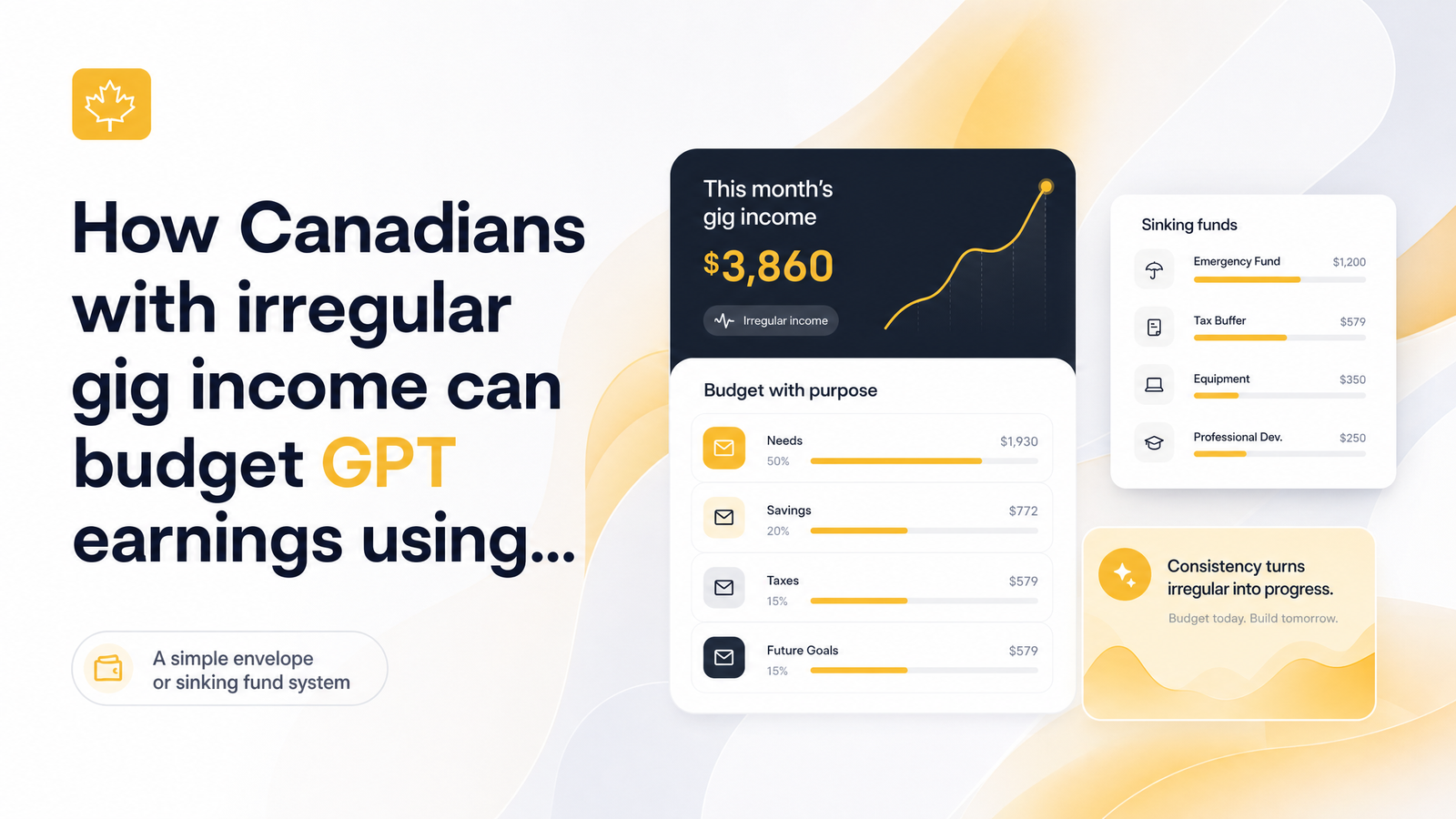
In practice, this means every cashout — no matter how small — gets divided immediately, by percentage, into three or four digital "envelopes":
- Bills/needs — money that goes toward existing obligations or debt
- Sinking funds — money set aside for known, irregular future costs
- Spend — guilt-free discretionary money you can use right away
- Save — optional fourth envelope for longer-term or emergency savings
Because the split happens per cashout rather than per month, it works no matter how small or sporadic your earnings are. A $6 cashout and an $80 cashout go through the exact same math — you're never waiting for a "big enough" payday to start.
Building a Sinking Fund From Side Hustle Money
A sinking fund is money set aside in small, regular amounts for an expense you know is coming, even though you don't know exactly when or how much it'll cost. That's different from an emergency fund, which exists for the unexpected — a job loss, a medical bill, a surprise repair with no warning. The sinking fund vs emergency fund distinction matters because mixing the two leads to confusion: if you raid your "car repair" money for a genuine emergency, you're left short when the predictable expense actually shows up.
Side hustle income is uniquely suited to funding sinking funds because it typically arrives outside your core household budget — money you weren't counting on to cover rent or groceries. That makes it easier to earmark without feeling the pinch. For Canadians, common sinking fund categories include:
- Car maintenance and winter tire changeovers
- Holiday and birthday gifts
- Annual insurance renewals (home, auto, or life)
- Back-to-school costs each September
- Vehicle registration or licence renewals
Rather than scrambling to cover these each time they hit, a sinking fund side hustle income strategy means a portion of every cashout quietly builds toward them all year. By the time December or renewal season arrives, the money's already there.
A Simple Weekly or Per-Cashout Split You Can Actually Follow
You don't need a complicated formula — you need one you'll actually use every time you cash out. A workable starting template, adapted from the familiar 50/30/20 budgeting concept, looks like this:
- 40% – Bills/needs: if you're carrying debt or have tight monthly obligations, this covers it
- 30% – Sinking funds: split further across your specific goals (car, gifts, insurance)
- 20% – Spend: no-questions-asked discretionary money
- 10% – Save: longer-term or emergency savings
This is a budget split side hustle income earners can adjust — if you have no debt, shift more into sinking funds or savings; if a holiday gift deadline is close, temporarily weight more toward that envelope.
Here's a percentage budgeting example using realistic CashSprint-sized cashouts:
- $6 cashout: $2.40 bills, $1.80 sinking funds, $1.20 spend, $0.60 save
- $40 cashout: $16 bills, $12 sinking funds, $8 spend, $4 save
- $80 cashout: $32 bills, $24 sinking funds, $16 spend, $8 save
Even a $6 cashout gets sorted the same way as an $80 one — no waiting, no exceptions, no "I'll deal with it later." Over a few weeks of mixed surveys, offers, and cashback, those small percentages add up into real sinking fund balances without ever feeling like a sacrifice.
Tools to Track It Without Overcomplicating Things
You don't need a specialized app to make this work — the system is designed to survive without one. A few low-effort options:
- Separate savings sub-accounts: most Canadian banks let you open free sub-accounts labelled by goal (e.g., "Car," "Gifts," "Insurance"). Move each envelope's share there right after a cashout.
- A notes app: a running tally of each envelope's balance is enough if you'd rather not open multiple accounts.
- A basic spreadsheet: useful if you want to see totals over time, but not required.
- Existing budgeting apps: if you already use one, add sinking fund categories rather than adopting a new tool.
The goal is to make tracking side hustle income budget habits sustainable, not sophisticated. For an official, no-cost starting point, the Government of Canada's Budget Planner tool and its guidance on preparing a budget with irregular expenses are both built for exactly this kind of variable-income planning. Worth noting too: the Financial Consumer Agency of Canada's own 2026 research found Canadians don't need to budget perfectly to see real benefit — starting simple and staying consistent matters more than precision.
Keeping the System Fed: Turning More Cashouts Into Envelope Deposits
A percentage split only works if cashouts keep happening — consistent side hustle income Canada earners can rely on comes from staying active across surveys, offers, games, and cashback rather than depending on one source. The more consistently you cash out, the more consistently your envelopes fill, which is what turns this from an occasional exercise into an actual system.
Payout speed matters here too: the faster your money clears, the sooner it's split and working toward your sinking funds instead of sitting in limbo. If you're deciding how to withdraw, CashSprint's payout options ranked by speed breaks down which methods — Interac, PayPal, or gift card — get your money to you fastest, so your envelope moment happens without unnecessary delay.
Put this into practice with your next cashout: split it three or four ways using the percentages above, before you spend a cent of it on anything else. Explore more surveys and offers on Cashsprint to keep the cashouts — and the envelopes — coming.
Frequently Asked Questions
How do I create a budget when my side hustle income is different every week?
Trigger your budget split at the moment of cashout rather than on a fixed calendar date. Every time money lands — whether it's $6 or $80 — divide it immediately by percentage into bills, sinking funds, spend, and save categories, so the system works regardless of how much or how often you earn.
What's the difference between a sinking fund and an emergency fund?
A sinking fund is money set aside for a known, irregular expense you're expecting — like car maintenance or an insurance renewal — while an emergency fund covers genuinely unexpected costs, like a job loss or sudden medical bill. Keeping them separate prevents you from raiding one goal's savings to cover another.
How much of my survey and cashback earnings should I save?
A workable starting split is 40% to bills or needs, 30% to sinking funds, 20% to discretionary spending, and 10% to longer-term savings. Adjust the percentages based on your debt load and how close your sinking fund goals are to being needed.
Can I use the envelope system without opening multiple bank accounts?
Yes — separate sub-accounts help, but a notes app or basic spreadsheet tracking each envelope's running balance works just as well. The system depends on consistency at each cashout, not on having dedicated accounts.
Should I budget GPT earnings before or after taxes?
Treat GPT and side hustle earnings as gross income when applicable and set aside a portion for tax obligations before splitting the rest into your envelopes, since this income is generally taxable in Canada. If you're unsure how your specific earnings should be reported, the Financial Consumer Agency of Canada's budgeting resources are a good starting point, though a tax professional can confirm your exact obligations.