
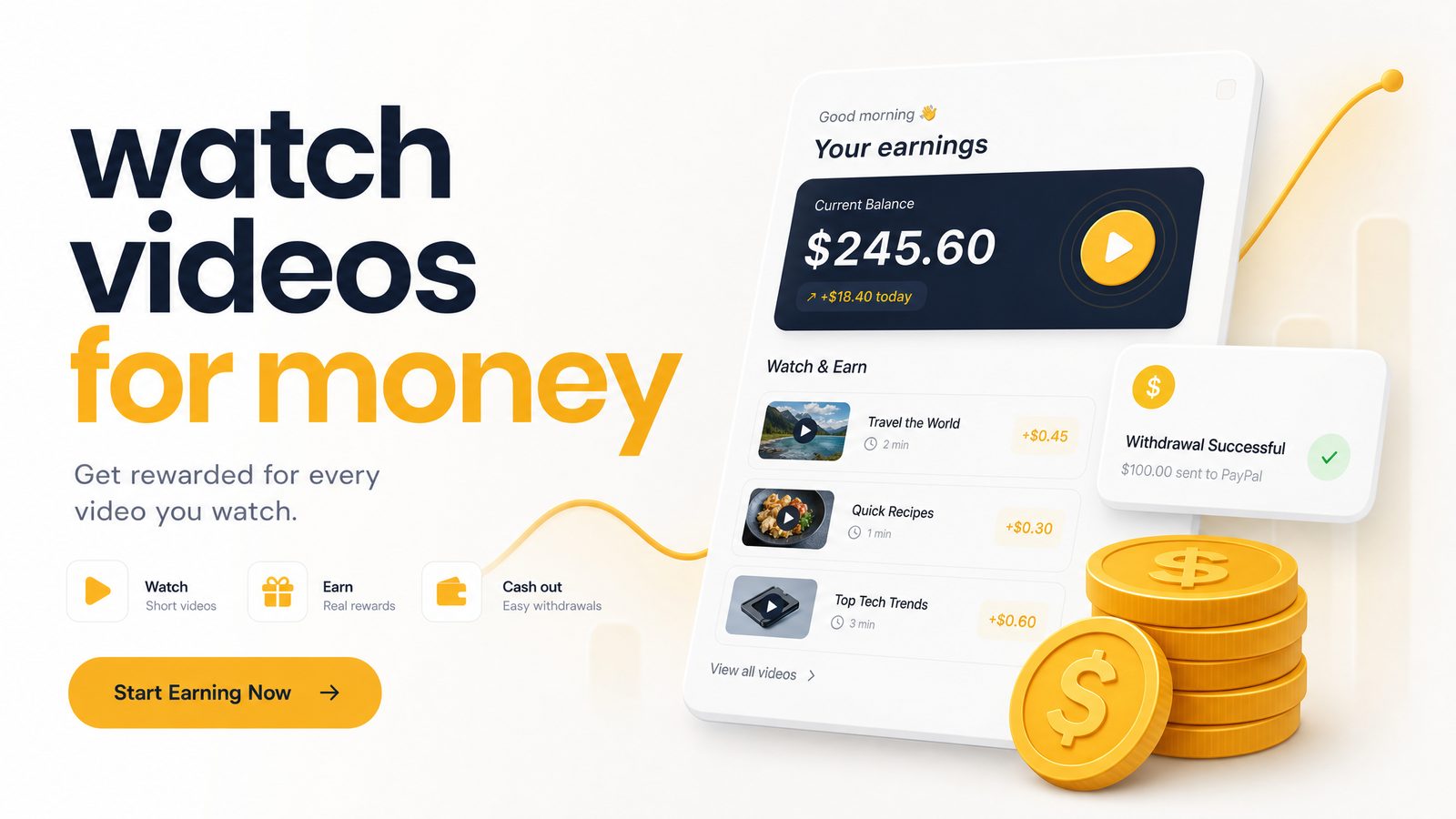
Can You Really Get Paid to Watch Videos?
Scroll TikTok long enough and you'll find someone claiming they made $200 watching a single video, or that some app pays $45 an hour just for keeping a browser tab open. It's a tempting pitch, and it's mostly nonsense. The honest version: you can get paid to watch videos in Canada right now — the pay is just modest, sessions are short, and nobody is retiring on it.
Video-watching tasks are a real, legitimate category inside the get-paid-to (GPT) world. Advertisers and research firms genuinely pay for your attention and viewing data. But "real" and "worthwhile as your main income" are two very different claims. Here's what actually happens once you sit down and start clicking play.
How Much Video-Watching Actually Pays
Set your expectations low and you won't be disappointed. On most legitimate GPT platforms, individual video views pay a few cents — often between $0.01 and $0.10, occasionally more for longer branded content or panel-style viewing. String enough together and you land in the realistic range several platforms openly report: roughly $2 to $5 an hour of active watching.
That's the number worth anchoring on. It's not a wage replacement — it's closer to finding loose change, except it's steady and adds up over weeks rather than minutes. Someone watching consistently across a few cash apps might realistically clear $10–$40/month, treating it as a regular five-minutes-a-day habit rather than a one-off binge. Compare that to viral $200-per-video claims and the gap tells you which one to trust.
Why Companies Pay You to Watch Videos
None of this is charity, and it isn't a scam by design — it's a straightforward exchange. Brands and market research firms need people to actually watch their ads, product previews, and trailers so they can measure engagement, test messaging, or hit ad-view quotas already paid for through media budgets. Getting paid to watch ads is essentially a rebate on that ad spend, redirected to you instead of vanishing into a platform's algorithm.
Some programs go further — panel-style setups collect viewing behavior data for research, similar in spirit to Nielsen ratings. In both cases, the money comes from a real budget line advertisers already allocate for reach and data. Understanding that mechanism explains the low pay: you're compensated for attention at scale, not skilled labor — which is why this works better as a video watching side hustle wedged into other habits than as a standalone plan.
The Main Types of Paid Video Tasks
Not all "watch and earn" tasks look the same, and knowing the categories helps you spot what's realistic versus a red flag.
In-app video ads on GPT platforms are the most common: short ad clips embedded in a rewards app, paying a few cents each, often capped at a certain number per day.
Trailer and product previews ask you to watch short branded or entertainment content — sometimes with a quick follow-up question — and typically pay slightly more than a plain ad view because the advertiser wants a reaction, not just a play count.
Panel and viewing-data programs, in the Nielsen-style tradition, pay you (sometimes passively, sometimes via opt-in surveys) for contributing viewing data over time rather than for individual videos.
Paid video reviews overlap with survey work — you watch something, then answer questions about recall, sentiment, or purchase intent, usually paying better per minute than a passive ad view because it demands more engagement.
Knowing these categories helps you avoid surprise when a "video" task is actually a hybrid survey. For the closely related category of clicking rather than watching, see Get Paid to Click on Ads: What It Really Pays in Canada — the pay dynamics are similar, and comparing the two helps you avoid double-counting your expectations.
Red Flags: How to Spot a Fake "Watch and Earn" App
This is where the viral hype turns into an actual problem. Is watching videos for money a scam? Not inherently — but plenty of apps built around the concept are. Watch for these signals before handing over any information or time:
- Promised payouts that don't match the business model — $45/hour, $200 per video, or anything close to a full wage for passive watching is a mathematical impossibility given what advertisers actually pay per view. If the number sounds like a job replacement, it's bait.
- Upfront fees or "activation" charges — legitimate GPT platforms never charge you to start earning. Any app asking for payment before you can cash out is a fee-collection scheme wearing that costume.
- No verifiable payout history or reviews — real platforms have a track record, visible payout proof, and a presence beyond a single viral video pushing downloads.
- Vague or missing cash-out mechanics — if you can't find a clear explanation of how earnings convert to Interac, PayPal, or gift cards, that's a warning sign, not a technicality.
Legit Canadian platforms will always be upfront about modest pay rates, because that's the honest reality of the business model. For a deeper look at evaluating a platform's legitimacy, Is Cashsprint Legit? A Skeptic's Evidence-Based Review walks through an evidence-based approach worth applying to any GPT site, not just this one.
How to Make Video Watching Actually Worth It on CashSprint
The math above means video watching will never carry your earnings alone. Where it works — and where CashSprint treats it as one piece of a bigger routine — is when you stack it with surveys, games, and cashback offers rather than relying on it in isolation.
A practical routine: check CashSprint's available offers daily, since video tasks and other quick-completion items refresh regularly and early movers get first access to capped daily tasks. Pair a few minutes of video watching with a survey or two, and add a game-based earning session for variety — each category pays differently and fills different pockets of downtime. If you're commuting or waiting somewhere anyway, that's exactly when a five-minute video queue earns its keep, since the opportunity cost is close to zero.
Track your time honestly too. If video tasks are only earning $3 an hour of attention, that's fine for background activity but not something to schedule around. For a comparison of how video and game-based tasks stack up, see Get Paid to Play Games in Canada: What It Really Pays, and if you're weighing surveys versus cashback instead, Survey Sites vs Cashback Apps: Which Pays More in Canada? breaks down the comparison directly. Earning money watching videos works best as a supplement — a way to squeeze small, reliable value out of time you'd otherwise spend scrolling anyway.
Cashing Out Your Video-Watching Earnings
Small per-video amounts only feel worthwhile if getting the money out is simple, and that's where CashSprint's payout structure matters. Earnings from video tasks accumulate alongside your survey, game, and offer income in one balance, convertible to Interac e-Transfer, PayPal, or a range of gift cards once you hit the applicable threshold.
Interac cash out is typically the fastest route for Canadians who want funds directly in their bank account, while PayPal or gift card rewards suit anyone who prefers flexibility across retailers. Processing speed varies by method, so it's worth checking Cashsprint Payout Options Ranked by Speed (2024 Guide) before picking a cash-out method, especially if you're combining video earnings with other categories.
Frequently Asked Questions
Is getting paid to watch videos actually legit in Canada?
Yes — Canadians can genuinely earn small amounts through video-watching tasks on established GPT platforms. The pay is modest by design, reflecting advertiser ad-spend and research budgets, not a wage. Legitimacy comes down to the specific platform, so verify payout history and avoid apps charging upfront fees.
How much money can you realistically make watching videos online?
Most legitimate platforms pay a few cents per video, translating to roughly $2 to $5 an hour of active watching. Over a month of casual, consistent use, that typically adds up to $10–$40 rather than anything close to a wage. Anyone promising far more per hour or per video isn't describing how this actually works.
What's the difference between watching videos for money and get-paid-to-click-ads sites?
Video tasks pay you to actually view content for a set duration, often with engagement or recall checks, while click-ad sites pay a small amount for clicking through to a page. Both draw from the same advertiser budget logic, but video tasks generally require more time per task and sometimes pay slightly more per action as a result.
Can you make a full-time income just watching videos?
No — the realistic $2–$5/hour range makes video watching unsuitable as a standalone income source. It works best as one component of a diversified routine that also includes surveys, games, and cashback offers, which together can meaningfully add up.
How do you cash out earnings from watching videos on CashSprint?
Video-watching earnings combine with your other CashSprint income into a single balance, redeemable through Interac e-Transfer, PayPal, or gift cards. Payout speed differs by method, so checking a payout speed comparison before choosing is a smart step, particularly if you want funds quickly.
Why do some apps promise $45 an hour or $200 per video?
These numbers are marketing bait, not achievable payouts — they don't match what advertisers actually spend per view. Apps making these claims typically use them to drive downloads before disappointing users with real payouts, or worse, hide upfront fees and no verifiable cash-out process behind the hype.
Realistic expectations are the whole point here: watch videos for money as a small add-on, not a plan. Stack it with surveys and games inside Cashsprint, lean on fast Interac or PayPal cash-out when your balance is ready, and check the payout speed guide alongside the surveys vs. cashback comparison to build a routine that actually adds up — and if you want the full picture of what else is worth your time, the 2026 side hustle effort guide is a good next stop.