
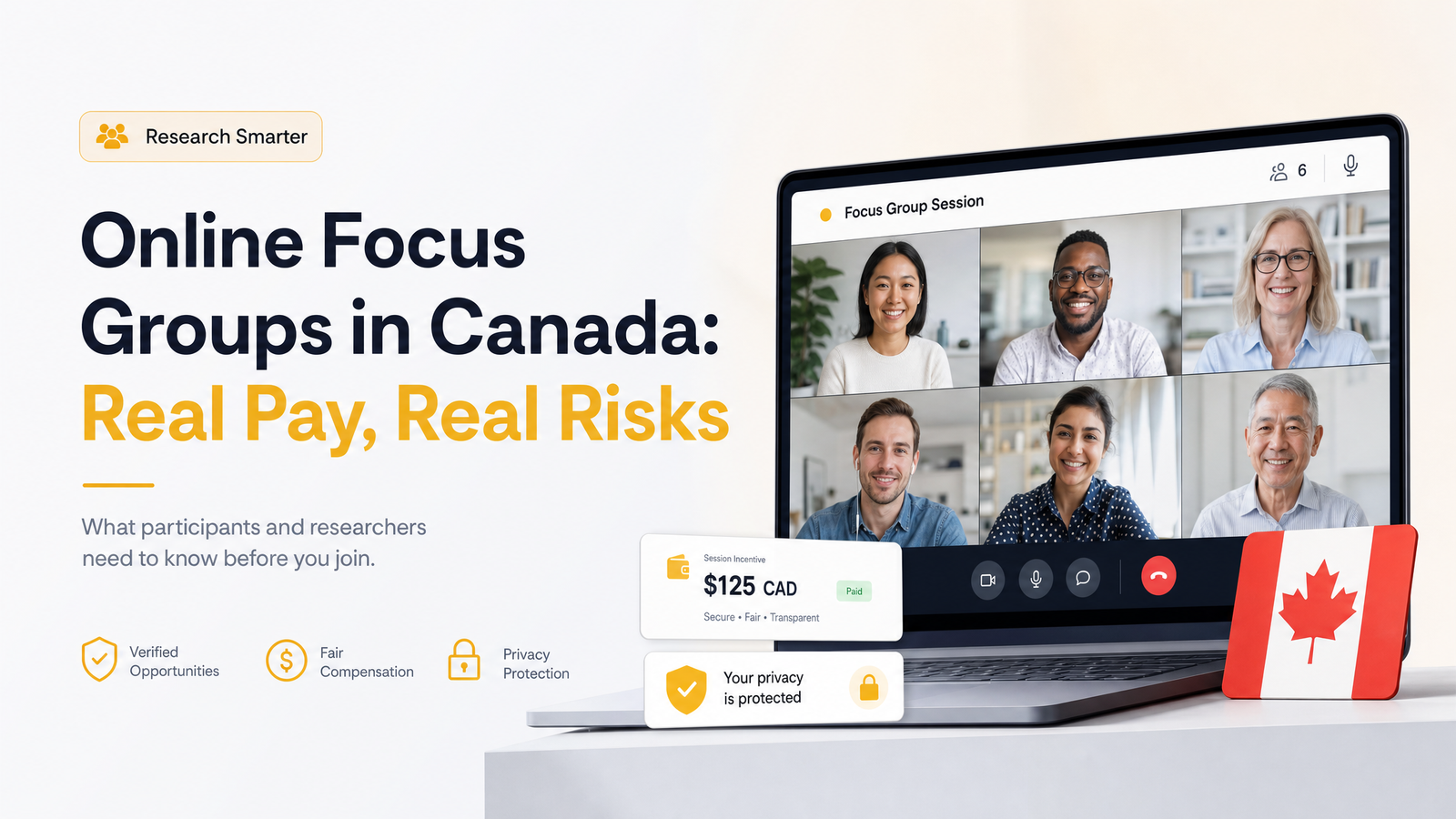
Search "focus groups online" and you'll hit US blog posts promising $50 to $450 an hour for chatting on Zoom. Those numbers exist somewhere, for someone, but they aren't the norm — and they rarely reflect what Canadian panelists actually get paid. This guide skips the hype and answers what Canadians actually want to know: what these sessions involve, what fair pay looks like here, how to avoid scams, and whether they're worth chasing over the steady survey and offer income you can already build on Cashsprint.
What Are Online Focus Groups, Exactly?
An online focus group is a moderated research session, usually held over Zoom or a similar platform, where a market research company gathers a small group of people (or sometimes just one, in an interview format) to discuss a product, ad concept, or opinion in depth. A trained moderator asks questions, probes for detail, and keeps the conversation on track while a client — often a brand or agency — observes quietly in the background.
This differs fundamentally from the one-off surveys you're used to on Cashsprint. A survey is self-paced: you read questions, click answers, and submit on your own schedule, usually in ten or fifteen minutes. A virtual focus group is scheduled, live, and conversational. You need to show up at a set time, stay on camera, and articulate your opinions out loud alongside strangers. It's qualitative research — the goal is depth and nuance, not the large-sample statistical data surveys are built to collect. That's exactly why focus groups pay more per session but come around far less often.
How Much Do Online Focus Groups Actually Pay in Canada?
Forget the $450/hour headlines. For Canadian participants, focus group honoraria typically land in the $50 to $250 range per session, with most standard 60- to 90-minute sessions clustering around $75 to $150. Higher outliers exist — specialized studies targeting niche professionals (physicians, IT decision-makers, high-net-worth individuals) can pay considerably more — but these are rare and usually recruited through professional networks, not general consumer panels.
Pay reflects the audience being recruited, the session length, and how hard the client needs to work to fill the room. A general consumer study about snack packaging pays modestly. A niche B2B study needing five bilingual supply-chain managers pays well because so few people qualify. For the average Canadian signing up through consumer panels, expect honoraria in the $50 to $250 band, usually paid by Interac e-Transfer, cheque, or prepaid card a few weeks after the session — not instantly, and not in cash on the day.
If you're building a monthly income estimate, it helps to compare this against what steady survey work pays; our guide on how much you can earn taking surveys in Canada breaks down realistic per-survey rates so you can weigh the two side by side.
How to Find Legitimate Focus Group Opportunities
Legitimate research firms in Canada — companies like CRC Research or global platforms like User Interviews — recruit participants through a fairly consistent process. It starts with a screener questionnaire: a short set of qualifying questions about your demographics, habits, or job that determines whether you fit the client's target profile. Passing the screener doesn't guarantee a spot; it just puts you in the pool the moderator picks from.
To actually get these invites, you generally need to be part of a market research panel or signed up directly with a research recruiting firm. Some consumer survey platforms occasionally forward focus group invites to their existing user base when a client needs general-population participants — one of the more overlooked ways Canadians stumble into legit paid research without hunting for niche panels. Keeping an active profile on a platform like Cashsprint means you're already in a pool where these occasional research invitations can surface alongside your regular survey and offer earnings, without chasing down a dozen separate research sites.
The honest caveat: even with a completed screener, acceptance rates are low. Research firms often need just eight to ten participants out of hundreds of screener responses, because they're filtering hard for a very specific mix of demographics and opinions. Getting rejected isn't a reflection of you — it usually means the quota for your profile was already filled.
Red Flags That Signal a Scam
Because "focus group" sounds official and the pay figures floating around online are inflated, this niche attracts fake recruiters. A few consistent warning signs separate real research opportunities from scams:
- Any request for payment upfront. Legitimate studies never charge a "registration" or "processing" fee to join a panel or attend a session.
- Requests for banking passwords or full account access. A real research firm needs an e-Transfer email or basic payment details — never login credentials to your online banking.
- Guaranteed high pay with no screening. If you're told you're "already approved" for a $400 session without ever completing a screener, that's a hard sign of a scam.
- Pressure to act immediately or provide a SIN number, passport scan, or other sensitive ID before any study details are shared.
- Vague or missing client/moderator information. Real invitations usually name the research firm and give you a sense of what the study is about.
If something feels off, read through common patterns in our piece on online survey mistakes costing Canadians real cash — many of the same scam tactics show up across both surveys and virtual focus group recruiting.
Focus Groups vs. Paid Surveys: Which Should You Prioritize?
This is the practical question, and the honest answer is: they solve different problems. Focus groups pay more per hour of your time, but they're infrequent, selective, and unpredictable — you might complete zero to a few per year unless you're on multiple specialized panels. Surveys and micro-offers pay less per task, but they're available daily, don't require a webcam or a fixed appointment, and don't depend on winning a competitive screening process.
Surveys win on frequency and reliability; focus groups win on per-session payout when you're actually selected. A realistic strategy treats focus groups as a bonus layer, not a plan. Build your baseline with consistent survey and offer completion — something you control daily — and treat any focus group invite that lands in your inbox as a welcome extra, not something to wait around for. For a grounded look at what that baseline can realistically generate, see our honest starter guide to online paid surveys in Canada.
Getting Started: Build a Reliable Base First
Given low acceptance rates and irregular scheduling, the smartest approach for Canadians looking to earn extra cash online is to treat focus groups as upside, not strategy. Sign up with one or two reputable research panels if you want a shot at the occasional higher-paying session, complete their screeners honestly, and then get on with earning consistently elsewhere while you wait to hear back — because you may wait months.
That's where a platform like Cashsprint fits in: daily surveys and offers you can complete on your own schedule, plus the chance that an occasional research invite surfaces through your activity. If you're new to the platform, our beginner's guide to Cashsprint walks through how it works, and our breakdown of payout options ranked by speed shows how quickly you can actually get paid once you start earning.
Frequently Asked Questions
Are online focus groups actually legit or is it a scam?
Legitimate online focus groups do exist and are run by real market research firms like CRC Research or platforms such as User Interviews. The scam risk comes from imposters who copy the format — the giveaway is any request for upfront payment, banking passwords, or sensitive ID before a screener is even completed. Treat the opportunity itself as legitimate, but vet each specific recruiter before sharing personal information.
How much can I really make from one online focus group in Canada?
Most Canadian participants earn between $50 and $250 per session, with typical 60- to 90-minute studies paying around $75 to $150. Higher payouts exist for niche professional studies, but they're uncommon and not what a general consumer panel member should expect. Payment usually arrives weeks later via Interac e-Transfer, cheque, or prepaid card, not instantly.
Do I need a webcam or special software to join a virtual focus group?
Yes, a working webcam and microphone are standard requirements, since sessions run live on video platforms like Zoom. Most studies also expect a stable internet connection and a quiet, private space to speak freely for the full session length. No specialized software purchase is typically needed beyond installing the video app the recruiter specifies.
How often will I get invited to a focus group once I sign up?
Invitations are infrequent for most people, since acceptance depends on matching a narrow demographic or opinion profile the client is targeting. Even after completing a screener questionnaire, many people wait months without a match, or get filtered out once the quota for their profile fills. This is why focus groups work better as an occasional bonus than a dependable income stream.
What's the actual difference between a focus group and a paid survey?
A focus group is a live, scheduled video discussion led by a moderator, while a survey is a self-paced questionnaire you complete on your own time. Focus groups pay more per session but require passing a competitive screener and showing up at a fixed time; surveys pay less per task but are available daily with no live commitment. That trade-off — higher pay but rare access versus lower pay but constant availability — is the core thing to plan around.
Can I find focus group invites through Cashsprint?
Occasional research invitations can surface through Cashsprint's platform alongside your regular survey and offer activity, though they aren't guaranteed or frequent. The platform's main strength is consistent, daily-available survey and offer earning that doesn't depend on being selected for anything. Treat any focus group invite you receive as a welcome bonus on top of that steady base.
Focus groups can pay well when you land one, but they're selective, irregular, and never something to count on month to month. The more reliable move is building a steady baseline of daily earning first, then treating any focus group invite as a bonus on top. Sign up free on Cashsprint and start earning from surveys and offers today.