
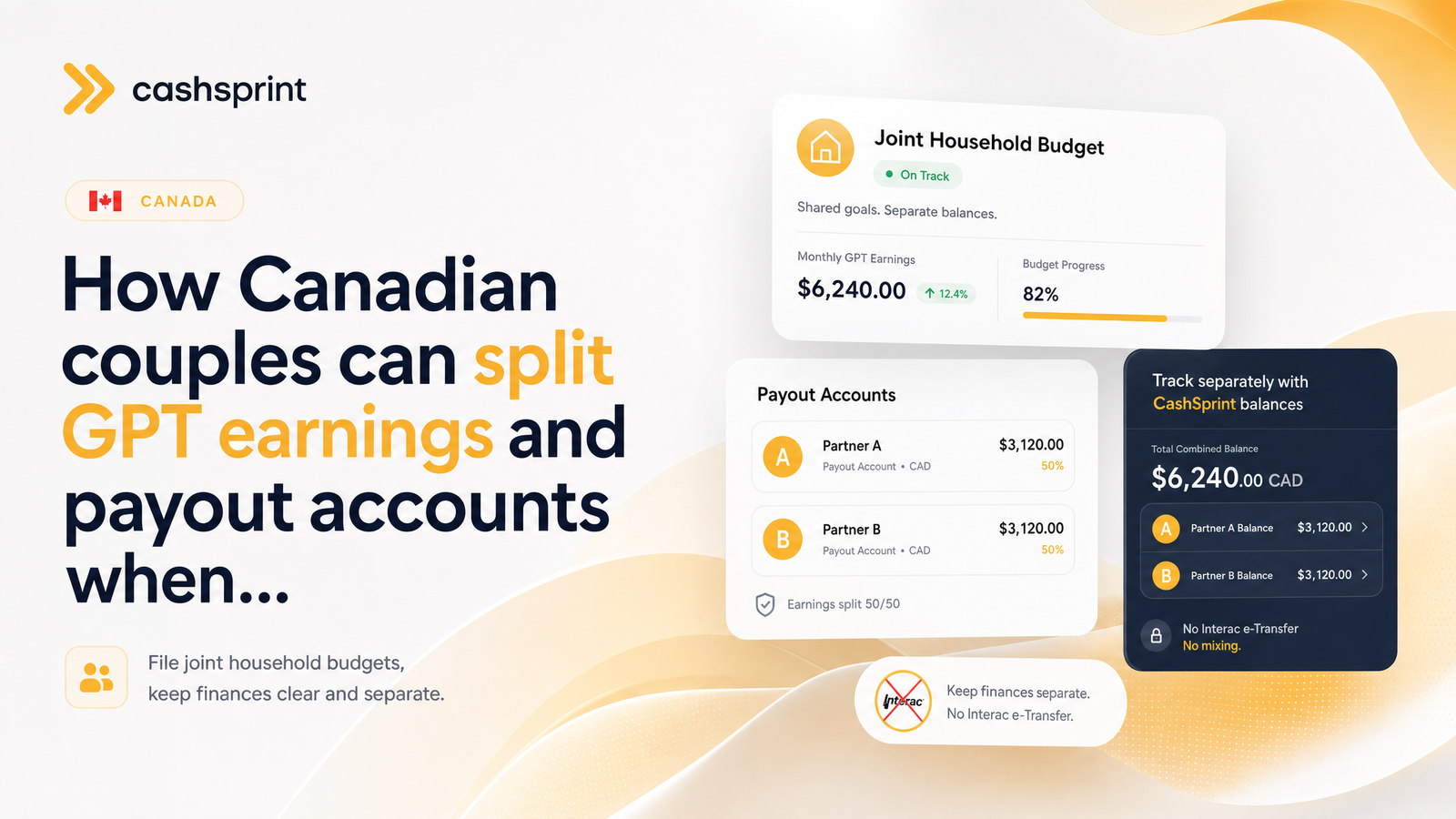
Most advice about get-paid-to (GPT) platforms assumes you're earning alone. But once you're budgeting as a couple, the question changes: how do two separate CashSprint balances become one honest number in a shared household budget — without either partner losing track of what's theirs? This is a workflow problem, not a legal one, and it has a clean operational answer.
Why Couples Should Keep Individual GPT Accounts (Even in One Household)
Start with the non-negotiable: each partner needs their own CashSprint account, login, and payout method. Most GPT platforms, CashSprint included, tie accounts to a single verified individual for security and fraud-prevention reasons, so sharing one login between two people risks flagged activity or a frozen balance right when you need the payout. Separate GPT payout accounts are the baseline, not an optional upgrade.
Here's the part couples don't expect: this separation is what makes joint budgeting easier, not harder. When each person's survey activity, offer completions, and cashback sit in their own account, you get a clean, timestamped record of exactly what each partner earned and when. Merging two people's activity into one login erases that trail immediately — you'd have no way to tell whose survey streak paid for groceries and whose covered the hydro bill. GPT accounts for couples in Canada work best when they mirror how most households already handle personal chequing accounts alongside a joint one: separate at the source, combined by choice, later, on paper.
Think of your CashSprint balance the same way you'd think of a personal paycheque before it hits the joint account. The paycheque is unambiguously yours until you decide to allocate it. The same logic keeps GPT income traceable.
Does Splitting GPT Income With a Spouse Trigger CRA Attribution Rules?
No — and this is the worry that stops a lot of couples from folding GPT income into a joint budget at all. CRA's spousal attribution rules exist to prevent one spouse from shifting investment or property income to a lower-earning spouse to save tax — think dividends, interest, or capital gains from assets one spouse transferred to the other. They target the transfer of income-producing property, not two people independently earning cash through their own survey and offer activity.
If you complete surveys on your own CashSprint account and your partner completes theirs, that's each of you earning income directly through your own effort — not one spouse redirecting property to the other. GPT income splitting in Canada, in the sense CRA cares about, isn't what's happening when a couple later decides to spend or save their respective earnings together. For the deeper mechanics of how attribution actually works with transferred property, the explanation at Advisor.ca is worth reading if you want the full picture. For most couples using GPT earnings as everyday extra income, the practical takeaway is simple: earn separately, report what you're required to report individually, and don't overthink the budgeting step that comes after.
The Two-Balance, One-Budget System
Here's the core framework, deliberately low-friction:
Each partner tracks their own CashSprint balance and payout history. You know what you've earned this month, what's pending, and what's been paid out — nobody else needs to log into your account to see that.
Both partners report one number, monthly, into a shared budget category. Call it "Household Extra Income" or something equally neutral. It's a single line in whatever budgeting tool you already use — a joint spreadsheet, a shared budgeting app, or a recurring note in your banking app. The line shows the combined total; the underlying detail stays in each person's own CashSprint dashboard.
This beats merging accounts for one reason: it separates earning from allocating. You track separate CashSprint balances precisely so that when a dispute or a question comes up later ("did I really cash out $80 in March?"), the answer is one login away, not buried in a shared thread neither of you fully trusts. Household budgeting side hustle income works best when the source data stays clean and only the summary gets merged.
A simple version of this in practice: a shared spreadsheet tab with two columns — Partner A's monthly CashSprint payout total, Partner B's monthly CashSprint payout total — and a third column that auto-sums them into the number that actually lands in the household budget app. Takes ten minutes a month to update, and neither partner has to hand over account access to make it work.
Routing Interac e-Transfers Without Losing Track of Whose Money Is Whose
This is where most couples actually lose the thread — not in tracking earnings, but in what happens the moment a payout hits a bank account. A few concrete tactics fix it:
Use memo/message fields deliberately. When you send an Interac e-Transfer from your personal account into the joint account, label it — "CashSprint payout, [name], [month]" — rather than leaving it blank. It costs nothing and makes the joint account's transaction history self-documenting.
Deposit to your personal account first, then move a set amount into joint. Rather than routing your CashSprint payout directly into a shared account, land it in your own chequing account first. That gives you a personal record of the exact payout before any commingling happens. From there, transfer a defined amount — all of it, half of it, whatever your household agreed on — into the joint account as a second, clearly labelled step.
Autodeposit vs. security-question transfers matter here. Autodeposit is convenient but silent — money just appears, with less friction to notice or label it. A security-question transfer forces a small pause where you can add context. If keeping payouts traceable matters more to you than speed, consider disabling autodeposit on the account that receives GPT payouts, or at minimum, get consistent about memo fields.
Watch per-bank Interac limits when timing transfers. Interac itself doesn't set a universal cap — each bank sets its own daily and weekly e-Transfer limits, and they vary meaningfully. If you're planning to move a larger monthly payout in one shot, check your bank's limit first rather than assuming; the comparison at Interac e-Transfer Limits in Canada (2026) breaks down major banks side by side. This matters for Interac e-Transfer household budgeting because a payout split into two smaller transfers due to a limit can look, at a glance, like two separate earners contributed — so label both halves the same way.
For payout methods themselves, not all options are equally easy to keep separate. Interac e-Transfer gives you the clearest audit trail because it lands with a timestamp and (if you use it) a memo. PayPal Canada similarly keeps a running transaction history tied to your individual account, useful if you'd rather keep GPT money out of your bank feed entirely until you choose to move it. Gift card payouts are the least traceable for budgeting purposes since they don't touch a bank ledger at all — fine for personal spending, harder to fold into a shared cash budget. If you're deciding which method fits your tracking system, Cashsprint's payout options ranked by speed is a useful reference before you commit to one as your default.
Deciding When to Cash Out and How to Allocate It
Two decisions sit inside this step, and couples do better when they set rules for both in advance rather than negotiating every month.
When to cash out. Some couples cash out GPT earnings the moment a balance clears a threshold; others let it accumulate and cash out monthly on a set date, matched to when they update the shared budget line. Monthly cash-outs tend to fit a household budget cycle better, since it gives you one clean number per person, per month, rather than a scattered series of small transfers that are harder to reconcile.
How to allocate it. Once both partners cash out, the money needs a job — savings, bills, or discretionary spending — and this is where most disagreements happen. A few workable defaults: split evenly regardless of who earned more that month (simplest, but can feel unfair if effort is lopsided); split proportionally to what each person actually earned (fairer, slightly more math); or earmark GPT income entirely for a specific shared goal, like a joint TFSA contribution or a recurring bill, so it never competes with regular paycheque budgeting decisions at all. Any of these works — the point is picking one and sticking with it so you're not re-litigating the split every payout cycle.
If you want to grow the individual balance you're now tracking, this step-by-step guide to maximizing CashSprint earnings is worth working through — the bigger the number each partner brings to the shared line, the more useful this whole system becomes.
Frequently Asked Questions
Can my spouse and I share one CashSprint account to make budgeting easier?
No — sharing one login between two people isn't recommended and can risk account verification issues, since GPT platforms tie accounts to a single individual. Keeping separate accounts is what makes joint budgeting simpler, because each partner has a clean, individual record of what they earned and when, which you then combine manually into a shared budget line.
Does combining GPT earnings with my spouse's income count as income splitting for CRA purposes?
Generally, no. CRA's attribution rules target income from property or investments transferred between spouses, not income each person earns independently through their own survey or offer activity. Combining already-earned GPT income into a shared household budget after the fact isn't the transfer scenario those rules were designed to catch.
What's the easiest way to send my GPT payout into a joint account without losing track of whose money it was?
Deposit the payout into your own personal account first, then move a defined amount into the joint account with a labelled Interac e-Transfer memo, such as "CashSprint payout, [name], [month]." This two-step process keeps a personal record intact before any commingling happens.
Should each partner cash out separately or combine balances before withdrawing?
Cash out separately, using each partner's own CashSprint account and payout method, then combine the totals afterward in your shared budget tracker. This keeps each person's payout history traceable back to their own account rather than blending two people's activity into one withdrawal.
How do we decide whose GPT earnings cover which household expense?
Pick one allocation rule and stick with it — split evenly, split proportionally to what each person earned, or earmark the combined total for a specific goal like a bill or TFSA contribution. Consistency matters more than which rule you choose, since it removes the need to renegotiate every payout cycle.
Will using Interac e-Transfer for GPT payouts cause problems with shared banking apps or budget trackers?
No, as long as transfers are labelled clearly and routed intentionally, e-Transfers integrate fine with most banking apps and budget trackers. The only real friction comes from unlabelled autodeposits or payouts split across multiple transfers due to bank-specific Interac limits, both easy to manage once you're aware of them.
Set up your own CashSprint account and payout method if you haven't already, then apply the two-balance, one-budget system above to fold your earnings into your household's shared line without losing track of whose money is whose. Check current payout options before picking a default method, and start (or keep) earning on Cashsprint.