
Why Generic Budgeting Advice Doesn't Quite Work in Canada
Most budgeting content online is written for an American reader and lightly reworded. It talks about 401(k)s instead of RRSPs, ignores GST/HST credit deposits, and treats "cost of living" as a single national number when a grocery bill in Vancouver looks nothing like one in Moncton. That gap matters more in 2026, as cost of living Canada 2026 conversations center on grocery inflation, rent increases in major metros, and gas prices that swing with little warning.
Real budgeting tips for Canada need to account for how income and deductions actually work here: tax withheld at source, CPP and EI contributions, provincial sales tax differences, and government benefits that land on specific CRA-scheduled dates rather than whenever you check your account. A budget built without these pieces looks tidy on paper and falls apart the first month you try to live by it. The rest of this guide fixes that, building a budget from the ground up using Canadian numbers, accounts, and timing.
Step 1: Find Out Where Your Money Actually Goes
Before picking a framework, you need real data, not guesses. Pull your last two to three months of bank and credit card statements — most Canadian banking apps let you export this or filter by category directly. This is the actual starting point for how to make a budget in Canada: you cannot manage what you haven't measured.
Sort every transaction into two buckets:
- Fixed costs: rent or mortgage, insurance, phone plan, loan payments, subscriptions — anything that doesn't change month to month.
- Variable costs: groceries, gas, dining out, entertainment, personal spending — anything that fluctuates.
Add a third column for irregular costs that don't hit every month but will eventually: vehicle registration, annual memberships, holiday spending, back-to-school costs. A simple monthly budget template Canada spreadsheet with these three sections — even just three columns in a free spreadsheet app — is enough. You don't need software; you need honesty about what's actually leaving your account.
Step 2: Pick a Budgeting Framework That Fits Your Income
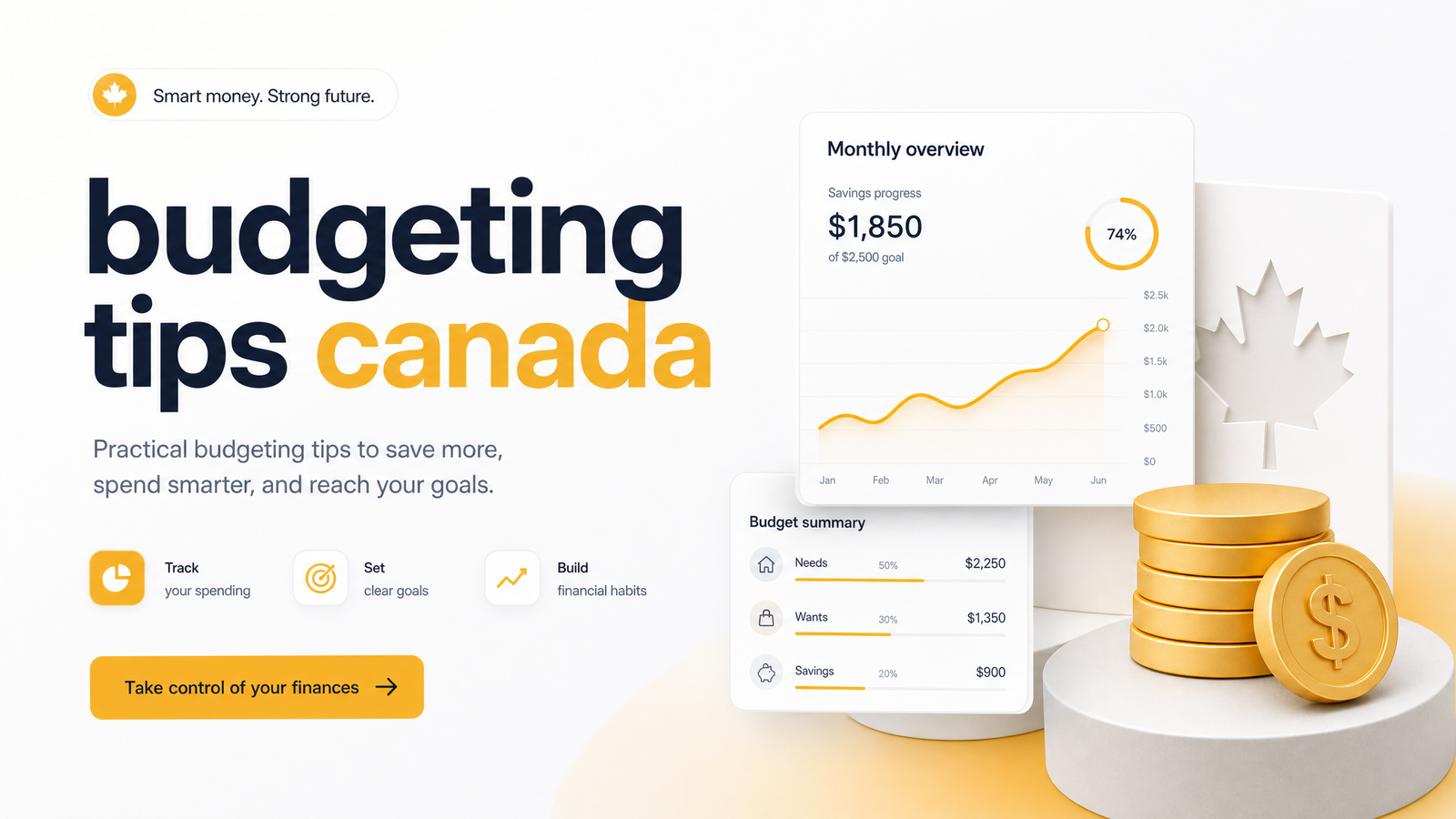
Once you know where the money goes, choose a structure. The 50/30/20 rule Canada version works like this: 50% of after-tax income to needs, 30% to wants, 20% to savings and debt repayment. On a $4,000/month after-tax income, that's $2,000 for needs, $1,200 for wants, and $800 toward savings or debt. It's a clean starting ratio, though in high-rent cities like Toronto or Vancouver, the "needs" slice often has to grow past 50%, pushing wants and savings down — a temporary adjustment, not a failure.
For anyone wondering how to budget on a low income Canada style, or whose income shifts week to week — freelancers, gig workers, part-time and seasonal employees — a fixed percentage framework can feel impossible to hit. Zero-based budgeting works better here: every dollar earned in a given month gets assigned a job (rent, groceries, savings, debt) until nothing is left unaccounted for. You budget against what actually landed, not a future paycheque that might not arrive. Pair it with a bare-bones "survival number" — the minimum you need to cover fixed costs — so you know your floor even in a slow month.
Step 3: Build in Canadian-Specific Line Items
This is where generic advice consistently falls short, and where budgeting tips for Canadians actually need to differ from what you'll find in a US-focused article.
TFSA and FHSA contributions. A TFSA contribution Canada line item deserves its own place in your budget, not leftover scraps at month-end. Contribution room accumulates annually whether you use it or not, and withdrawals are tax-free, making it a flexible home for both short-term savings and long-term investing. If you're saving toward a first home, the FHSA combines a tax deduction on contributions with tax-free withdrawals for a qualifying purchase — worth prioritizing over a regular savings account if homeownership is on your five-year horizon.
RRSP contributions. These reduce your taxable income now, with tax paid on withdrawal later — generally most useful once you're in a higher tax bracket. If your employer matches RRSP contributions, that match is effectively free money and belongs ahead of most other budget lines.
CRA benefit timing. The GST/HST credit and the Canada Child Benefit (CCB) arrive on fixed CRA schedules, not randomly. Knowing your deposit dates lets you plan around them instead of being short the week before. Build these into your monthly cash flow the same way you'd plan around a paycheque date.
Provincial cost variance. Housing, insurance, and even grocery prices vary significantly by province. A budget percentage that works in Halifax may not survive contact with Toronto or Vancouver rents, while someone in Alberta may have more room in the "wants" category thanks to no provincial sales tax. Adjust your framework's ratios to your actual province, not a national average.
Step 4: Cut Costs Without Feeling Deprived
Cutting costs doesn't have to mean cutting joy. A few moves that make a real dent without turning your life into a spreadsheet exercise:
- Audit subscriptions quarterly. Streaming, apps, and memberships quietly compound; cancel anything you haven't opened in 30 days.
- Shop grocery flyers and price-match apps. With grocery inflation still a major line item for most households, matching flyer prices across two or three stores — or using one price-matching app — can shave a meaningful percentage off a monthly total.
- Time gas purchases and use loyalty programs. Prices fluctuate through the week in many Canadian cities; combining that timing with a gas rewards card adds up over a year.
- Stack cashback on purchases you're already making. Rather than changing spending habits, cashback apps return a small percentage on groceries, gas, and everyday purchases you'd buy anyway.
- Negotiate renewal rates. Phone, internet, and insurance providers routinely offer better rates to customers who call and ask, especially at contract renewal.
These are genuinely how to save money in Canada moves rather than gimmicks — small, repeatable habits that don't require willpower so much as routine. A deeper best way to save money Canada comparison across cashback and reward platforms is better covered in a dedicated piece than squeezed in here.
Step 5: Add a Small, Flexible Income Buffer
Once your fixed costs, savings, and cost-cutting are locked in, there's still a role for a modest, flexible income line — not as a replacement for a real job, but as a buffer. This is where a bit of side income earns its place in a monthly budget: covering the gap between a slightly higher grocery bill and last month's number, topping up a gas tank, or nudging an emergency fund forward without touching your main paycheque.
Surveys, cashback offers, and simple in-app tasks on platforms like Cashsprint won't replace a full-time income, and treating them like one usually leads to burnout. But as a line item worth an extra $50–150 a month, paid out through Interac e-Transfer, PayPal, or gift cards, they're a realistic way to earn extra income Canada-style without adding a second job to your calendar. If you're weighing whether it's worth the time, Earn Extra Cash Online Canada: Surveys & Games 2026 breaks down what these platforms actually pay and how long it takes. For readers who want something with a bigger ceiling than micro-tasks, the Side Hustle Ideas for Canadians: The 2026 Effort-Based Guide ranks options by effort versus payoff.
Whichever budgeting apps Canada tool you use to track this, the key is treating extra income as a bonus buffer line, not a core income assumption your budget depends on to break even.
Tools to Keep Your Budget on Track
You don't need a paid subscription or a finance degree to stay on top of a budget. A few options that actually work for most Canadians:
- A free spreadsheet template with the fixed/variable/irregular structure from Step 1 — Google Sheets or Excel Online both work fine and cost nothing.
- Your bank's built-in budgeting features. Most major Canadian banks now offer spending categorization and alerts directly in their apps, removing the need for a separate tool entirely.
- Dedicated budgeting apps. Among the best budgeting apps Canada users rely on, look for ones with Canadian bank integration (via Plaid or direct bank connections) and CAD-native categories rather than US-designed tools retrofitted for Canada.
- Notification-based tracking. Turning on transaction alerts for every purchase over a small threshold creates passive awareness that keeps spending visible without extra effort.
Among budgeting apps Canada free options, the honest answer is that a simple spreadsheet plus your bank's existing app covers 90% of what most people need — paid tools add convenience, not results.
Frequently Asked Questions
What is a realistic monthly budget for someone living in Canada?
There's no single number — it depends heavily on province and household size — but a realistic budget starts with your actual after-tax income split across fixed costs (rent, utilities, insurance), variable costs (groceries, transportation, discretionary spending), and savings. In high-cost cities like Toronto or Vancouver, housing alone can take 40–50% of income, meaning you adjust the wants and savings percentages downward rather than forcing a fixed national template.
What is the 50/30/20 budgeting rule and does it work in Canada?
The 50/30/20 rule allocates 50% of after-tax income to needs, 30% to wants, and 20% to savings or debt repayment. It works as a starting framework in Canada, but housing costs in expensive provinces often push the "needs" share above 50%, so treat it as a flexible guideline rather than a strict formula.
What are the best free budgeting apps for Canadians?
The best free options are typically your own bank's built-in budgeting and categorization features, paired with a simple spreadsheet for irregular costs and savings goals. Look for tools with direct Canadian bank integration and CAD-based categories rather than apps designed primarily for US users.
How can I budget on a low or irregular income in Canada?
Zero-based budgeting works best for irregular income, since it assigns every dollar earned in a given month a job rather than relying on a fixed paycheque assumption. Calculate a bare-bones "survival number" covering only essential fixed costs, then build savings and discretionary spending on top of whatever comes in above that floor.
How much should Canadians save from each paycheque?
A common target is 20% of after-tax income, split between an emergency fund, TFSA or RRSP contributions, and any debt repayment beyond minimums. If 20% isn't realistic yet, even 5–10% built consistently, plus automatic transfers on payday, matters more than hitting a perfect percentage immediately.
How can extra income from apps like Cashsprint fit into a monthly budget?
Modest earnings from surveys, cashback, and offers work best as a flexible buffer line — covering a grocery bill top-up, a gas fill, or an emergency fund contribution — rather than a core income source. Payouts via Interac e-Transfer, PayPal, or gift cards can hit your account quickly enough to smooth out short-term gaps.
Building a Canadian budget is less about finding the perfect formula and more about grounding whatever framework you choose in real numbers: your province's cost of living, your CRA benefit dates, your TFSA and RRSP room, and your actual bank statements. Once those fundamentals are in place, a small, flexible income stream can genuinely help — covering a grocery bill or a gas top-up without becoming a second job. Cashsprint is one easy way to build that buffer through surveys, games, and cashback, with payouts landing via Interac, PayPal, or gift cards — and if you're curious how fast those payouts actually move, the Cashsprint Payout Options Ranked by Speed (2024 Guide) lays it out clearly.